[ad_1]
Washington will not extend sanctions waivers allowing countries to purchase Russian and Iranian energy, US Treasury Secretary Scott Bessent announced on Wednesday. India was a key beneficiary of the sanctions waivers, which attracted significant criticism by US politicians for enriching loosening financial pressure on Moscow and Tehran.
“We will not be renewing the general license on Russian oil and we will not be renewing the general license on Iranian oil. That was oil that was on the water prior to March 11. So all that has been used,” said Bessent at a press conference.
Also Read | US grants 30-day waiver to India for Russian oil purchase as Iran conflict triggers energy concerns
What was the 30-day waiver?
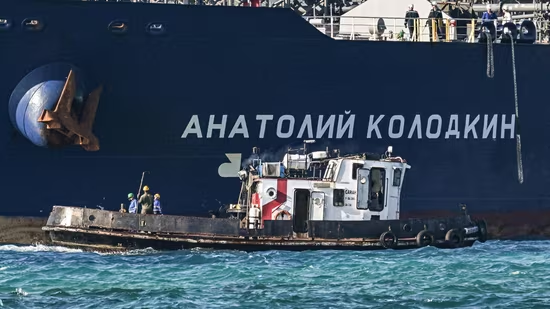
On March 12, the US Treasury announced that a temporary, 30-day waiver had been issued allowing Indian refiners to purchase Russian energy that had already been loaded onto tankers.
“To enable oil to keep flowing into the global market, the Treasury Department is issuing a temporary 30-day waiver to allow Indian refiners to purchase Russian oil. This deliberately short-term measure will not provide significant financial benefit to the Russian government as it only authorizes transactions involving oil already stranded at sea,” said Bessent in a statement announcing the waiver. Washington justified the waiver as a necessary measure to stabilise global energy prices, especially crude oil which surged above $100 a barrel due to the outbreak of the US-Iran conflict in late February.
Washington later announced another 30-day license allowing countries to purchase Iranian oil. While the Russian oil waiver expired on April 11, the Iranian oil waiver will expire on April 19.
Also Read | After Trump’s America and Iran both block Strait of Hormuz, how will it impact India? Explained
Push for extension of waivers
The US Treasury’s decision came despite numerous reports that officials from Asian nations, including India, were pushing Washington to extend the sanctions waivers.
India was a key beneficiary of the sanctions waivers. According to reports citing government officials, India placed orders for roughly 30 million barrels of oil from Russia after the sanctions waiver was put into effect.
Indian refiners like Reliance had previously wound down their purchases from Russian suppliers like Rosneft and Lukoil due to US sanctions against these energy majors.
Also Read | Russia says it ‘does not need permission’ to supply its oil, calls it ‘matter of sovereignty’
Criticism for waivers
However, the sanctions waivers attracted significant criticism, particularly from the opposition Democratic party.
“No way the Russia sanctions waiver should be extended. Trump’s waiver has handed Russia an extra $150 billion a day to fuel its murderous war machine killing & kidnapping Ukrainian kids—while it aids Iran with intelligence to target our troops,” said US Senator Richard Blumenthal in a post on X on April 10.
Three more Democratic senators – including Senate Minority Leader Chuck Schumer – also called for the Trump administration to reverse the “dangerous” sanctions waiver policy.
“In addition to flouting notification requirements to Congress under the Countering America’s Adversaries Through Sanctions Act before relaxing sanctions on the Kremlin, Secretary Bessent characterized the license as a temporary and ‘short term’ measure that would not provide significant financial benefit to the Russian government,” the senators said in a joint statement.
“But Russia’s decision to cancel its planned budget cuts demonstrates that, as we warned, Russia is directly benefiting from the administration’s sanctions relief. It is incumbent on the Trump Administration to reverse this dangerous policy, ensure that Russia does not reap any additional benefit and prevent the United States from further boosting Putin’s war machine,” they added.
[ad_2]