[ad_1]
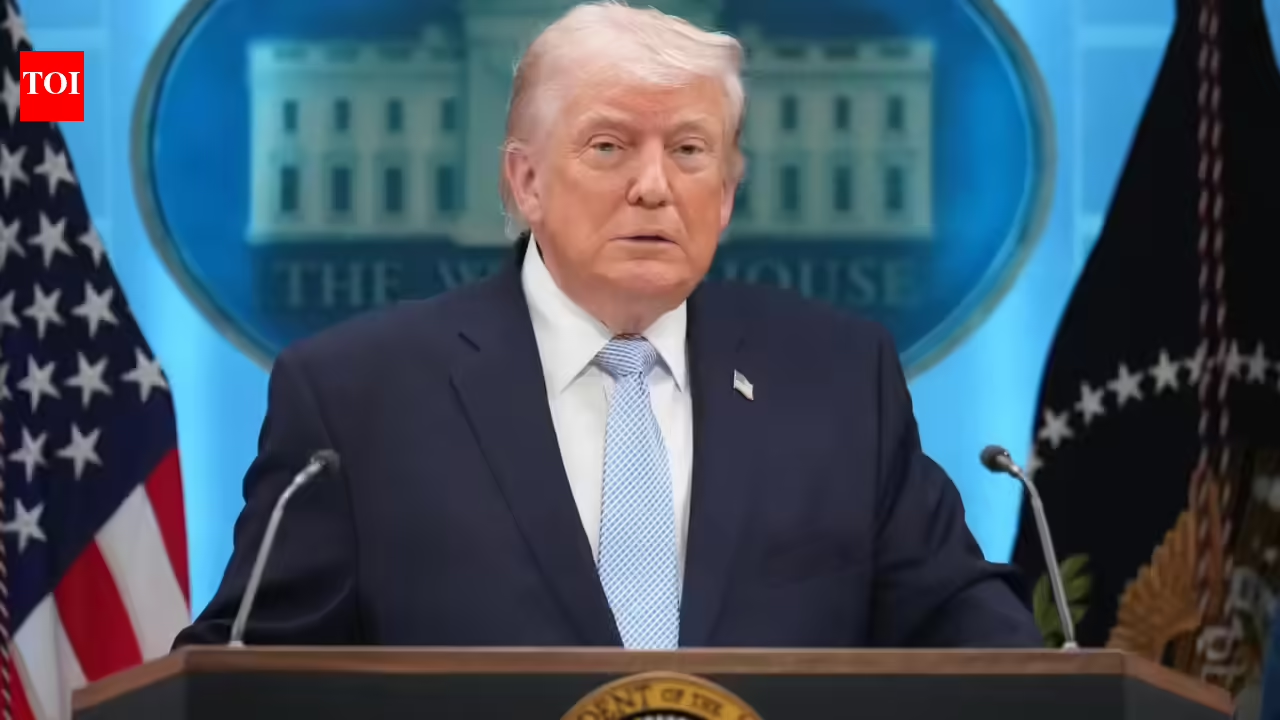
US President Donald Trump on Monday held a press conference on Monday giving as his 48-hour deadline set for Iran looms. The US president gave out details on the 2 airmen rescued after US jets went down in Iranian territory, while reiterating his warnings to ‘take out Iran’During a press conference, he said, “Iran could be taken out in one night.” He also mentioned how military worked in the “historic operation”.He was joined by senior national security officials, including Defence Secretary Pete Hegseth and special envoy Steve Witkoff, along with his children Eric Trump and Tiffany Trump and their spouses.This conference came as a US Air Force F-15E fighter jet was shot down over southwestern Iran, forcing its two crew members to eject into hostile territory and triggering a large-scale rescue operation. After nearly two days of coordinated military and intelligence efforts, both airmen were successfully recovered, though the mission reportedly involved significant equipment losses.Here’s what the US President said in news conference
- Amid the looming deadline to open Strait of Hormuz, he said, “Iran could be taken out in one night, and that night might be tomorrow night.”
- “US military personnel faced gunfire at very close range during rescue in Iran,” said the US President, referring to the rescue operation for the two pilots, adding that “God was watching us” while talking about its success.
- “I ordered the US armed forces to do whatever was necessary to bring our brave warriors back home… In the United States military, we leave no American behind,” also said the US President as he dished out details on how the US military rescued the pilots.
- He further added, “Second rescue mission in Iran involved 155 aircraft.” Trump also said more than 170 US military aircraft were deployed in the Iran rescue mission, including 21 in the first operation and 155 in the second, adding that two transport planes were destroyed after getting stuck in sand.
- Donald Trump alleged that details of the Iran pilot rescue operation were leaked. He said that he would “ask the media organisation to reveal the name” of the Iran rescue leak source, warning it was a “national security” issue and that the person responsible could face jail if they don’t cooperate. “We have to find that leaker because that’s a sick person… They put this mission at great risk,” he added.
- Further revealing more details, he continued, “it included four bombers, 64 fighters, 48 refueling tankers, 13 rescue aircraft, among others.”
- Donald Trump also said that the rescued airman was hiding in Iranian mountains and kept climbing higher to improve chances of recovery, calling the mission “like finding a needle in a haystack.”
- “As Commander-in-Chief, I never forget the extraordinary risk taken by the warriors that we send into battle — and the genius,” said Trump.
- “Over the past 37 days, America’s armed forces have carried out more than 10,000 combat flights over Iran, striking more than 13,000 targets,” said the POTUS on Operation Epic Fury.”It’s a record that is unparalleled in the history of military air operations,” he added.
- Further justifying his attacks on Iran he said, “Iranians want us to keep bombing as they want freedom.”
US officials also take the podiumApart from Donald Trump, other senior officials also spoke about the operation. John Ratcliffe said the CIA carried out a deception campaign to mislead Iranian forces searching for the downed airmen, adding, “It was like finding a needle in a haystack,” as he confirmed one of them was located alive before a successful extraction. He said intelligence later indicated Iran was “embarrassed” by the operation. Defence Secretary Pete Hegseth said, “Our troops turned a potential tragedy into a resounding demonstration of American resolve and capability,” adding that the mission showcased US military excellence. He also warned adversaries that the US would act “anywhere, at any time” to protect its personnel and credited Trump for directing that no one would be left behind.Meanwhile, Dan Caine, Chairman of the Joint Chiefs of Staff, described the mission as “incredibly dangerous,” but said it fulfilled a promise to American warfighters that they would “not be left behind.” He added that the operations reflected the US military’s “most sacred obligation” to always bring its personnel home.
[ad_2]