[ad_1]
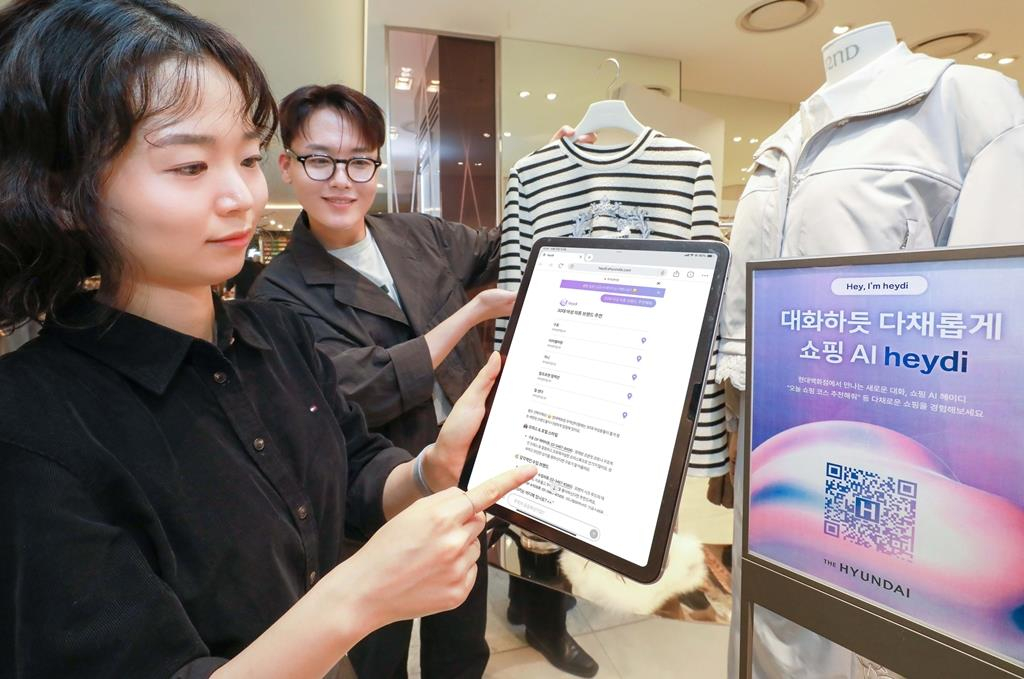
![A Hyundai Department Store employee uses a generative AI shopping assistant called “Heydi” to offer personalized offline shopping recommendations to customers. [YONHAP]](https://koreajoongangdaily.joins.com/data/photo/2026/04/02/894e3868-25a1-43ac-8a70-7b4aba1b637a.jpg)
A Hyundai Department Store employee uses a generative AI shopping assistant called “Heydi” to offer personalized offline shopping recommendations to customers. [YONHAP]
Online shopping is getting personal, with e-commerce platforms moving away from simple price comparisons to recommend products that match consumers’ preferences based on their data.
Hyundai Department Store announced that it will launch a premium e-commerce platform, The Hyundai Hi, on April 6.
The platform serves as an online version of The Hyundai, its offline retail space, and combines its existing online mall
The Hyundai.com and its grocery platform
Hyundai Food Hall To Home.
The Hyundai Hi will feature around 3,000 brands, including 2,000 with offline stores at the Hyundai Department Store and 1,000 online-only brands. It will group products such as fashion, home goods and food into separate sections and plans to add more online-only luxury brands.
Hyundai plans to use purchase data from its offline stores to offer personalized recommendations. A customer, for example, who buys flowers in-store and wine glasses online may receive recommendations for items like perfume or vases for special occasions.
The company aims to move away from the traditional e-commerce model focused on large product selections and price comparisons and instead focus more on customer preferences.
“We are introducing a new paradigm in offline retail with The Hyundai Seoul, and we will grow The Hyundai Hi into a leading model for premium e-commerce,” said Jung Jee-young, the president of Hyundai Department Store.
![The Hyundai Seoul is seen in Yeouido, western Seoul. [HYUNDAI DEPARTMENT STORE]](https://koreajoongangdaily.joins.com/data/photo/2026/04/02/d2ed5f2e-7a9f-4e84-9486-cfb3f1c4b2de.jpg)
The Hyundai Seoul is seen in Yeouido, western Seoul. [HYUNDAI DEPARTMENT STORE]
This shift toward personalized recommendations is also spreading across specialized platforms.
Fashion platform Musinsa changes how products are shown based on search history and uses AI to sort items with dozens of filters to streamline recommendations.
Fashion and beauty platform Ably also uses its own AI to personalize shopping. For example, users who like classic jacket styles may see recommendations tailored to their data.
Experts expect the trend to continue.
“As AI advances, e-commerce has become a more effective channel for offering personalized and specialized services,” said Hwang Jin-joo, an adjunct professor of consumer studies at Inha University. “More companies are also linking online and offline shopping, making it easier and more convenient for customers to shop.”
The trend is also evident across the broader e-commerce industry.
“E-commerce used to focus on finding the lowest-priced products, but it is now shifting toward helping customers find products that match their individual preferences,” an industry representative said. “As demand for personalized consumption grows, platform strategies will continue to change.”
This article was originally written in Korean and translated by a bilingual reporter with the help of generative AI tools. It was then edited by a native English-speaking editor. All AI-assisted translations are reviewed and refined by our newsroom.
BY NOH YU-RIM [[email protected]]
[ad_2]