[ad_1]
Last Updated:
The scale of US Tomahawk strikes on Iran has drawn scrutiny within the Pentagon after over 850 were used in four weeks, dwarfing the military’s usual yearly procurement.
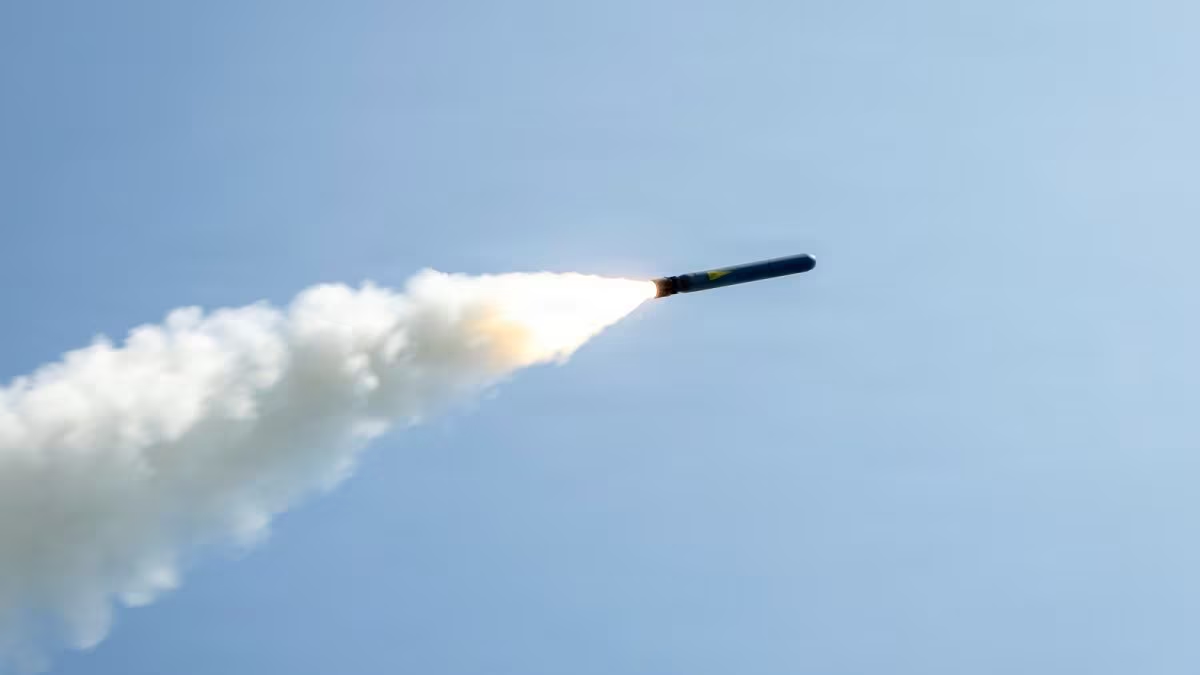
The US Navy Arleigh Burke-class guided-missile destroyer USS Delbert D. Black fires a Tomahawk Land Attack Missile (TLAM) in support of the Operation Epic Fury attack on Iran from an undisclosed location. (REUTERS)
The United States military has fired more than 850 Tomahawk cruise missiles at Iran in just four weeks of war, a pace of usage that has alarmed some Pentagon officials and triggered internal discussions on how to make more of these weapons available, the Washington Post reported on Friday.
The number of missiles used is several times higher than the US military’s annual procurement. The concern is not just the scale, but the speed.
The 850-plus figure is roughly nine times the number of Tomahawk missiles the Pentagon buys on average each year. According to the Center for Strategic and International Studies, the US typically procures about 90 such missiles annually. The Navy requested only 57 missiles for fiscal year 2026, according to US Defense Department budget documents.
Even as these numbers raise questions, the US administration has publicly dismissed concerns over shortages.
White House Press Secretary Karoline Leavitt said the US military has “more than enough munitions, ammo, and weapons stockpiles” to achieve the goals of Operation Epic Fury and beyond. She added that President Donald Trump continues to push defence contractors to speed up production of American-made weapons.
Pentagon spokesperson Sean Parnell similarly said the military has everything it needs to execute any mission “at the time and place of the President’s choosing.”
What Is A Tomahawk Missile?
The Tomahawk is a long-range, precision-guided cruise missile developed during the Cold War and continuously upgraded since.
It is primarily launched from US Navy destroyers and submarines and can travel more than 1,000 miles to strike targets with high accuracy, including those protected by advanced air defence systems.
While it has traditionally been a Navy-operated weapon, it has in recent years also been adopted by the Marine Corps and the Army as part of a broader shift towards long-range precision strike capabilities. Allied militaries, including the British Royal Navy, also operate the system.
According to Pentagon data, the missile has been flight-tested more than 550 times and used in over 2,300 operational strikes across conflicts ranging from Iraq and Syria to the current war involving Iran.
There is no indication that Iran possesses or uses Tomahawk missiles.
Why Is The US Using Them At Such Scale?
Tomahawk missiles are often used when the US needs to strike distant or heavily defended targets without risking aircraft or pilots.
In the current conflict, they have been used repeatedly against Iranian targets as part of a broader campaign involving multiple long-range weapons systems.
At a Senate hearing earlier this week, Democratic Senator Jack Reed said US forces have fired “thousands of Tomahawks, Precision Strike Missiles, and other long-range offensive weapons” into Iran, while also deploying air defence systems such as Patriot, THAAD and Standard Missile interceptors at what he described as an alarming rate.
How Big Is The US Stockpile, And Why Are Officials Concerned?
The Pentagon is estimated to have around 3,100 Tomahawk missiles in its inventory, according to Kelly Grieco, a senior fellow at the Stimson Center. “It’s been recognized that we don’t have enough long-range strike capability, so we’ve been trying to build up these stockpiles, but we keep depleting them,” Grieco told CBS News.
Using more than 850 in a matter of weeks represents a significant drawdown when seen against annual procurement levels.
Can The US Replace Them Quickly?
Production capacity exists, but actual output remains limited.
The maximum rate of production is estimated to be 2,330 per year: Three contracts from Raytheon each have a capacity of 600, and a BAE has a contract to produce up to 530 missiles per year, according to a report from the Center for Strategic and International Studies.
However, actual procurement has been far lower — around 90 per year in recent cycles, according to the Center for Strategic and International Studies, reflecting structural limits in the US defence industrial base.
Analysts have long said the system is designed for steady, predictable demand rather than rapid wartime expansion, making it difficult to quickly replenish stockpiles during sustained conflict.
Efforts are now underway to change that.
RTX (Raytheon) has entered into agreements with the US government to scale production to over 1,000 missiles annually over several years. A separate Pentagon contract issued in September 2025 also funds work to expand production capacity, with completion expected by March 2028.
Defence Secretary Pete Hegseth has said the US is working to rebuild its defence industrial base and cut production timelines, adding that new agreements are aimed at reducing “long lead times on exquisite munitions.”
“We’re going to be refilled faster than anyone imagined,” he said at a recent press conference.
How Much Do Tomahawks Cost?
The cost of a Tomahawk missile depends on the version being used, with prices varying based on capability and launch platform.
Standard variants are estimated to cost about $2.2 million each. More advanced versions — particularly those designed to strike moving targets such as ships — can cost over $4 million per missile.
In addition to the missile itself, ground-based launch systems add significantly to the overall cost, with each launcher priced at more than $6 million.
Why This Matters
The scale at which Tomahawks are being used in the Iran war highlights a broader challenge for modern militaries.
Advanced precision weapons allow long-range strikes with minimal risk to personnel, but they are expensive, complex to produce, and — as the current conflict shows — can be consumed far more quickly than they can be replaced.
Even as US officials maintain that stockpiles remain sufficient, the pace of this war is forcing a closer look at how sustainable such operations are over time.
March 28, 2026, 08:22 IST
Read More
[ad_2]