[ad_1]
The global energy innovation landscape is undergoing a structural transformation. While climate mitigation remains central inspiration to energy innovation, the primary forces shaping research, funding and policy in 2026 are energy security and economic competitiveness.
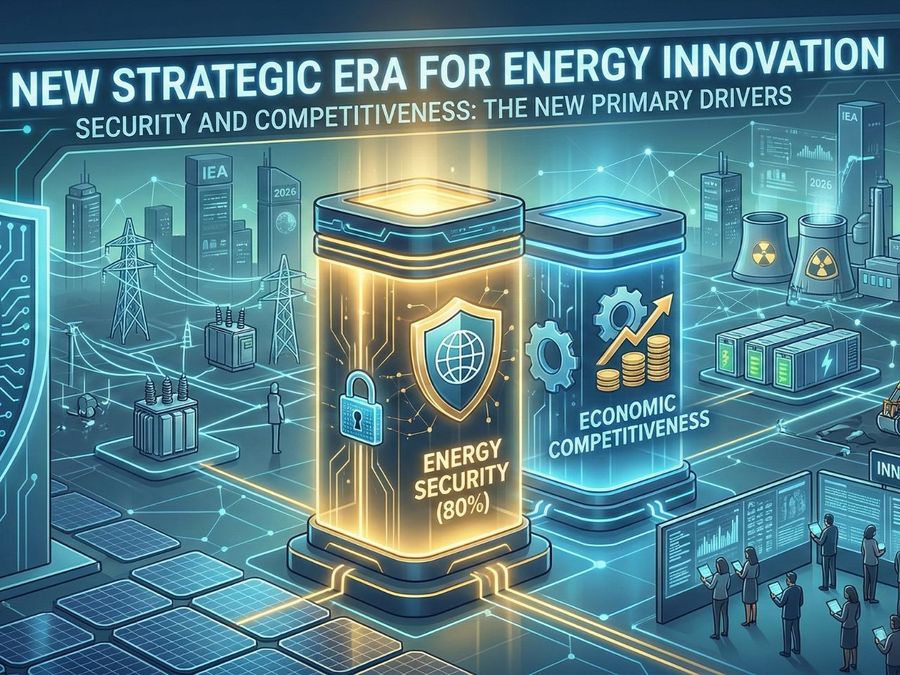
The State of Energy Innovation 2026 report by International Energy Agency (IEA) highlights this shift. In a survey of more than 270 experts across over 40 countries, 80 percent of respondents ranked energy security among their top three innovation drivers. By importance, energy security emerged as the single most influential driver of innovation activity in 2025.
This marks more than a rhetorical change – it signals a reordering of global energy priorities.
Security Overtakes Climate as the Primary Driver
Energy innovation has historically been associated with decarbonisation goals. However, survey findings show that practitioners now respond more strongly to geopolitical risks, supply chain vulnerabilities and system reliability concerns than to emissions targets alone.
/saur-energy/media/post_attachments/2c9b22a4-5c0.png)
Energy security carried the highest weighted importance among innovation drivers, followed by cost reductions. Reducing greenhouse gas emissions ranked third. This does not diminish the role of climate action, but it places it within a broader strategic framework.
Governments are increasingly designing energy policies that strengthen domestic supply chains, reduce import exposure and protect critical infrastructure. Innovation decisions are being shaped accordingly.
Competitiveness Becomes Core Industrial Policy
The report notes that many innovation-relevant policies launched in 2025 explicitly promote technological strength to enhance economic competitiveness and energy security. Initiatives such as the US Genesis Mission and the proposed EU Competitiveness Fund reflect this strategic orientation.
Energy technologies are no longer viewed solely as environmental solutions. They are trillion-dollar markets. Global markets for batteries, turbines, transformers and other energy equipment are already worth trillions of dollars, and energy spending accounts for up to 10 percent of global GDP.
In this context, innovation that reduces energy supply costs or strengthens domestic manufacturing directly enhances comparative advantage. Countries that lead in energy technologies gain export potential, industrial capacity and strategic leverage.
Funding Patterns Reflect a Period of Transition
After years of expansion, energy innovation funding appears to be entering a transitional phase. Public energy R&D spending is estimated at USD 55 billion in 2025, slightly lower than recent peaks. Corporate energy R&D growth has slowed, and venture capital investment in energy start-ups has declined for three consecutive years.
However, the slowdown is not uniform across technologies. Venture capital is increasingly concentrating in areas aligned with security and competitiveness priorities. Funding has expanded in critical minerals, nuclear fission and fusion, next-generation geothermal, carbon dioxide removal and low-emissions industrial production.
At the same time, energy patenting remains robust. Energy technologies now account for roughly one in ten global patents. Battery-related patenting alone represents 40 percent of all energy patenting, an unprecedented dominance.
These signals suggest that innovation is not contracting – it is being redirected.
Critical Minerals and Domestic Supply Chains Gain Prominence
Battery innovation has become a strategic priority. The rapid rise in energy storage patenting reflects the central role of batteries in electric mobility, grid stability and defence systems.
The emphasis is no longer limited to performance improvements. Governments and companies are investing in critical mineral extraction, processing technologies and recycling systems to secure supply chains. Innovation in mineral diversity and alternative chemistries is increasingly viewed as a matter of national resilience.
Regional dynamics reinforce this trend. China’s rapid growth in energy patenting, particularly in storage and industrial efficiency, underscores how innovation leadership can translate into industrial strength. Europe and the United States are responding with policies aimed at reinforcing domestic capabilities. In 2023, China represented close to two-fifths of all energy patenting. In contrast, energy technology patents from the United States fell by 10% between 2022 and 2023, while Europe recorded a third consecutive annual decline, with energy patenting falling by 28 percent over the same period.
Grid Resilience and Nuclear Return to the Fore
The report dedicates focused analysis to electricity grid resilience and fusion energy, reflecting their growing strategic relevance.
Electricity grids face mounting pressures from extreme weather events, rising demand from data centres and increasing electrification. Technologies such as grid-forming inverters, solid-state transformers and long-duration storage have emerged from years of public R&D and are now positioned as essential resilience tools.
Fusion energy, long supported through international public collaboration, is also framed through a competitiveness lens. While commercial deployment remains distant, recent milestones and strong venture capital interest highlight its strategic significance.
In both cases, innovation is linked not only to decarbonisation but to national security and economic continuity.
Balancing Climate Ambition with Strategic Resilience
The report makes clear that climate goals remain critical. Yet climate-driven innovation is increasingly evaluated through its contribution to broader policy objectives.
Some clean energy sectors experienced slower momentum in 2025. Hydrogen projects faced delays. Renewables deployment forecasts were adjusted downward. Certain first-of-a-kind industrial decarbonisation projects required emergency financial support.
This reflects a difficult trade-off. Technologies that strengthen security and competitiveness may attract more consistent funding than those perceived as climate-only solutions.
The challenge for policymakers is to align decarbonisation pathways with industrial and resilience strategies rather than treating them as separate agendas.
Policy Priorities for the Coming Year
Against this backdrop, the report highlights three priority areas for action
First, policymakers should target synergies between competitiveness, resilience and energy technology. Second, funding mechanisms must address financial gaps across the innovation lifecycle, particularly as private capital shifts toward AI and other sectors. Third, partnerships and international networks must be strengthened to maintain knowledge exchange in an increasingly fragmented geopolitical environment.
The report also notes that public energy R&D spending remains well below historical peaks as a share of GDP. Sustained investment is necessary to prevent security-driven priorities from becoming short-term reactions rather than long-term innovation strategies.
A New Strategic Era for Energy Innovation
Energy innovation in 2026 is defined by pragmatism. Security, affordability and industrial strength are shaping research agendas and policy frameworks. Climate action remains integral, but it is embedded within a broader strategic architecture.
The finding that 80 percent of experts prioritise energy security signals a durable shift. Innovation is increasingly treated as strategic infrastructure — essential for economic resilience, technological leadership and geopolitical stability
[ad_2]