[ad_1]
In the shadow of India’s booming skylines, a quieter challenge has been unfolding—one that doesn’t make headlines as often as infrastructure or growth figures. In districts like Gautam Buddha Nagar, part of India’s rapidly expanding National Capital Region, the race to vaccinate every child has been complicated by the very forces driving urban success: migration, density, and informality.
Here, families move frequently. Settlements appear and expand without formal records. Entire pockets of the population exist beyond the reliable reach of public health systems. For an immunization programme built on stable population data and settled communities, this fluid urban reality has created dangerous blind spots.
Faced with these constraints, district authorities chose an unconventional route: they looked beyond the traditional health workforce.
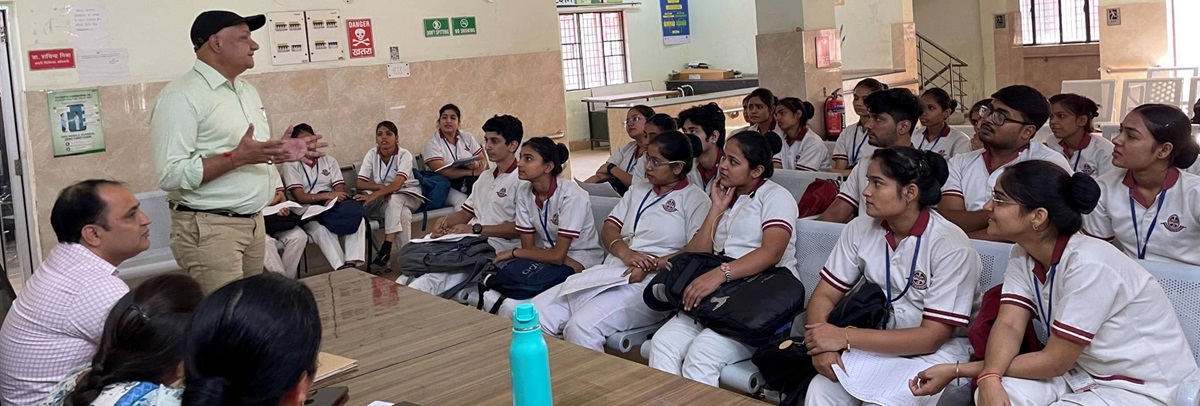
Five local nursing colleges became unlikely but powerful allies. Around 300 nursing students were mobilized and deployed across urban clusters, each assigned clearly mapped areas. Their task was straightforward but transformative—go door to door, count every household, and document every eligible child and pregnant woman.
This wasn’t a casual survey. It was structured, systematic, and embedded within the district’s immunization strategy. Behind it was strong administrative intent. District leaders convened sensitization meetings, aligned stakeholders, and ensured that roles were clearly defined. The result was a coordinated public–private partnership that expanded workforce capacity almost overnight—while bringing in young, motivated individuals trained to engage directly with communities.
/countries/india/community-engagement-in-migrant-clusters.jpg?sfvrsn=6a60a9a8_3 "community engagement in migrant clusters")
Nursing students being briefed before the start of community engagement in migrant clusters (© WHO India / Virender Kumar)
The WHO–National Public Health Support Network (NPSN) team played a central role in shaping how the initiative unfolded. From designing standardized data tools to training students in immunization basics and survey methods, WHO ensured that the exercise met global standards. Equally important was the emphasis on community engagement—how to approach households, build trust, and collect information ethically and accurately.
By grounding the initiative in WHO frameworks, the district avoided a common pitfall: collecting data that cannot be used. Instead, the information gathered fed directly into microplanning—helping health workers refine session sites, estimate targets more accurately, and allocate resources where they were needed most.
What the teams found was striking. More than 115 000 households were surveyed. Within them were over 14 500 children and 1100 pregnant women—nearly three times higher than previous estimates. Armed with better data, the district recalibrated its approach. In high-migration areas, immunization coverage rose by over 10% in a relatively short period. For public health programmes, where gains are often incremental, this was significant. Behind that increase was a simple shift: knowing exactly where the missed children were.
/countries/india/door-to-door-survey-in-urban-settlement.jpg?sfvrsn=305aae5e_3 "door to door survey in urban settlement")
Nursing students conducting door-to-door surveys in urban settlements (© WHO India / Om Prakash)
The Gautam Buddha Nagar experience offers a blueprint for other rapidly urbanizing regions.
First, urban immunization cannot rely on rural models transplanted into cities. It demands flexible, locally adapted solutions that address workforce gaps, unreliable data, and the complexities of transient populations. Second, partnerships matter—but not just with traditional actors. Academic institutions, often underutilized in public health delivery, can provide both manpower and a pipeline of future professionals exposed to real-world challenges. Finally, structure is as important as innovation. WHO frameworks ensured that this local initiative remained systematic, scalable, and aligned with global standards—turning a district-level experiment into a model others can replicate.
India’s cities will continue to grow, pulling in millions in search of opportunity. Ensuring that every child in these shifting landscapes receives life-saving vaccines will remain a formidable task. But Gautam Buddha Nagar shows that the solution doesn’t lie in working harder within old systems—it lies in rethinking them. With the right partnerships and strong technical guidance, even the most complex urban environments can be mapped, understood, and served.
And in that process, the “unseen” children of the city can finally be seen and protected.
[ad_2]