[ad_1]

Welcome back—it’s a tough time to be a startup in Indonesia. The country was central to Southeast Asia’s startup boom, attracting a huge share of the $73 billion invested in the region between 2019 and 2023. Now, sentiment is being hit by two very different trials involving prominent figures.
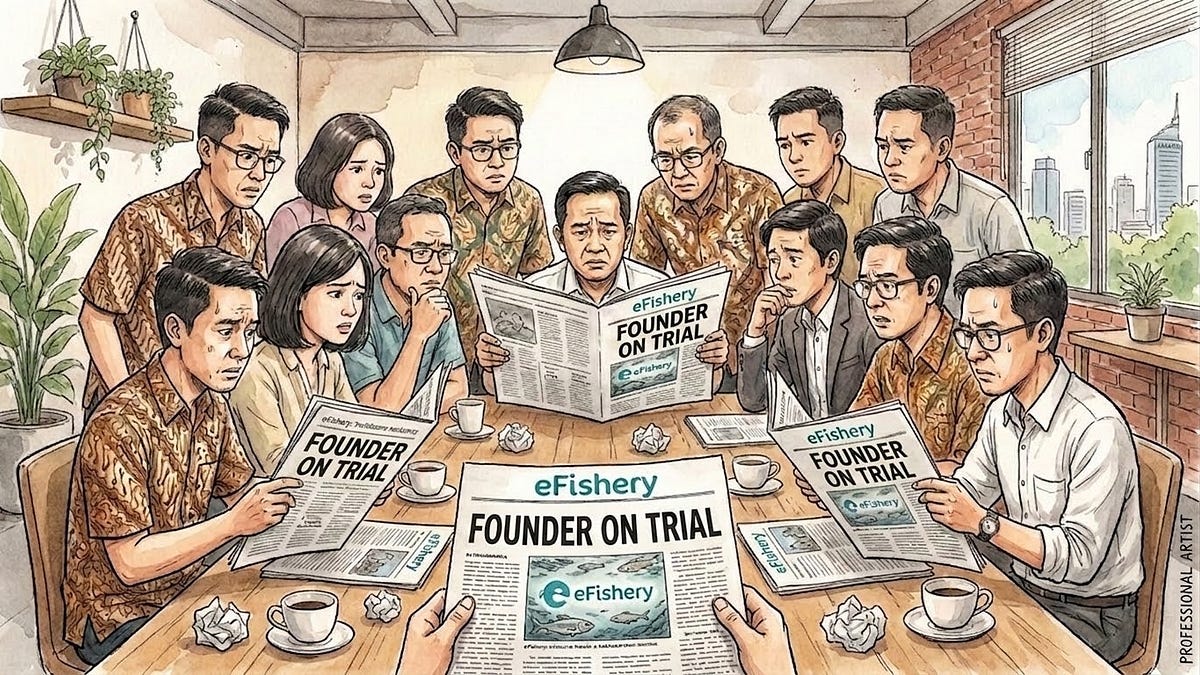
Gibran Huzaifah, CEO and co-founder of eFishery, is facing a potential 10-year sentence for fraudulently inflating his company’s revenues to mislead investors.
Nadiem Makarim, Indonesia’s best-known startup founder after building Gojek, is now on trial over alleged corruption linked to his time as a government minister. A decision is expected next month.
Huzaifah last year admitted to fabricating revenue numbers for eFishery, which reached a valuation of over $1 billion and counted SoftBank and Temasek as investors. Prosecutors at a court in Bandung last week said eFishery’s co-founders were responsible for more than $4 million in apparent losses in the criminal case. Overall, investors are estimated to have lost about $300 million.
In contrast, Makarim has denied corruption charges linked to the procurement of Chromebook-based laptops during his time as education minister between 2020 and 2022. His legal team took his defence to LinkedIn, publishing details of the procurement process and arguing that the programme was subject to oversight and audit. Makarim also apologised for the way he dealt with officials at the time, suggesting his direct manner may have created enemies.
One case looks like clear startup fraud, the other may be political. Nevertheless, the damage to Indonesia’s startup narrative is real.
Huzaifah claimed he fudged the numbers because other founders were doing it. TaniHub, another once prominent startup, was found to have doctored its numbers. When I was a reporter, there were often rumours of startups across the region ‘gaming’ numbers through tactics like liberally calculating ARR (annual recurring revenue).
If Makarim has been targeted, what does that say about startups or individuals that challenge the status quo without bending the rules?
The flashier years are not coming back soon. Any recovery is more likely to come from resilient startups building quietly and showing real traction. Baskit, a startup that’s digitising offline networks in Indonesia and elsewhere in Southeast Asia, for example, just announced a $4.4 million Series A after being profitable for the last 18 months.
It is a long road back, but Indonesia is still Indonesia and many of the problems startups set out to solve have not gone away. Digitisation, connectivity and banking, especially outside major cities, remain weak spots that incumbents are not well placed, or motivated, to fix. Startups can still play a key role.
Asia Tech Review (well, Jon) will be at Money2020 in Bangkok this week, drop us a line if you’re also there.
Have a great rest of the week,
Jon
Meta’s $2.5 billion acquisition of Manus looked smart in December. It bought an ambitious startup whose founders had already moved from China to Singapore to build with more freedom. Now, it looks like an evolving nightmare.
First, Manus’ two co-founders were barred from leaving China, though it isn’t clear why they were back there. Now the deal has become the subject of a top-level national security probe that could force it to unwind, the Financial Times reports:
Chinese regulators have since mobilised across multiple agencies to review the transaction, drawing in bodies including the National Development and Reform Commission, the commerce ministry and China’s antitrust watchdog, according to people familiar with the matter.
Officials are examining the deal using a range of tools, from export control rules to foreign investment and competition laws, the people said.
The Manus co-founders considered leaving Meta to ease pressure, the FT reported. If tough retaliation forced the deal to be undone, Manus’ future would hang in the balance.
It is easy to see how that could become a warning to other founders and dealmakers. At the same time, a heavy-handed approach could scare local founders away from China, a situation that’s obviously not in Beijing’s best interests. The FT reports that officials are divided on how to respond, which should worry all involved.
There’s been speculation for some time that DeepSeek is opening to raising external funding for the first time. Now, The Information reports that it is in talks to bring in $300 million at a valuation of over $10 billion.
Reuters reported that DeepSeek rejected advances from Chinese investors when it first emerged from under the radar. It is unclear if US funds would be open to an investment given the chaos around Manus.
Yet DeepSeek needs access to top technology (read: US technology) to ensure its services are competitive against the likes of OpenAI, Anthropic and others. It will need to develop (or disclose) an overseas strategy to use Nvidia and other tech that’s blacklisted in China.
The Information has a strong track record on China and funding scoops, but time will tell whether a deal is actually completed.
The market regulator fined seven major ecommerce and food delivery platforms more than $525M (3.6B CNY) for failing to verify food vendor licences and allowing ghost kitchens to operate link
Chinese chipmaker YMTC planned two new fabrication plants that would lift capacity to 500,000 wafers a month once all three sites are online link
RedNote, the TikTok-like app that briefly went viral in the West last year, is now trying to grow its social media and ecommerce business in the US through hiring, university events and a shopping portal for American consumers link
Amazon opened its first smart warehouse in Shenzhen, reportedly cutting costs for Chinese sellers by up to 45% and streamlining exports to the US link
ByteDance rolled out its Seedance 2.0 video model to enterprise users in more than 100 countries, but crucially that excludes the US where Hollywood threatened legal action link
Alibaba launched Happy Oyster, an AI world model that can generate 3D environments and real-world simulations for games, film and video link
A Crunchbase report found that startup funding in Asia rose to $27.4B in Q1 2026, up 20% from the previous quarter and nearly double from a year earlier thanks mostly to a rebound in China link
A Chinese deep-sea mission tested a device capable of cutting submarine cables at depths of 3,500 metres link
China has sharply increased chipmaking equipment imports from Malaysia and Singapore in 2025 as shipments from the US fell to an eight-year low link
China ordered safety checks on smart vehicle road tests after a robotaxi incident link
Hesai unveiled a colour-detecting lidar system aimed at improving perception for autonomous vehicles ahead of mass production later this year link
Airwallex is entering the in-person payments space as it expands its challenge to Stripe, Square and Adyen link
A US bill to tighten chipmaking equipment curbs on China was scaled back but still proposed a nationwide restriction on ASML’s DUV immersion machines link
Alibaba open-sourced Qwen3.6-35B-A3B, a mixture-of-experts model aimed at stronger coding performance with far fewer active parameters link
Competition for AI talent in China is intensifying as major tech companies poach from rivals and recruit researchers from overseas hubs such as Silicon Valley link
Ola has been a prominent India startup developing local AI products but its ambitions appear to have stalled after Kruti, the assistant developed by its Krutrim sibling company, disappeared from app stores and the development of Krutrim 3 was reportedly paused according to sources link
India has now officially confirmed that it dropped a proposal to require smartphone makers including Apple and Samsung to pre-install the Aadhaar app link
More than 2,000 attendees turned up to Y Combinator’s first ‘startup school’ event on Indian soil link
Google is bringing Gemini’s Personal Intelligence feature to India, letting users connect services such as Gmail and Google Photos to get personalised answers link
JioHotstar expanded its Warner Bros Discovery partnership to bring HBO Max to India as an add-on starting at $0.53 a month link
Tata Group injected $160M into Tata Electronics as it expanded its push into iPhone manufacturing, including the recently acquired Pegatron India business link
Vibe-coding startup Emergent launched Wingman, a messaging-first autonomous AI agent that looks a lot like a wrapper on top of OpenClaw link
IndiGo invested $1M in Bengaluru electric flying taxi startup Sarla Aviation via its IndiGo Ventures fund link
Computer science graduates from India are not ready for the AI era, according to a Bloomberg report which says companies such as Infosys have been pushed instead to retrain new hires on modern tools link
India is said to be keen to access the US State Department’s new $250M Pax Silica seed fund designed to secure global supply chains for artificial intelligence, semiconductors and critical minerals link
Top fintechs in India are pushing Anthropic for early access to its Mythos AI model amid concerns it could trigger a new wave of cyberattacks link
Flipkart is preparing to sell movie and concert tickets and is also piloting a food delivery service link
Brand analytics platform GobbleCube raised $15M in funding led by Susquehanna Venture Capital link
The FBI and Indonesian authorities disrupted W3LL, a phishing kit that let hackers build fake login sites for as little as $500 link
A Tracxn report found that Southeast Asian startups raised $2.8B in Q1 2026, up 146% from the previous quarter, as late-stage deals drove a rebound link
Profile of Hyperliquid, the Singapore-based crypto trading platform that has distributed billions of dollars in tokens and became one of the world’s most profitable startups per employee link
Malaysia plans to tighten environmental laws to curb illegal e-waste imports and avoid becoming a dumping ground for global electronic waste link
The Trump administration struck a deal with the Philippines to build a US-run AI-powered industrial hub on the island of Luzon that will be focused on critical minerals link
Southeast Asia’s platform ecommerce market reached $157.6B in 2025 in a new report from Momentum Works link
TSMC posted a record first-quarter profit that beat forecasts as AI chip demand drove a 58% jump in earnings link
Furthermore, TSMC said revenue should grow by more than 30% in 2026 as it expands capacity for AI and high-performance computing demand link
SoftBank, NEC, Honda and Sony came together to build large-scale AI models for Japan, the joint venture is expected to receive government backing link
SoftBank is widening lender participation in its $40B loan for its OpenAI investment as the deal enters a soft-launch phase link
Japan will grant Sony up to $390M in subsidies to expand semiconductor output for smartphone and vehicle chips link
Korean AI chip startup DeepX is reportedly preparing a domestic IPO with plans to list in the US later link
South Korea became ASML’s biggest market in the first quarter as memory chipmakers ramped up tool purchases to tackle AI-driven shortages link
A global shortage of memory chips is expected to last until at least 2027 as manufacturers expand DRAM output too slowly to meet demand link
Two New Jersey men were sentenced to more than 7 years in prison for helping North Koreans secure IT jobs at more than 100 US companies link
Manycore Tech, which develops 3D design, simulation and modeling tools, raised $160M in a Hong Kong IPO as it looks to focus on mapping ‘physical AI’ link
Chinese AI agent startup StepFun is dismantling its offshore red-chip structure ahead of a planned Hong Kong IPO as Beijing tightens oversight of overseas listing mechanisms used by domestic tech firms link
[ad_2]