[ad_1]
Doctors’ Platform for People’s Health (DPPH) yesterday demanded that those responsible for the recent surge in preventable deaths of children from measles be identified and punished.
The organisation said negligence in vaccine procurement by the interim government, bureaucratic delays and institutional indifference towards public health have significantly contributed to the ongoing measles outbreak, leaving many children dead.
It called for immediate corrective measures, including launching a nationwide mass vaccination campaign, declaring the measles outbreak a public health emergency, and undertaking all-out efforts with the highest priority to contain the crisis.
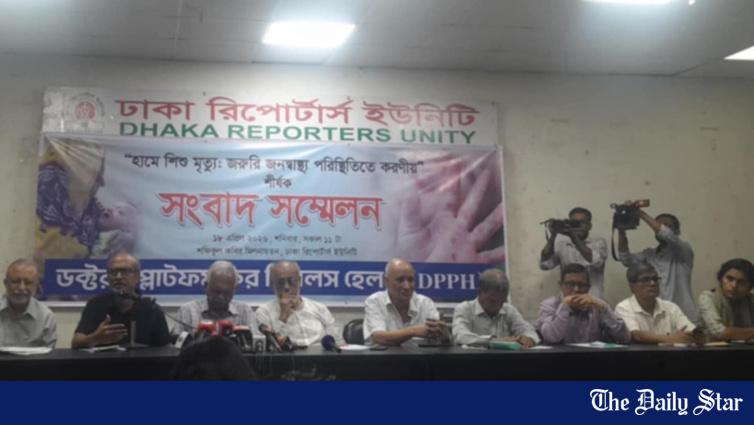
DPPH, formed in May 2020, made the observations and demands at a press conference at Dhaka Reporters’ Unity titled “Deaths of Children in Measles: What Should Be Done in this Public Health Emergency”.
Public health expert and DPPH convening committee member Mushtaq Husain read out their keynote paper.
He said the current measles situation is a serious public health crisis that has exposed weaknesses in the healthcare system and gaps in vaccination coverage.
Citing data from the DGHS, he said 206 children died from measles and measles-like symptoms between March 15 and April 16 this year. “These deaths could have been prevented if timely and effective measures had been taken,” he added.
Of them, 34 cases were confirmed through laboratory tests, while the rest showed symptoms consistent with the disease. More than 20,000 people have been infected so far, with over 3,000 currently undergoing treatment in hospitals, he also said.
“We believe that negligence in vaccine procurement by the previous interim government, bureaucratic delays, and institutional indifference towards public health have contributed to this outbreak and weakened the Expanded Programme on Immunisation (EPI). Those responsible for these preventable child deaths must be identified and held accountable,” he said.
Replying to a query, he said a measles epidemic is currently underway in the country, whether the government acknowledges it or not.
“We are seeing the government take various emergency measures. However, it may be refraining from declaring measles a public health emergency, possibly out of concern that it could create panic among people or have political consequences,” he added.
Replying to another query, he said since the government has started mass vaccination, the rising trend of measles cases may decline within one and a half months, adding that the number of deaths, however, may take another month to come down.
AM Zakir Hussain, former director of the Institute of Epidemiology, Disease Control and Research (IEDCR), said in previous years, three out of every 1,000 measles patients died in the country, but this time the number has risen to 10.
“The government must conduct thorough analysis to identify the reasons behind the increased death rate,” he added.
DPPH Convener Prof Mahbub-E-Rashid said Bangladesh had been performing well in controlling communicable diseases, with the main concern shifting to the rise of non-communicable diseases.
However, the country has faltered in controlling communicable diseases like measles, attributing the situation to negligence by those concerned, he added.
[ad_2]