[ad_1]
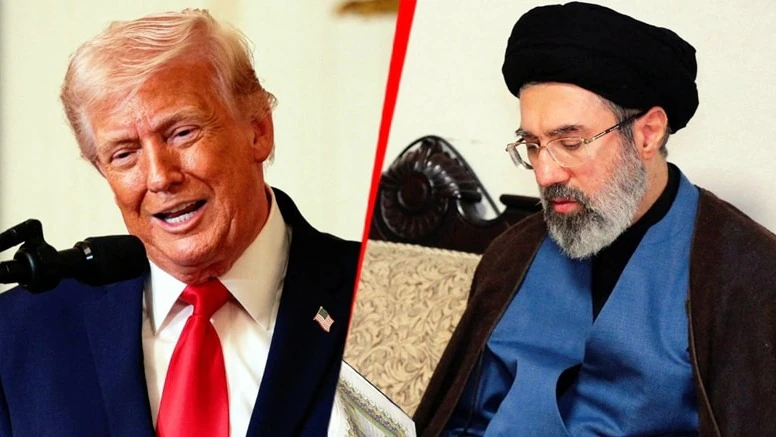
US President Donald Trump issued a stark warning on Monday, bluntly declaring that if the fragile two-week ceasefire with Iran expires Tuesday evening without a breakthrough, “then lots of bombs start going off.”
Speaking to PBS News, Trump was blunt when asked what would happen if the ceasefire expires tomorrow evening. “Then lots of bombs start going off,” he replied. When pressed on whether Iran would still show up for the planned talks in Islamabad, the US President sounded uncertain but determined. “I don’t know. I mean, they’re supposed to be there. We agreed to be there, although they say we didn’t. But no, it was set up. And we’ll see whether or not it’s there. If they’re not there, that’s fine too.”
Trump warned Iran as the US delegation prepared to return to the negotiating table for the second round of talks in Pakistan amid deep uncertainty over Tehran’s participation. With the clock ticking toward the April 22 ceasefire deadline, a temporary truce has halted direct hostilities. Both sides remain locked in a high-stakes standoff over Iran’s nuclear ambitions and ongoing disruptions in the Strait of Hormuz.
He made clear that the core demand remains unchanged. “No nuclear weapons. Very simple. Iran cannot have a nuclear weapon. Very simple,” he said, repeating the red line that has defined Washington’s position throughout the crisis.
The US President expressed confidence in his negotiating team, describing them as his “A-team” and defending his son-in-law Jared Kushner despite questions about potential conflicts of interest stemming from Kushner’s extensive business ties across the Middle East. “Whether you have business or not, everybody knows that’s the right thing. He’s a very good negotiator,” Trump said, adding that Jared Kushner was focused solely on preventing Iran from acquiring nuclear capability.
IS JD VANCE ACTUALLY HEADING TO PAKISTAN?
Adding to the sense of diplomatic flux, Trump had earlier said that JD Vance would not travel to Pakistan, only to confirm today that the Vice President would indeed lead the delegation. Trump said that a high-level US delegation — including Vice President JD Vance, special envoy Steve Witkoff, and adviser Jared Kushner — is already en route to Islamabad for the next round of negotiations.
However, contrary to Trump’s assertions that the team was already en route, news agency Reuters reports indicate JD Vance is yet to depart Pakistan as of Monday. This back-and-forth has fueled perceptions of mixed signals from the administration.
IRAN REJECTS NEXT ROUND OF TALKS
Iranian state media has so far shown little enthusiasm for the next round. State broadcaster IRIB reported there are “currently no plans to participate in the next round of Iran-US talks,” while IRNA cited “Washington’s excessive demands, unrealistic expectations, constant shifts in stance, repeated contradictions, and the continuing naval blockade” as reasons for hesitation. Iranian President Masoud Pezeshkian also pushed back against Washington’s approach to the ongoing nuclear negotiations, posting on X that honouring commitments forms the foundation of any meaningful dialogue.
“Honouring commitments is the basis of meaningful dialogue,” Pezeshkian wrote. “Deep historical mistrust in Iran towards US government conduct remains, while unconstructive and contradictory signals from American officials carry a bitter message; they seek Iran’s surrender. Iranians do not submit to force.”
TRUMP SAYS HE IS OPEN TO FACE-TO-FACE TALKS WITH IRAN
Despite the setbacks, Trump dismissed any notion that the process was collapsing. “We’re supposed to have the talks. So I would assume at this point nobody’s playing games,” he told The New York Post earlier. The US President also left open the possibility of direct high-level engagement. “I have no problem meeting them,” he said. “If they want to meet, and we have some very capable people — but I have no problem meeting them.”
The latest round of diplomacy follows the collapse of the first direct talks held last week in Islamabad, where more than 21 hours of intense negotiations failed to yield any agreement. Vice President JD Vance, who led the American side alongside special envoy Steve Witkoff and adviser Jared Kushner, called the outcome disappointing. “The bad news is that we have not reached an agreement, and I think that’s bad news for Iran much more than it’s bad news for the United States of America,” Vance said at the time. Iran, meanwhile, blamed Washington’s “excessive demands” and the continuing naval presence for the impasse, particularly the demand to completely dismantle Tehran’s nuclear programme.
The temporary ceasefire has offered a brief respite for civilians on both sides, but the risk of renewed escalation looms large, particularly as Iran continues to show little sign of participating in the talks. Pakistani mediators continue to play a quiet but crucial role in trying to keep the channels open, though success appears far from guaranteed.
– Ends
WIth inputs from agencies
Tune In
[ad_2]