
[ad_1]
Databricks is itself still raising venture capital money but has at the same time built a portfolio of more than 50 startups to strengthen its market position.

When Andrew Ferguson launched Databricks’ corporate venture arm four years ago, he did not anticipate how quickly it would scale. “I just did not foresee the volume of investing that we would do,” he says. Yet what began as a focused ecosystem effort has become one of the more active corporate venture operations in enterprise AI, with more than 50 portfolio companies and roughly 15 new bets a year across its core strategies and accelerator.
The rise of Databricks itself explains much of that momentum. Founded in 2013, the company sits at the centre of the modern data and AI stack. It has continued to attract vast sums of capital — including a $5bn funding round concluded recently — even as it runs its own investment arm from the balance sheet. That combination, of still being venture-backed while acting as a venture investor, is unusual. But it reflects a broader shift: fast-growing technology companies are increasingly using corporate venture capital not merely for financial return but to shape the ecosystems on which their platforms depend.
From the outset, Databricks Ventures was designed to be complementary rather than competitive with traditional venture capital. “We don’t lead rounds,” Ferguson says. “We participate alongside a lead financial investor who sets the terms in series A or later rounds.” The aim is not to dictate valuations or anoint category leaders but to secure a strategic foothold in technologies adjacent to Databricks’ platform.
A three-pronged strategy
The original thesis was straightforward: invest in companies building on, or tightly integrated with, Databricks’ data platform. “We started with ecosystem investing,” Ferguson says. That meant backing software companies whose products enriched the Databricks environment and, in turn, made the platform more valuable to customers. [Read more in our article “Databricks: how to follow the “enterprise software CVC playbook”.]
Over time, the remit broadened. The second prong focused on system integrators — growth-stage consultancies helping large enterprises implement Databricks. “We use an investment to really tightly align and make sure we have a stable partner that understands our platform really well and is committed to being a best-in-class Databricks thought partner and implementer for our enterprise customers,” Ferguson explains. In a market where enterprise AI deployments are complex and talent is scarce, that alignment can be decisive.

Want to hear more from Andrew Ferguson?
He will be speaking at the GCVI Summit in Monterey, the biggest dedicated gathering of corporate venture capital and C-suite innovation leadership.
Find out how you can join the Summit here.
The third strand, unveiled in 2025, pushes further down the maturity curve. “The third prong to the strategy is the AI Accelerator programme, which is a collaboration between our startup programme and Databricks Ventures to work with the earlier end of the market,” he says. While the core venture activity targets series A and beyond, the AI Accelerator supports seed and pre-seed companies, offering access to the platform, modest funding and the imprimatur of the Databricks brand.
The logic is both defensive and opportunistic. Early engagement allows Databricks to cultivate future ecosystem leaders — and to learn. The accelerator companies sometimes serve as case studies. “We hope that those companies will serve as examples,” Ferguson says. “Someone might see a martech company that’s built on Databricks and understand how to leverage parts of the platform in their own business.”
Lean by design
Despite the volume of activity, the operation remains compact. “The team is still pretty lean,” Ferguson says. Rather than building a large, standalone investment shop, he draws on Databricks’ broader corporate development and M&A functions for execution. Capital comes directly from the company’s balance sheet, giving flexibility. “In general, we look to do as many interesting, relevant deals as we find in a given year.”
“We’re more focused on whether it makes strategic sense to get into the round, than on the valuation.”
That flexibility matters in an AI market prone to excess. Valuations have surged as enterprises race to deploy generative and “agentic” systems. Yet Ferguson insists on strategic discipline. “We’re more focused on whether it makes strategic sense to get into the round, than on the valuation,” he says. Because cheque sizes are relatively modest and the primary return is strategic, Databricks can tolerate headline-grabbing price tags — provided the company in question strengthens the platform.
He is also wary of investing in businesses that could be outflanked by the very infrastructure players on which they depend. “We think very hard about whether the AI company [is] going to get displaced by the model providers or by a data platform like us,” he says. In crowded segments, the question is less about picking a single champion than about ensuring exposure to categories where “there’s going to be more than one winner.”

An intelligence network
Corporate venture capital has sometimes been criticised for weak diligence and muddled incentives. Ferguson argues, however, that a platform company has the edge in many ways. “You have several advantages as a corporate. We’ve got technical employees who like to play around with these types of products.” Engineers, product managers and field teams offer informal but informed assessments of adjacent technologies. Customer conversations provide another filter.
“We get a lot of feedback about what segments are waxing and waning.”
Over time, the portfolio itself becomes a sensor network. “The fact that we now have over 50 portfolio companies actually compounds that learning benefit,” he says. The result is “a lot of ecosystem intelligence and a lot of feedback about what segments are waxing and waning.” In a fast-moving AI landscape, that information may be as valuable as any financial upside.
The relative youth of Databricks also helps. “There was not the bureaucracy and red tape, institutional pushback and risk aversion that might have been had I been trying to do the same thing at a regulated financial institution,” Ferguson says. Founder Ali Ghodsi, active in the startup ecosystem, remains engaged. Investment approvals flow through an ad hoc committee: “There are people that are on the email thread and can weigh in, but there are fewer ultimate deciders.”
Betting on the application layer
Looking ahead, Ferguson is particularly animated by application development in the era of agentic AI. “One area where we’re spending a lot of time is in the app-building space broadly defined,” he says. Databricks’ evolving product stack — including its Lakebase transactional database and its Databricks Apps offering — is designed to support secure, governed, internal enterprise applications built on proprietary data.
That creates fertile ground for partnerships with emerging application-development platforms. “It doesn’t mean we’re going to invest in all of them,” Ferguson cautions. But as enterprises move from experimentation to production-grade AI systems, the application layer — not just the models or the infrastructure — may prove decisive.
The pattern is clear. Databricks Ventures is less concerned with backing the next standalone unicorn than with reinforcing the architecture around its own platform. In an AI market where ecosystems matter as much as algorithms, that may be the more durable strategy.
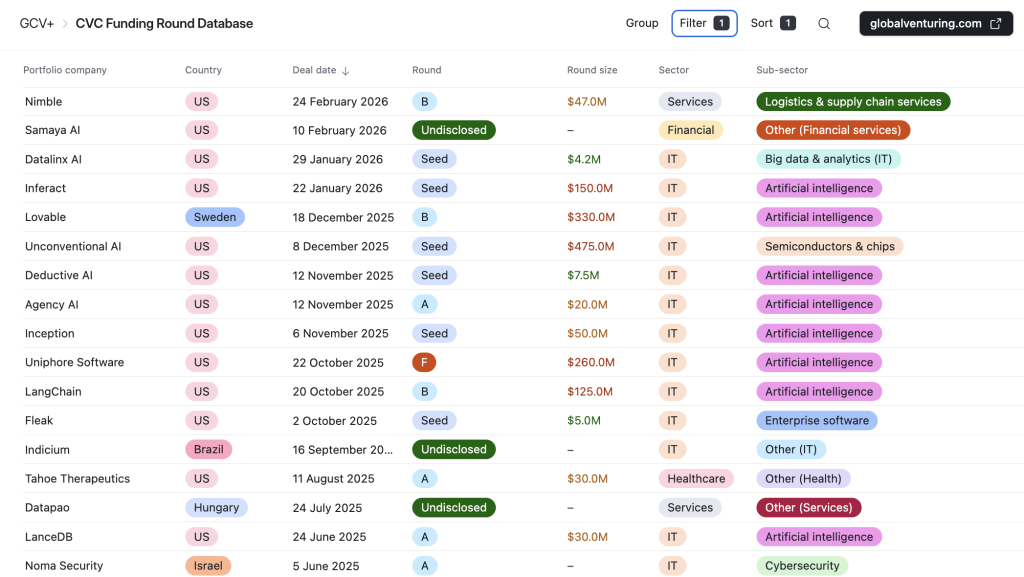
See all the recent Databricks startup investments in the CVC Funding Round Database
[ad_2]