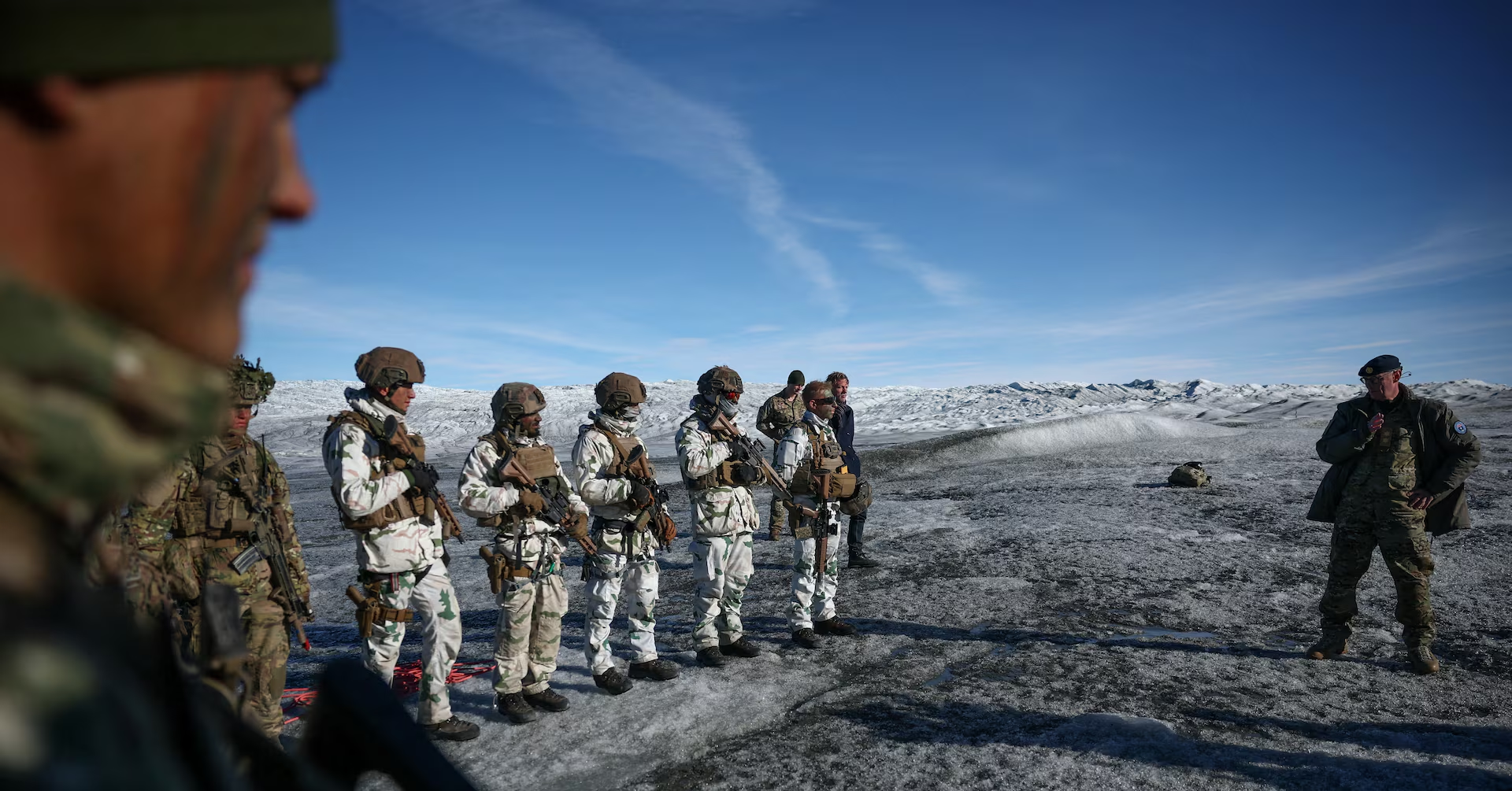
Item 1 of 2 Chief of Joint Arctic Command, Major General Soren Andersen speaks to members of the Danish and French armed forces during a military drill as Danish, Swedish, and Norwegian home guard units together with Danish, German and French troops take part in joint military drills in Kangerlussuaq, Greenland, September 17, 2025. REUTERS/Guglielmo Mangiapane/File Photo
Eight nations have territory in the Arctic: Russia, the United States, Canada, Denmark, Norway, Sweden, Finland and Iceland. Here is an overview of their military assets:
Sign up here.
RUSSIA
Half of the landmass in the Arctic is Russian territory. Since 2005 Moscow has re-opened and modernised tens of Soviet-era military bases, both on its Arctic mainland and on the islands off its northern coast.
The area is also home to Russia’s Northern Fleet, headquartered in Severomorsk, which operates six of the country’s 12 nuclear-armed submarines, according to data from the International Institute for Strategic Studies. The other six are operated by the Pacific Fleet based in Vladivostok.
The only way for the Northern Fleet to access the North Atlantic is via the Barents Sea, between the Norwegian Svalbard archipelago and the northern coast of Europe. Keeping that access free is therefore essential to Moscow.
UNITED STATES AND CANADA
Since 1957, the U.S. and Canada have jointly defended against threats to their homeland, including from nuclear missiles, via the North American Aerospace Defense Command, known as NORAD.
They are modernising NORAD, according to the IISS: Canada is procuring two over-the-horizon radar systems covering the Arctic and polar approaches, with the first due to reach initial operating capability by 2028.
President Trump is keen to develop a new missile defence system, called Golden Dome, for which he says Greenland is crucial.
Washington has the Pituffik Space Base in northern Greenland under a defence agreement with Denmark. Otherwise, most of its Arctic forces are located across eight bases in Alaska and count approximately 22,000 military personnel, according to IISS and the U.S. Northern Command.
Canada has five Arctic bases, including Alert, a signals intelligence station on Ellesmere Island that is the world’s northernmost permanently inhabited settlement.
South of the Arctic Circle, Canada operates a base at Yellowknife in the Northwest Territories, which hosts a ranger patrol group and an air base.
Canada is building a facility on Baffin Island to refuel offshore patrol ships – though the project has sustained numerous delays. The U.S., meanwhile, is expanding existing port facilities at Nome, Alaska, according to IISS.
DENMARK
JAC is also present at the Kangerlussuaq air base as well as four smaller military stations in eastern and north-eastern Greenland. JAC has one liaison officer at Pituffik.
Its Sirius dog sled patrol – derided by Trump – is a military unit that conducts long-range reconnaissance in the extreme conditions of northeastern Greenland.
SWEDEN AND FINLAND
Sweden has no bases north of the Arctic Circle, but has an air force base at Lulea, on the northern coast of the Gulf of Bothnia, and an army base with two regiments in Boden, some 40 km (25 miles) inland.
Finland has an air base in Rovaniemi, on the Arctic Circle, and a Jaeger Brigade base further north in Finnish Lapland.
Since joining NATO, the two countries have been integrating their militaries with the rest of the alliance.
NORWAY
Norway is NATO’s monitor for a vast maritime area of some 2 million sq km (770,000 sq mi) of the North Atlantic, including the Arctic.
Many of its military installations are above the Arctic Circle. It has four air bases, including one for its new F-35 fighter jets, two navy bases, a string of army bases and a reception centre for NATO allies coming for reinforcement in case of attack.
There are no military installations on Svalbard, Norway’s Arctic archipelago.
ICELAND
The North Atlantic island is a NATO member but has no military, only a coastguard service.
It hosts U.S. Navy P-8A Poseidon maritime-patrol aircraft in a rotational deployment, based at Keflavik air base, near Reykjavik.
NATO fighter jets periodically rotate at Keflavik to keep Icelandic airspace secure. The deployment usually lasts two to three weeks, three times a year.
Sources: International Institute of Strategic Studies’s Military Balance 2025; Mathieu Boulegue; NATO; U.S. Northern Command; Icelandic government
Reporting by Gwladys Fouche in Oslo; additional reporting by Jacob Gronholt-Pedersen in Nuuk, Stine Jacobsen in Copenhagen and Mark Trevelyan in London; Editing by Alex Richardson
Our Standards: The Thomson Reuters Trust Principles.