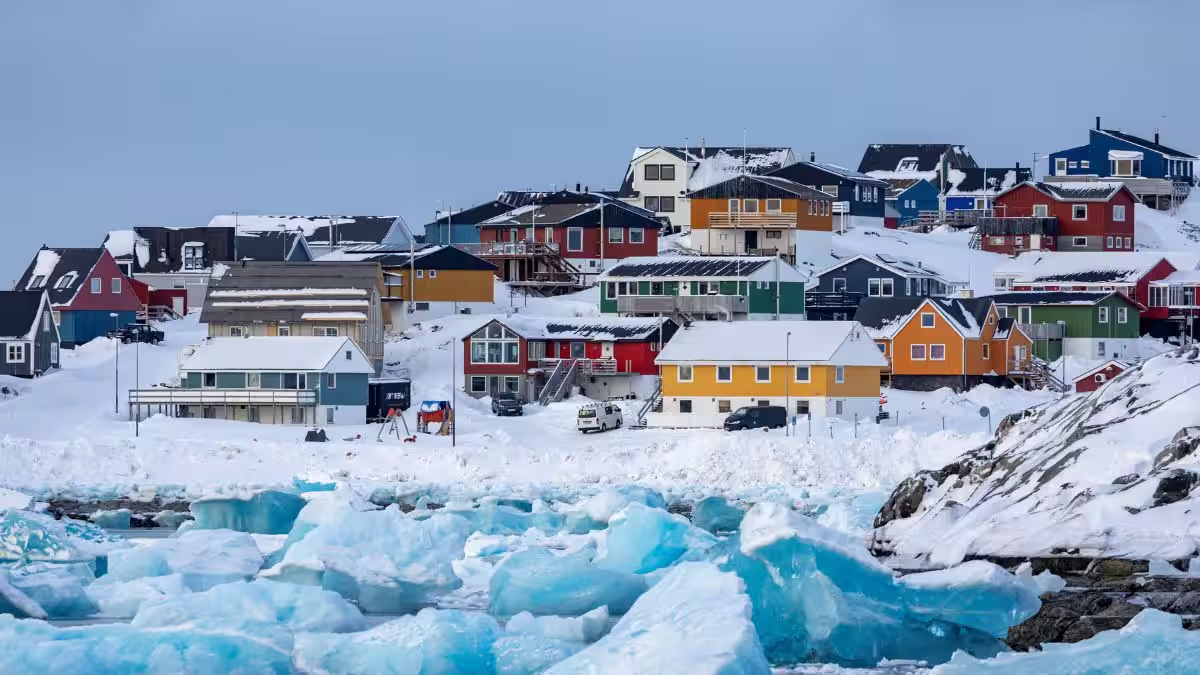
Europe, led by the UK and Germany is exploring a stronger Nato presence in Greenland to reinforce Arctic security following US President Donald Trump’s call for American ownership and reported invasion planning.
European powers led by the United Kingdom and Germany are weighing plans to bolster Nato’s military presence in Greenland, moving to assert allied control over Arctic security after US President Donald Trump openly revived calls for American ownership of the strategically vital territory and reportedly asked special forces to prepare contingency plans for a possible invasion to seize it.
According to a Bloomberg News report citing people familiar with the discussions, European governments are considering a more visible Nato role in Greenland as a signal that Arctic security is a shared transatlantic responsibility and not one that requires unilateral US action. Germany is expected to propose the creation of a joint Nato mission aimed at protecting the Arctic region, reflecting growing unease in Europe over Trump’s rhetoric and reported behind-the-scenes moves.
The discussions come after Trump said on Friday that the United States “needs to own” Greenland to stop Russia or China from taking control of the Arctic island. He has repeatedly alleged that Russian and Chinese naval activity is occurring near Greenland, claims that Nordic countries and regional allies have firmly rejected.
Trump’s statements have taken on sharper significance following reports that he asked U.S. special forces to prepare contingency plans for a possible invasion of Greenland, a move that has reportedly met resistance from senior military officials. The Pentagon has not publicly confirmed the reports, but the disclosure has rattled European capitals and prompted renewed focus on alliance-based deterrence in the Arctic.
Greenland, an autonomous territory within the Kingdom of Denmark, occupies a critical geostrategic position between North America and Europe. It hosts key infrastructure linked to the U.S. ballistic missile early-warning system and sits along emerging Arctic shipping routes that are becoming more accessible as climate change accelerates ice melt. Control over the Arctic has also become central to global competition for natural resources, including rare earths, hydrocarbons and strategic minerals.
European officials fear that Trump’s renewed push for Greenland risks undermining established norms of sovereignty and could destabilise Nato cohesion. By strengthening a Nato-led military framework in the region, European allies hope to reinforce the principle that Arctic security challenges should be addressed collectively, rather than through unilateral assertions of control.
Germany’s reported proposal for a joint Nato mission would mark a notable shift for Berlin, which has traditionally played a restrained role in the Arctic. But officials argue that the evolving security environment including Russia’s military build-up in the High North and heightened great-power competition, leaves European allies with little choice but to step up their presence.
Britain is also playing a key role in the discussions, reflecting its broader push to underline its relevance in European security despite having left the European Union. London has increasingly framed itself as a leading NATO power and has deepened defence coordination with Nordic and Baltic states in response to Russian aggression.
Denmark, which retains responsibility for Greenland’s defence and foreign policy, has not formally commented on the reported Nato discussions. However, Copenhagen has already announced plans to invest more heavily in Arctic security, including surveillance capabilities and naval assets, amid criticism including from Trump that it has not done enough to defend the territory.
Trump’s comments have triggered unease not just in Europe but also within the U.S. defence establishment. Military planners are said to be wary of the strategic, legal and political consequences of any attempt to seize Greenland, particularly given that Denmark is a Nato ally. Such a move would risk severe damage to alliance unity at a time when Nato is already stretched by the war in Ukraine and rising tensions in Asia.
European leaders are also sceptical of Trump’s repeated claims that Russian and Chinese vessels are operating near Greenland. Nordic governments, which closely monitor Arctic maritime activity, have said they have seen no evidence to support those assertions. Instead, they argue that existing Nato structures, combined with closer cooperation among Arctic states, are sufficient to manage current threats.
Still, the renewed focus on Greenland highlights how the Arctic is fast becoming a central theatre of geopolitical competition. Melting ice is opening new sea lanes and intensifying interest from both Western and non-Western powers, heightening the risk of miscalculation.
By exploring a stronger Nato footprint in Greenland, European allies appear intent on drawing a clear line: Arctic security should remain anchored in multilateral cooperation and international law, not driven by unilateral demands, even from the alliance’s most powerful member.
End of Article