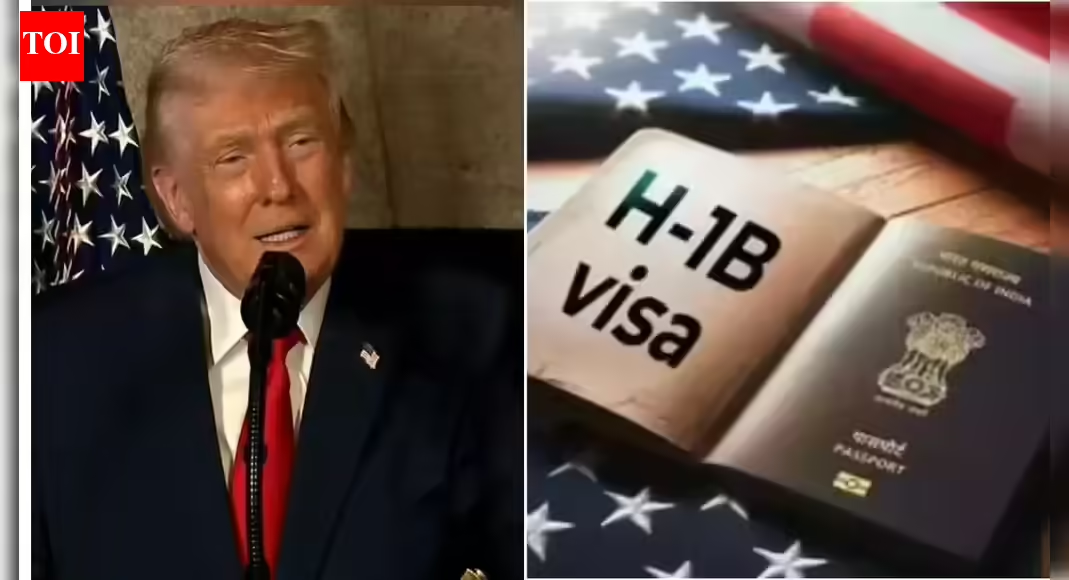
A US federal judge upheld the Trump administration’s move to move ahead with President Donald Trump’s proposal to impose a $100,000 fee on new H-1B visas, dealing a setback to the American technology companies and business groups challenging the move.US District Judge Beryl Howell in Washington DC on Tuesday rejected a lawsuit filed by the Chamber of Commerce, which argued that the steep fee violated federal immigration law and would force companies, hospitals and other employers to cut jobs and services.
Howell ruled that Trump had the legal authority to impose the fee, noting that his proclamation was issued under “an express statutory grant of authority to the President.” “The parties’ vigorous debate over the ultimate wisdom of this political judgment is not within the province of the courts,” Howell wrote, Reuters reported.“So long as the actions dictated by the policy decision and articulated in the Proclamation fit within the confines of the law, the Proclamation must be upheld,” she added.The Chamber of Commerce had argued that the president lacked the power to impose such a fee and warned it would hurt employers that rely on skilled foreign workers.Its executive vice president and chief counsel Daryl Joseffer said many small and medium-sized businesses would struggle to afford the cost. “We are disappointed in the court’s decision and are considering further legal options to ensure that the H-1B visa program can operate as Congress intended,” Joseffer said in a statement.
What is the $100,000 H-1B fee?
The H-1B visa programme allows US employers to hire foreign workers in specialised fields and is widely used by technology companies. The programme issues 65,000 visas annually, with an additional 20,000 visas for workers with advanced degrees, typically valid for three to six years.Until now, H-1B visa fees generally ranged between $2,000 and $5,000, depending on various factors. Under Trump’s order, however, the fee for new H-1B applications would jump sharply to $100,000.H-1B visas are allocated through a lottery system, though the programme mainly serves the tech sector. The US Department of Homeland Security has also moved to overhaul the selection process, replacing the random lottery with a system that favours higher-paid and more highly skilled foreign workers. The Trump administration says this change is aimed at protecting American wages and jobs.
Which companies could be most affected?
Companies such as Amazon, Tata Consultancy Services (TCS), Microsoft, Meta Platforms and Apple are among the largest users of H-1B visas, according to US government data cited by Bloomberg.Opponents of the policy argue that the higher fee would force employers to choose between significantly higher labour costs or hiring fewer highly skilled foreign workers. Separate legal challenges have also been filed by Democratic-led states and a coalition of employers, nonprofits and religious organisations.In issuing the order, Trump cited his authority under federal immigration law to restrict the entry of foreign nationals deemed detrimental to US interests. Judge Howell further stated that the administration had adequately supported its claim that the H-1B programme was displacing American workers, pointing to examples where companies laid off thousands of US employees while continuing to seek H-1B visas.