More than 60 countries, including India, held urgent talks on Thursday to chart a path to reopen the Strait of Hormuz amid mounting concerns over the disruption of energy supplies amid the US-Iran war. The UK-led virtual meeting focused on diplomatic and economic options – a ‘Plan B’ – to restore shipping through the critical energy corridor, amid fears that Donald Trump could end US operations without securing access to the strait, according to a Bloomberg report.
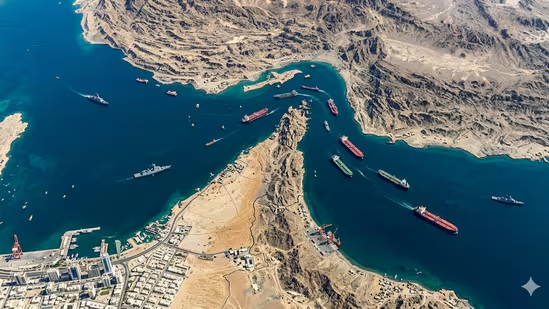
The Strait of Hormuz is one of the world’s most strategically vital maritime chokepoints, serving as the only sea link between the Persian Gulf and the Arabian Sea, flanked by Iran to the north and Oman to the south.
It carries roughly a fifth of global oil and gas supplies, making it indispensable for the global energy market and for major exporters such as Saudi Arabia, the UAE, Iraq and Qatar, whose crude and LNG shipments largely pass through this narrow corridor.
Blockades of the strait, like the current one, sends immediate shocks to global oil prices and supply chains, particularly for energy-dependent economies in Asia, including India.
India joins global push, stresses free navigation
India was among the key participants in the meeting, represented by Foreign Secretary Vikram Misri, who joined counterparts from France, Germany, Italy, Canada and the UAE.
New Delhi underscored the “importance of freedom of navigation and unimpeded transit through international waterways”, highlighting the direct impact of the crisis on its energy security. India also pointed out it is the only country to have lost mariners in attacks on merchant vessels in the Gulf during the ongoing conflict.
Misri called for de-escalation and a return to diplomacy, even as India continues to coordinate with Iran and other stakeholders to ensure safe passage for Indian-flagged ships.
Allies prepare fallback strategy without US
The meeting, chaired by UK Foreign Secretary Yvette Cooper, focused on political and diplomatic solutions rather than military intervention. Notably, the United States did not attend.
The discussions reflected growing concern among US allies that Washington may not prioritise reopening Hormuz. Participants emphasised that any ceasefire deal must include restoring navigation – but also began preparing contingency plans if that fails.
Military planners from participating nations are set to meet next week to examine how naval assets could be deployed to secure and de-mine the Strait of Hormuz.
However, there is little appetite for forcing the issue militarily without Iran’s agreement. Instead, countries are exploring coordinated diplomatic pressure, including sanctions, and a possible role for the United Nations in negotiations.
Japan, represented by foreign minister Toshimitsu Motegi, called for cooperation in creating safe maritime corridors for stranded vessels.
Energy lifeline under strain
The urgency stems from the severe disruption to global oil flows. The Strait of Hormuz, handling nearly 20% of the world’s energy trade, has seen daily ship traffic plunge from over 100 vessels before the war to just three or four now.
About 2,000 ships remain stuck on either side of the passage, according to the International Maritime Organization.
Countries heavily reliant on Middle Eastern oil have been forced into emergency measures, including reduced work weeks and limits on power consumption.
India navigates a delicate balance
Despite the broader disruption, India has secured limited relief. Iran has designated it among a handful of “friendly nations” allowed conditional passage through the strait, alongside China, Russia, Iraq and Pakistan.
Six Indian ships have crossed Hormuz safely in recent days, even as New Delhi monitors 18 Indian-flagged vessels and several others carrying energy supplies bound for the country.
India has reiterated that it is not engaged in any talks with Iran on paying transit fees, even as Tehran considers imposing a toll on ships using the waterway – a move criticised by US Secretary of State Marco Rubio as “illegal” and “dangerous”.