Last Updated:
Iran stated a phone call from Israeli Prime Minister Benjamin Netanyahu to Vance during the negotiations shifted the dynamics of the talks
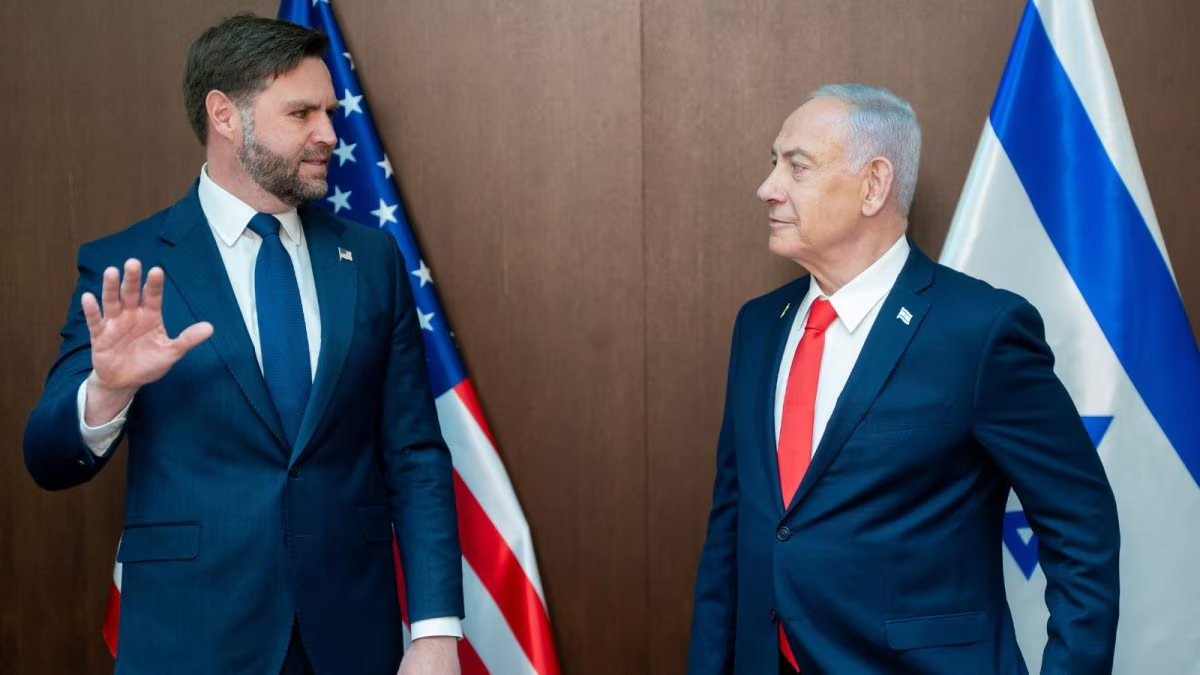
US Vice President JD Vance with Israeli PM Benjamin Netanyahu | File Image: AFP
A phone call placed by Israeli Prime Minister Benjamin Netanyahu to US Vice President JD Vance in the middle of negotiations in Pakistan upended what Tehran says was a potential breakthrough in the long-running Iran-US standoff.
The US delegation, led by Vice President JD Vance, said the talks failed after Iran rejected what Washington described as its “final and best offer.”
Speaking after the negotiations ended, Vance said the United States was unable to secure Iranian agreement on key terms, despite extensive discussions. “We leave with a very clear proposal. It is our final and best offer,” he said.
Shortly after the talks broke down, President Donald Trump said negotiations failed because Iran was unwilling to abandon its nuclear programme, a long-standing point of contention between the two sides.
Iran, however, placed the blame elsewhere, accusing outside actors of undermining the process.
According to Iranian media, Foreign Minister Seyed Abbas Araghchi said a phone call from Israeli Prime Minister Benjamin Netanyahu to Vance during the negotiations shifted the dynamics of the talks.
Araghchi claimed the call redirected discussions away from US-Iran engagement toward Israeli priorities, effectively stalling progress.
“The United States tried to extract at the negotiating table what it failed to achieve on the battlefield,” Araghchi said, according to Iran’s Press TV.
Officials familiar with the talks said negotiations stalled over unresolved disputes involving Iran’s nuclear activities, access to frozen Iranian assets, and security arrangements linked to the Strait of Hormuz, a vital corridor for global energy supplies.
Iranian officials also pointed to deep mistrust following weeks of hostilities as a major obstacle.
Foreign ministry spokesperson Esmaeil Baqaei said the talks took place in an atmosphere shaped by war and skepticism. While acknowledging that a breakthrough in a single session was unlikely, he said Tehran remained open to further diplomatic efforts.
The failure to reach an agreement has cast immediate uncertainty over the ceasefire that had temporarily halted escalating military tensions.
Although neither side has formally declared the truce over, increasingly sharp rhetoric has raised concerns that renewed confrontation could follow.
The diplomatic setback has also revived anxiety in global energy markets. Before the ceasefire was announced earlier this month, Brent crude prices had surged above $119 a barrel amid fears of disruption in the Strait of Hormuz.
Prices eased during the pause in fighting but are now under renewed pressure, with analysts warning that oil could again climb into triple-digit territory if the ceasefire collapses.
April 13, 2026, 08:10 IST
Read More