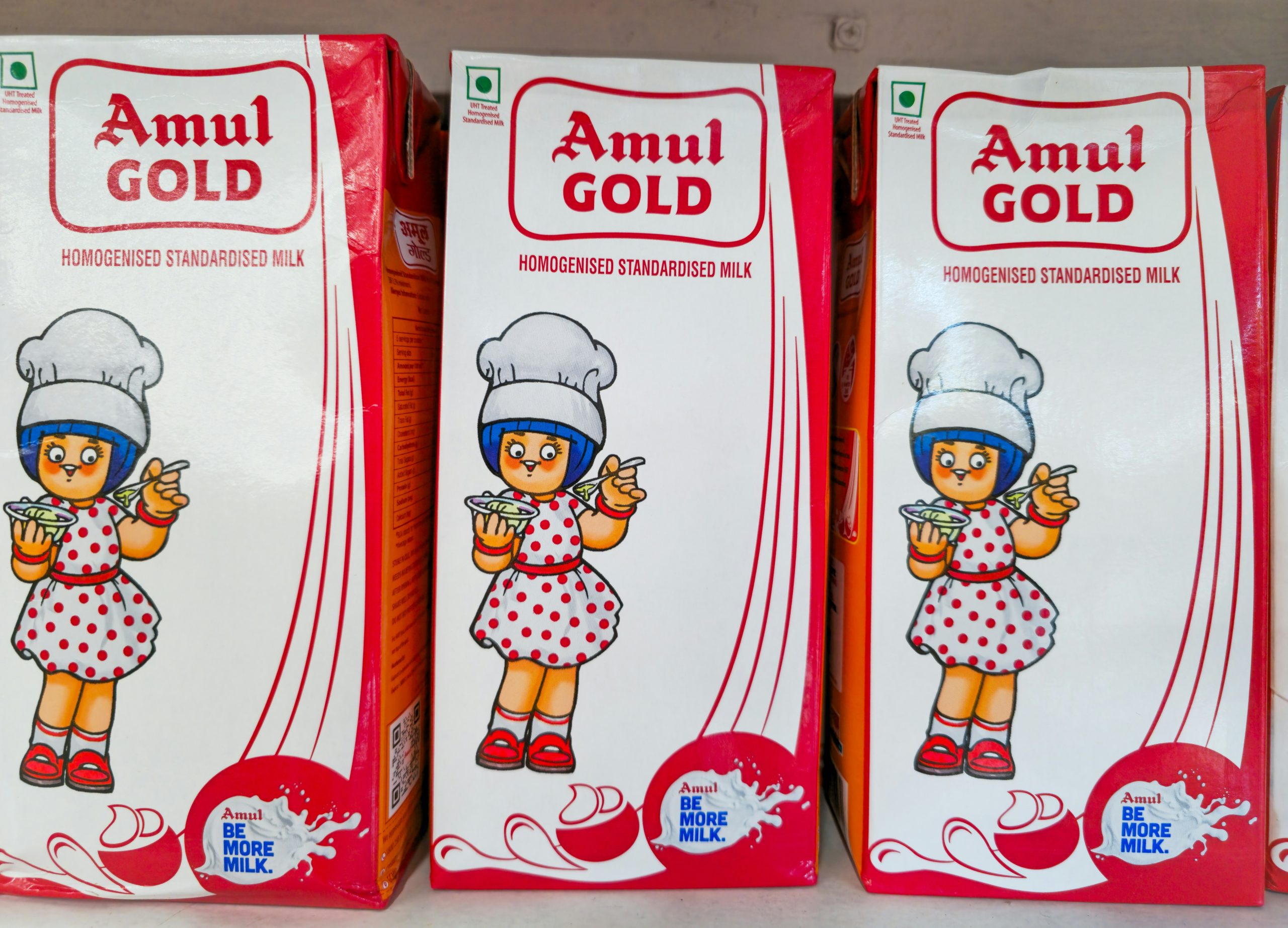
AI dairy farming has found its most ambitious deployment yet – not in a Silicon Valley lab nor a European agri-tech campus, but in the villages of Gujarat, India, where 36 lakh (3.6 million) women milk producers are now being served by an AI assistant named Sarlaben.
Amul, the world’s largest dairy cooperative, has launched what it calls Amul AI: a platform built on five decades of cooperative data, designed to give every farmer in its network round-the-clock, personalised guidance in their own language.
Amul was launched just ahead of India’s AI Impact Summit 2026 and backed by the Ministry of Electronics and Information Technology (MeitY) with the EkStep Foundation. It is a test case for whether AI – the kind being debated in boardrooms and policy forums globally – can actually reach the last mile.
Meet Sarlaben: The AI dairy farming assistant
Sarlaben draws from one of India’s most comprehensive agricultural data repositories. It’s accessible via the Amul Farmer mobile app – already downloaded by over 10 lakh (one million) users on Android and iOS – as well as through voice calls for farmers using feature phones or landlines.
The system is integrated with Amul’s Automatic Milk Collection System (AMCS) and the Pashudhan application, allowing it to offer personalised, cattle-specific guidance.
What makes Amul AI substantially different from most agricultural chatbots is the scale of its training data. The platform was built on a digital backbone managing over 200 crore (two billion) milk procurement transactions annually, veterinary treatment records from more than 1,200 doctors covering nearly 3 crore (30 million) cattle, approximately 70 lakh (seven million) artificial inseminations conducted each year, ISRO satellite imagery for fodder production mapping, and a cattle census conducted every five years.
Every animal in the system carries a unique ID, with individual records of feed intake, disease history and milking status. “Amul AI is about taking dependable, verified information directly to the farmer – instantly and in a language they are comfortable with,” said Jayen Mehta, Managing Director of the Gujarat Cooperative Milk Marketing Federation (GCMMF), which markets the Amul brand.
He said how, by using decades of structured data and integrating it with their operational systems, the platform will help farmers make timely decisions that improve animal productivity and income.
India’s productivity paradox
India is the world’s largest producer of milk, generating 347.87 million tonnes in 2024-25 according to the Department of Animal Husbandry and Dairying – more than double the US’s 102.70 million tonnes. And yet despite leading in volume, India’s per-animal milk yield remains among the lowest globally.
The reasons are structural. India’s dairy sector is characterised by small herd sizes, low-quality feed, limited access to veterinary care in rural areas, and widespread lack of awareness about modern breeding and husbandry practices. Amul’s network spans more than 18,600 villages in Gujarat, where farmers supply over 350 lakh litres (35 million litres) of milk daily.
But information asymmetry has long been a bottleneck – a farmer facing a sick animal at midnight in a remote village has few places to turn; the gap Amul AI is designed to close.
Available initially in Gujarati – the primary language of the cooperative’s farmer base – the platform is built on the government’s Bhashini multilingual framework and could, in principle, be extended to 20 Indian languages, reaching Amul’s presence in 20,000 villages in 20 states.
The cooperative model
The technology story here is inseparable from the institutional one. Amul’s cooperative structure – built over five decades under the original White Revolution – created the data infrastructure that makes Amul AI possible.
Most private agri-tech startups are working backwards: collecting data first, building products second. Amul already had the data. What was needed was a way to make it actionable at the farmer level.
Experts tracking the dairy-tech space see this as significant. Sreeshankar Nair, Founder of Brainwired, a dairy-tech startup, identifies three specific challenges that Amul AI could meaningfully address: farmer awareness, access to quality veterinary guidance, and connectivity to grazing and feed resources.
“If AI can integrate local dialects of Indian languages, India can have White Revolution 2.0,” Nair said, pointing to the transformative potential of vernacular AI in a sector where not every farmer speaks the same dialect.
Saswata Narayan Biswas, Director of the Institute of Rural Management, Anand (IRMA) – the institution closely associated with Amul’s founding ethos – frames it as an AI embedded in a cooperative framework. It becomes “not a technology upgrade, but an instrument of inclusive rural transformation.”
For Biswas, the specific abilities Amul AI brings – predictive disease detection, oestrus tracking, optimised feed formulation, localised weather risk advisories – are abilities Amul had been building for years. AI accelerates and democratises them.
Scale and the test ahead
The launch has drawn backing from the highest levels of government. Gujarat Chief Minister Bhupendra Patel launched the platform and confirmed it will be showcased at the AI Impact Summit 2026. The cooperative has acknowledged MeitY and the EkStep Foundation – an open digital infrastructure nonprofit – as partners in building the AI layer.
Farmers not affiliated with Amul can also access general dairying and animal husbandry information through the app. At its current scale, Amul AI already covers more cattle – nearly 3 crore (30 million) – than most national veterinary databases anywhere in the world.
The harder question, as with most AI deployments at a population scale, is whether the tool will serve those who need it most. The farmers most likely to benefit first – those already comfortable with smartphones, already plugged into Amul’s digital system – may not be the ones with the greatest information deficit.
The rollout of Bhashini-enabled dialect support, the adoption rate among feature-phone users relying on voice calls, and whether AI-driven advisories translate into measurable yield improvements will be the metrics that determine whether this is genuinely White Revolution 2.0.
Amul has built an AI system grounded in half a century of real cooperative transactions, real animals, and real farmers. Such an infrastructure is, arguably, the most credible foundation for AI dairy farming at scale. Whether it fulfils its promise will depend on execution – and on whether Sarlaben’s voice can reach in the last few miles; those that have always been the hardest to cross.
See also: Hitachi bets on industrial expertise to win the physical AI race
Want to learn more about AI and big data from industry leaders? Check out AI & Big Data Expo taking place in Amsterdam, California, and London. The comprehensive event is part of TechEx and co-located with other leading technology events. Click here for more information.
AI News is powered by TechForge Media. Explore other upcoming enterprise technology events and webinars here.