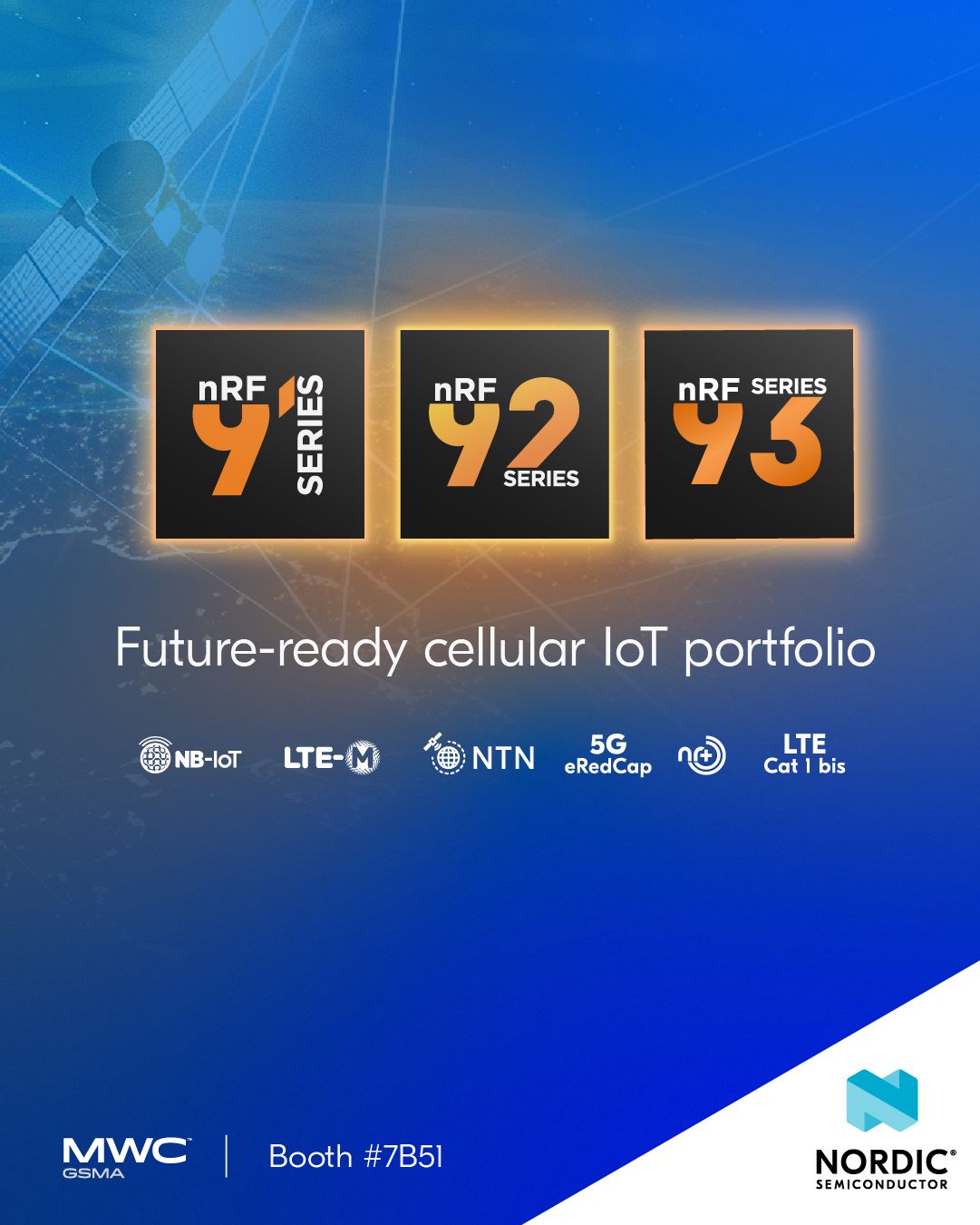
If there’s one thing MWC 2026 has made clear, it’s that the race to make low-power cellular IoT smarter, smaller, and more connected is no longer a slow burn–it’s a sprint. And Nordic Semiconductor showed up in Barcelona with what may be its most consequential product announcement in years: two entirely new chip series, a major refresh of its flagship line, and a unified roadmap designed to carry IoT developers from today’s network realities into a satellite-enabled future.
The Norwegian chipmaker unveiled the nRF92 and nRF93 Series at MWC Barcelona 2026, alongside significant updates to its industry-leading nRF91 Series–a portfolio expansion that CEO Vegard Wollan framed with characteristic directness:
“Nordic is building the next era of cellular IoT, and we are expanding our portfolio to give developers the most trusted, power-efficient, and scalable connectivity platform for billions of devices worldwide. Our goal is to make globally connected products easier to build, deploy, and scale–from chip to cloud.”
nRF92: The smallest, most integrated low-power cellular IoT solution Nordic has ever built
At the top of the new lineup sits the nRF92 Series–Nordic’s most integrated cellular solution to date and the one generating the most attention from developers watching the edge AI space.
The nRF92 packs a high-performance application MCU with ultra-low-power edge AI through Nordic’s Axon NPUs (Neural Processing Units), a multi-constellation GNSS receiver, Wi-Fi locationing, and sensor co-processing–all in what Nordic describes as its smallest and most power-efficient cellular form factor.
Target applications include smart meters, asset trackers, industrial sensors, labels, and wearables, all with the promise ofmulti-year battery life. Lead customer sampling is already underway. General availability is slated for early 2027.
nRF93: Higher throughput, still built for the real world
For use cases that need more bandwidth without sacrificing the low-power cellular IoT fundamentals Nordic is known for, the nRF93 Series steps in. The nRF93M1 module delivers up to 10 Mbps downlink and 5 Mbps uplink with global LTE support and built-in Wi-Fi location capabilities–all while maintaining Nordic’s compact form factor and low-power consumption.
It’s optimised for asset tracking, fleet management systems, gateways, security devices, advanced metering, and consumer devices, and is fully integrated with nRF Cloud–including FOTA updates, observability, remote debugging, and location services. Birkenes put the product case plainly: “The nRF93M1 delivers what customers have been asking for–a high-quality, low-power Cat. 1 bis module that’s smaller, easier to integrate, and built for the cloud from day one.”
Lead customers are already in development with the nRF93M1. General availability starts mid-2026.
nRF91 gets smarter: Satellite NTN and sub-GHz fallback
Nordic isn’t leaving its existing installed base behind either. The nRF9151–the flagship of the nRF91 Series–is being enhanced with 3GPP-compliant GEO and LEO satellite NTN (Non-Terrestrial Network) connectivity, giving devices in logistics, smart agriculture, energy, and remote infrastructure the ability to stay connected even where public networks don’t reach. A sub-GHz fallback feature adds another layer of resilience.
Nordic is also introducing the nRF91M1, a compact Smart Modem module built for customers who want a straightforward, fast route to adding cellular connectivity without the complexity of a full custom design.
A roadmap built for what’s coming
What makes this announcement more than the sum of its product specs is the deliberate architecture of the portfolio itself. Nordic is building a tiered offering that spans LTE-M, NB-IoT, LTE Cat 1 bis, and satellite NTN–a unified stack that gives developers a single ecosystem to design within, regardless of which connectivity tier their application requires.
Oyvind Birkenes, EVP Long-Range at Nordic Semiconductor, underscored the strategic intent: “This expansion marks a defining moment for Nordic’s long-range strategy. A unified, market-leading portfolio spanning across these technologies gives developers clarity, confidence, and a long-term roadmap they can rely on–even as networks and requirements evolve worldwide.”
For IoT developers, that clarity is not a small thing. The fragmentation of connectivity standards has long been one of the sector’s biggest operational headaches–with product teams forced to choose between standards early and live with the consequences across a device’s entire lifecycle.
A portfolio that spans from ultra-low-power NB-IoT all the way to satellite NTN, with a consistent cloud integration layer underneath, meaningfully reduces that risk. From chip to cloud, and now from ground to orbit — Nordic is playing a long game. And at MWC, it just showed its hand.
(Photo by Nordic Semiconductor)
See also: When industrial IoT pays off — and when it doesn’t
Want to learn more about IoT from industry leaders? Check out IoT Tech Expo taking place in Amsterdam, California, and London. The comprehensive event is part of TechEx and co-located with other leading technology events. Click here for more information.
IoT News is powered by TechForge Media. Explore other upcoming enterprise technology events and webinars here.