A second pregnancy alters the brain in distinctive ways that are not simply a repeat of the first, new research shows.
Compared with women having their first child and those who had never given birth, the shifts in brain matter documented by a team from the Netherlands indicate some natural ‘fine-tuning’ that may be occurring in preparation for bringing up a second child.
And it builds on earlier findings from the same researchers, which showed that a first pregnancy can lead to significant changes in the brain’s default mode network, responsible for functions related to self-reflection and social interaction.
“The majority of women become pregnant one or more times in their lives, but only now are researchers beginning to unravel how this affects the female brain,” says neuroscientist Elseline Hoekzema, from the Amsterdam University Medical Center.
“Each pregnancy leaves a unique mark on the female brain.”
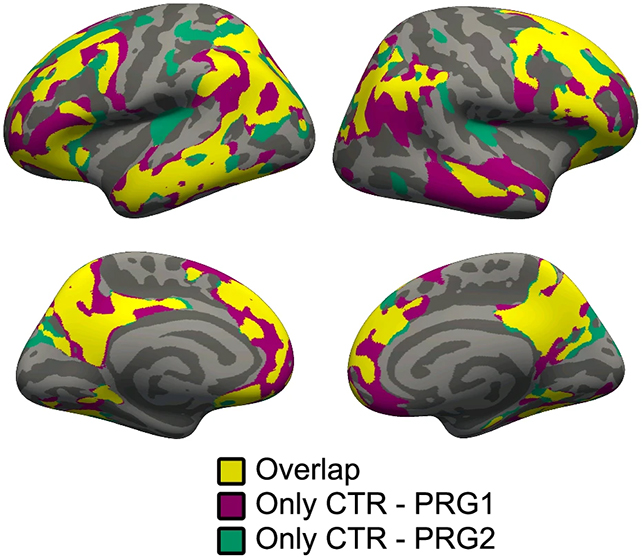
The team analyzed brain scans from 30 women before and after their second pregnancy, comparing them to scans from 40 women before and after their first pregnancy, and scans from 40 women who have never given birth.
While a second pregnancy also led to changes in the default mode network, they weren’t as noticeable as those for a first pregnancy. In women having their second child, the largest shifts were observed in brain regions that respond to visual and auditory stimuli and direct attention.
“A second pregnancy changes a woman’s brain,” the study authors write, “and uniquely impacts its gray matter structure, neural network organization, and white matter tracts.”
The researchers also noticed significant drops in the volume of gray matter in both first and second pregnancies, something they put down to an increase in neuroplasticity – similar to changes during adolescence – rather than neurodegeneration.
Overall, the second pregnancy picture shows a brain repeating some of the adaptations from the first pregnancy, along with additional refinements that may be required to raise two kids rather than just one.
“It seems that during a second pregnancy, the brain changes more significantly in networks involved in responding to sensory stimuli and directing your attention,” says neuroscientist and first author Milou Straathof, from the Amsterdam University Medical Center.
“These processes can be beneficial when caring for multiple children.”

This new study aligns with earlier research from 2024, which found that pregnancy can reduce gray matter volume and improve connectivity between neurons – more signs of the brain fine-tuning itself for new roles and responsibilities.
Though little research has been done on the female brain and how it changes across pregnancy, it seems the shifts are not necessarily consistent from one pregnancy to the next.
It’s important to bear in mind that brain scans weren’t carried out during the pregnancy for ethical reasons, and that the sample size of women was relatively small. Further research will be needed to investigate the details of these brain changes, including how age may affect them.
Even with some limitations, the research breaks new ground in our understanding of pregnancy. Through questionnaires and other checks, the researchers were also able to link these brain adaptations to mother-and-child bonding and peripartum depression (during pregnancy or shortly after the baby is born).
Related: One Diet Choice While Pregnant May Protect Your Child’s Heart For Life
It’s evidence that the brain changes that showed up in the scans may also be linked to mental health, and further down the line, this knowledge could be used to improve support and care given to pregnant women, whether or not they’ve had a baby before.
“This knowledge can help us to better recognize and understand mental health issues in mothers,” says Hoekzema. “We must understand how the brain adapts to motherhood.”
The research has been published in Nature Communications.