By Alyx Arnett
For decades, the clinical lab’s contribution to diabetes care followed a familiar script: A patient showed up with symptoms, a clinician ordered an A1C or fasting glucose test, and the lab returned a number confirming the diagnosis.
That model is starting to shift. The 2026 American Diabetes Association Standards of Care place greater emphasis on earlier identification and more precise classification of diabetes, including the use of islet autoantibody testing in people at elevated risk for type 1 diabetes.1
“Ten years ago, the lab’s role in type 1 diabetes was predominantly to confirm disease,” says Jeanie Chiu, MD, medical director at Beckman Coulter Diagnostics. “Today, the paradigm has shifted toward presymptomatic detection and staging.”
That shift is prompting labs to reconsider how they organize testing, which assays they offer, and how results are reported to clinicians.
A1C Remains Central, but Context Matters More
A1C testing isn’t going anywhere. The 2026 standards reaffirm it as a cornerstone of diabetes screening and monitoring, with continued emphasis on National Glycohemoglobin Standardization Program-certified methods traceable to the Diabetes Control and Complications Trial reference assay.1 But the standards also underscore that A1C has limits and highlight the importance of recognizing when results may be unreliable.
Conditions such as anemia, altered red blood cell turnover, pregnancy, chronic kidney disease, and recent transfusion can all skew A1C results. “A1C is a powerful marker, but it reflects glycation over erythrocyte lifespan,” says Michael O’Bryan, MD, MHA, headquarters director of medical science liaisons for diagnostics at Siemens Healthineers. “When that lifespan changes, interpretation must be adjusted accordingly.”
Chiu points to fructosamine as a practical alternative when A1C reliability is in question. “Fructosamine serves as an alternative for patients whose HbA1c may be unreliable due to conditions where red blood cells have shortened lifespans,” she says. “In these cases, fructosamine provides a two- to three-week snapshot of glycemic control.”
On the analytical side, Chiu says modern A1C assays have made meaningful gains. Older methods required manual sample lysis or complex pretreatment steps, creating bottlenecks and errors in busy labs. Current enzymatic and immunoturbidimetric designs include on-board automated lysis, allowing labs to load the primary tube without additional preparation steps.
“In addition, the industry has made incredible strides in analytical specificity,” she says. “We can now report accurate HbA1c results in the presence of common hemoglobin variants like hemoglobin S, hemoglobin C, or hemoglobin D. This is a huge win for health equity.”
Beyond A1C: The Cardiometabolic Panel Takes Shape
O’Bryan says many labs are moving away from standalone A1C orders toward broader cardiometabolic panels. “The most important shift underway is conceptual,” says O’Bryan. “Diabetes testing is evolving from isolated glucose or A1C measurement toward integrated cardiometabolic risk assessment.”
Labs are increasingly running A1C alongside lipid profiles, renal markers such as creatinine and eGFR, urinary albumin-to-creatinine ratio, insulin, and C-peptide—all from a single sample on a consolidated platform, he says.
O’Bryan describes this as a shift “from volume-driven A1C testing toward integrated cardiometabolic panels and automation strategies.” That shift aligns with how often diabetes occurs alongside conditions such as obesity, cardiovascular disease, chronic kidney disease, and metabolic dysfunction–associated steatotic liver disease, as noted in the 2026 standards.1
Consolidating these assays onto core chemistry or integrated immunoassay/chemistry systems offers several operational advantages. O’Bryan cites workflow consolidation, reduced footprint and maintenance from eliminating standalone analyzers, improved turnaround times, and the ability to support holistic diabetes assessment from screening through complication monitoring.
Chiu says the advantage of consolidation becomes clear in routine sample handling. “Every time a secondary tube is poured off or a sample is moved between ‘islands’ of automation, the risk of labeling errors and specimen degradation increases,” she says. “A single platform also significantly improves turnaround time. If a clinician needs a C-peptide to clarify a diagnosis, running it on the same track as the routine chemistry panel means the result is delivered in minutes or hours, not days.”
C-peptide itself has gained new relevance. Chiu describes “quite a resurgence” in its use, particularly for differentiating type 1 from type 2 diabetes in adults, where clinical presentation can be ambiguous. It also plays a role in assessing residual beta-cell function to guide insulin therapy decisions.
Autoantibody Testing Steps Out of the Research Lab
One area drawing increased attention is islet autoantibody testing, which can identify presymptomatic type 1 diabetes in people at elevated risk. The standards discuss testing for autoantibodies against insulin, GAD, IA-2, and ZnT8 in individuals with a family history of type 1 diabetes or elevated genetic risk, and outline a three-stage model of disease progression that allows clinicians to identify the disease before symptoms appear.1
As awareness grows, Lisa-Jean Clifford, president of Gestalt Diagnostics, says laboratories that have never offered autoantibody panels are beginning to see requests for them.
Chiu adds that early identification reduces the risk of diabetic ketoacidosis, enables patient education, and supports timely use of disease-modifying therapies such as teplizumab.
But early detection isn’t just about timing; it’s also about accuracy. Misclassification remains a challenge, particularly in adults whose symptoms can resemble type 2 diabetes. Clifford says the problem is common. “A significant number of adults who are initially diagnosed with type 2 diabetes are actually type 1,” she says. “And conversely, a large number of adults who are diagnosed with type 1 diabetes are actually not.”
The ADA standards note that up to 40% of adults with new-onset type 1 diabetes may initially be misclassified.1 Autoantibody testing at the point of early diagnosis can correct that. “Using autoantibody testing in early diagnosis not only provides a correct classification but is essential, as identification ability degrades in long-standing disease,” Clifford says.
For labs implementing these panels, Jessica Dunne, MD, type 1 diabetes medical director at Sanofi, points to several considerations. “Clinical cutoffs must be predefined and validated per established guidance prior to clinical deployment, and [quality control] must cover each of the four autoantibodies,” she says. “Labs will need clear protocols for interpreting two independent plate reports, handling invalid plate scenarios, and determining when follow-up confirmatory testing or reflex metabolic testing for staging is clinically appropriate.”
Multiplex Assays and Dried Blood Spots Expand Testing Options
Expanding autoantibody testing will require assays designed to handle higher volumes. Several manufacturers are developing multiplex platforms that can test for multiple autoantibodies from a single specimen.
Madhuri Hegde, PhD, senior vice president and chief scientific officer at Revvity, describes the company’s 4-plex assay, which delivers a combined result for GAD, IA-2, and ZnT8 plus a separate insulin autoantibody result from one specimen. “When a combined positive result is detected, the system supports a clear reflex testing protocol that guides laboratories through confirmatory individual antibody testing,” Hegde says. “This two-tier approach balances efficiency in initial screening with diagnostic precision in confirmation.”
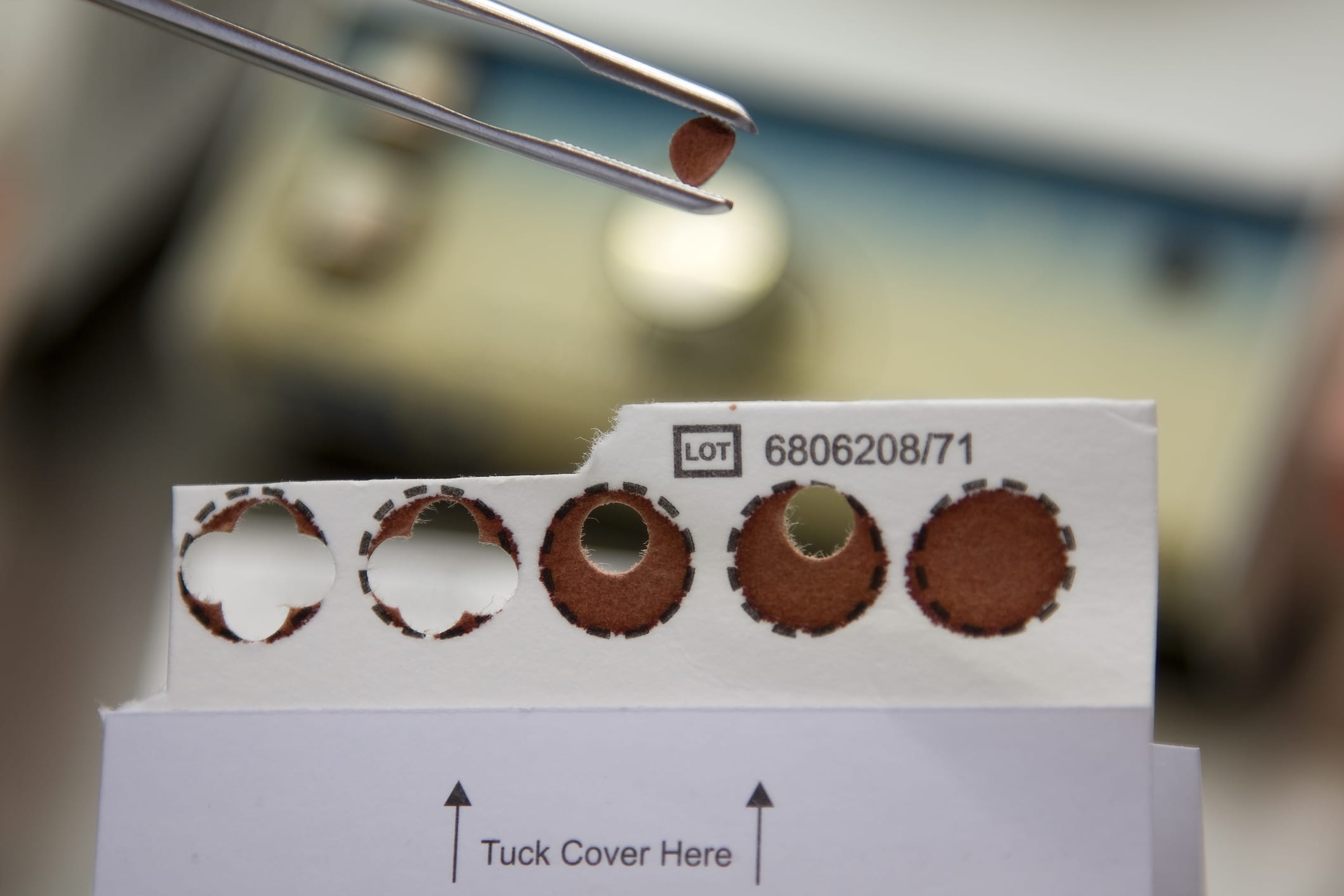
A key feature of Revvity’s approach is specimen flexibility. The assay works with dried blood spot cards—both capillary and venous blood on filter paper—which remain stable at room temperature and eliminate cold chain requirements. “This enables home collection where individuals mail samples to laboratories, extends access to remote areas where refrigerated transport is impractical, and reduces complexity and cost,” Hegde says. For labs already running genetic screening processor platforms for newborn screening, adding type 1 diabetes screening requires no new capital investment, Hegde says.
But scaling these approaches beyond individual labs will also depend on regulatory approval and standardization, says Dunne. “In vitro diagnostics (IVD) status is essential for population-scale screening because it ensures standardized, validated clinical performance and quality products manufactured under GMP across all deploying laboratories,” she says. “IVD clearance also facilitates reimbursement, enables broad deployment across commercial lab networks, and supports the multi-jurisdictional regulatory strategy needed to advance type 1 diabetes screening globally.”
Helping Clinicians Interpret Results
As autoantibody testing expands, laboratories and clinicians may need more help interpreting the results, according to Dunne. She says positive findings need to be placed in the right clinical context, including confirmatory testing, metabolic staging, and referral pathways. She also notes that primary care and pediatric clinicians will need clear guidance on how to act on results.
Clifford says labs should provide more than raw numbers, including “standardized reporting templates that include clear clinical explanations of both the testing that was done and the results.” She adds, “There could be informational or educational terms, definitions, and explanations of the different autoantibody assays that are used and how they differ in the ability to provide early and more accurate diagnosis versus previous testing methods.”
According to Dunne, a positive screen is only the starting point, and labs need clear pathways for what comes next. “We need the convergence of validated IVD-approved assays, clear clinical pathways defining what happens after a positive screen—confirmatory testing, metabolic staging, referral—and reimbursement that supports the full screening-to-intervention continuum,” Dunne says. “Equally important are clinical and national guidelines, as well as provider education so that primary care and pediatrics can act on results.”
Point of Care and Core Lab: Complementary, Not Competing
Diabetes testing is taking place across both point-of-care and core laboratory settings, with diagnostics leaders pointing to distinct roles for each.
Point-of-care A1C testing, when performed on US Food and Drug Administration-approved devices in CLIA-certified settings, allows clinicians to make immediate decisions in outpatient and decentralized settings. O’Bryan describes a tiered approach, with “point-of-care testing in outpatient and non-traditional settings, including pharmacies, to expand access and enable immediate decision-making, complemented by core laboratory integration for high-throughput, comprehensive cardiometabolic evaluation.”
Clifford anticipates that point-of-care diabetes testing “will evolve to include more comprehensive testing, allowing for more consistent monitoring of a patient’s disease state, and provide clinicians with information that they are able to act upon sooner.”
At the same time, laboratory testing remains central to diagnosis and interpretation. Chiu notes that continuous glucose monitoring (CGM), while increasingly common, complements rather than replaces lab testing. “Diagnosis still requires lab-confirmed A1C or glucose. CGM-derived glucose management indicator is supportive but not standalone,” she says. When clinicians see discrepancies between CGM data and lab-based A1C, “the lab is the first place they turn for an explanation,” she says.
What Comes Next
The near-term outlook for clinical labs in diabetes testing points to rising volumes, expanding test menus, and pressure to do more with limited staff. Chiu predicts that the most immediate change laboratorians will notice is “a rapid rise in test orders for islet autoantibody panels for T1D risk screening due to the updated 2026 ADA standards of care.”
Hegde says the impact will extend beyond test volume into day-to-day operations. “Clinical laboratorians will first notice rising volumes of islet autoantibody testing, increasingly ordered by primary care and pediatrics, confirmatory testing, and longitudinal monitoring workflows tied to early-stage disease identification and treatment eligibility.”
Those changes are already creating new demands on laboratory infrastructure and workflows. Clifford says one of the biggest gaps is not just testing capacity, but also awareness and access.
“The gaps are more in clinician access to current information regarding the testing that is available and to determine who and when to order it for,” Clifford says. “Not all laboratories may have the assays available on their test menus, and clinicians may have to find labs that do offer autoantibody testing that are outside their existing network.”
O’Bryan says the shift is ultimately about identifying patients earlier. “A substantial proportion of individuals with diabetes remain undiagnosed, underscoring the need for earlier identification strategies,” he says.
ID 16974398 © Kireevdmitry | Dreamstime.com
Reference
- American Diabetes Association Professional Practice Committee for Diabetes. Diagnosis and classification of diabetes: Standards of Care in Diabetes—2026. Diabetes Care. 2026;49(Suppl 1):S27-S49.
Alyx Arnett is chief editor of CLP. Question or comments? Email [email protected].