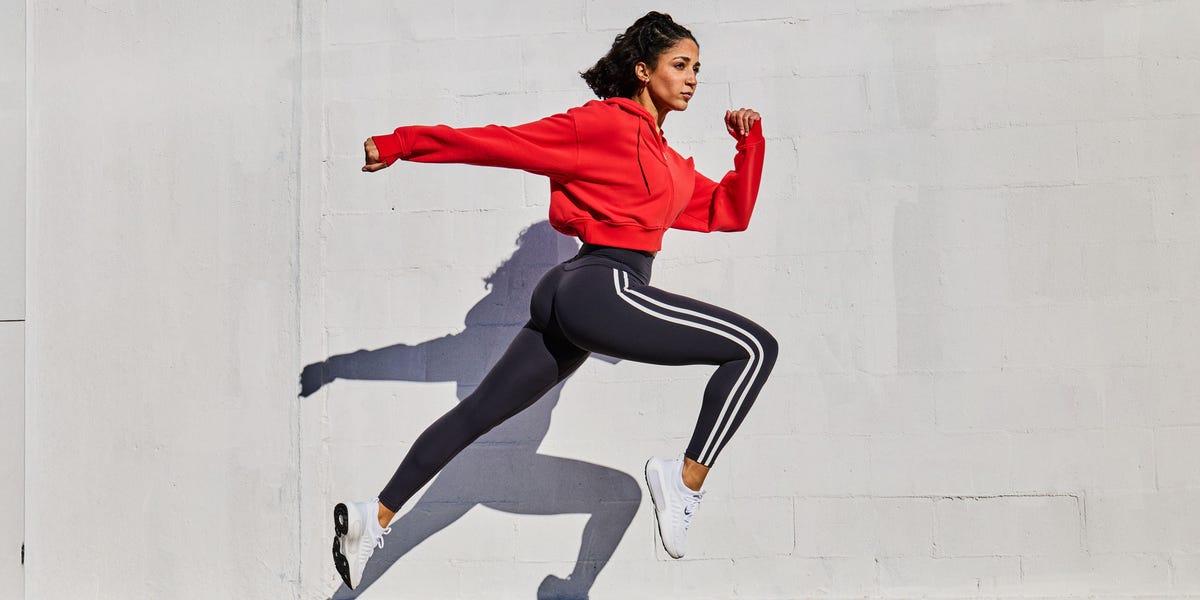
Having a good memory can help you do everything from crush it at work to remember the name of someone you ran into at a party. But it’s frustrating when it feels like your memory isn’t up to par. Now, new research suggests there may be a simple solution: Squeeze in a quick workout.
The study, published in the journal Brain Communications, found that as little as 20 minutes of cardio could spark brain activity linked to learning and memory. Even better: The effects were observed after a single workout.
Here’s what’s behind this cool phenomenon.
Meet the experts: Juan F Ramirez-Villegas, PhD, study co-author and research scientist at Universidad Miguel Hernandez; Amalia Peterson, MD, behavioral neurologist and assistant professor of neurology at Vanderbilt University Medical Center; and Davide Cappon, PhD, director of neuropsychology at Tufts Medical Center.
What did the study find?
For the study, researchers worked with 14 patients who were being monitored for drug-resistant epilepsy. (Epilepsy is a neurological disorder that causes seizures.) The participants had electrodes temporarily implanted for pre-surgical care, which allowed the researchers to record their brain activity.
First, researchers took a baseline measurement while the participants rested. Then, they had participants do 20 minutes of moderate-intensity cycling on a stationary bike. Post-workout, the team recorded the participants’ brain activity again to see how the cardio impacted brain rhythms linked to memory.
After the cycling session, the electrodes showed an uptick in brain ripple activity among participants. “Brain ‘ripples’ are very brief bursts of highly synchronized activity in the hippocampus, a key region for memory,” explains Juan F Ramirez-Villegas, PhD, study co-author and research scientist at Universidad Miguel Hernandez. “They are thought to help the brain organize and stabilize information after an experience.” Brain ripples are “moments when the brain is actively processing and reinforcing memories,” Ramirez-Villegas adds.
The researchers also discovered that there was a link between higher heart rates and larger increases in ripple activity, suggesting that higher-intensity workouts may be associated with stronger brain ripple activity.
Why might cardio trigger brain ripples?
According to experts, there are a few theories. “Exercise has been shown to increase the connection between different parts of the brain,” says Amalia Peterson, MD, behavioral neurologist and assistant professor of neurology at Vanderbilt University Medical Center. “Ripples may be one mechanism by which this occurs.”
Brain ripples are thought to play a role in how the brain “replays” and stores information, explains Davide Cappon, PhD, director of neuropsychology at Tufts Medical Center. “When we see more of these ripples, it usually reflects more efficient learning and memory processing,” he says. “We see similar ripple activity during deep sleep, which is when the brain consolidates memories overnight, and also when actively learning something new or doing mentally-engaging tasks.”
Part of the link between a higher heart rate and stronger ripples could be that more of the body is activated during this time, Cappon says, adding that some of that may be due to energy. “Exercise improves how the brain uses glucose, its main fuel.”
Other ways to trigger brain ripples
The study only looked at the impact of moderate-intensity cycling, making it tough to know for sure if the effect is the same with other forms of exercise. That said, Ramirez-Villegas says it’s likely that other kinds of aerobic activity that ramp up your heart rate (like running, brisk walking, or swimming) could have a similar impact.
What’s the takeaway here?
There are a few things to keep in mind. One is that exercise appears to be good for the brain and memory. You might also find it beneficial to schedule a workout before an important meeting or event where you need your memory to be especially sharp.
“Our findings suggest that exercise may ‘prime’ the brain by enhancing memory-related activity shortly afterward,” Ramirez-Villegas says. “This raises the possibility that exercising before learning could be beneficial, but this will need to be tested in future studies.”

Korin Miller is a freelance writer specializing in general wellness, sexual health and relationships, and lifestyle trends, with work appearing in Men’s Health, Women’s Health, Self, Glamour, and more. She has a master’s degree from American University, lives by the beach, and hopes to own a teacup pig and taco truck one day.
Carina Hsieh, MPH, is the deputy features editor of Women’s Health. She has more than a decade’s worth of experience working in media and has covered everything from beauty, fashion, travel, lifestyle, pets, to health.
She began her career as an intern in the fashion closet at Cosmopolitan where she worked her way up to Senior Sex & Relationships Editor. While covering women’s health there, she discovered her passion for health service journalism and took a break to get her Masters in Public Health. Post-grad school, she worked as a freelance writer and as The Daily Beast’s first Beauty, Health, and Wellness Reporter.
Carina is an alum of the Fashion Institute of Technology and the Yale School of Public Health. She and her French Bulldog, Bao Bao, split their time between Brooklyn and Connecticut. She enjoys reformer Pilates, (slow) running, and smelling the fancy toiletries in boutique fitness class locker rooms.