BOTTOM LINE
Safe but Worthy Sequel
PLATFORM
NETFLIX
ADVERTISEMENT
RUNTIME
2 hours 16 minutes
What Is the Film About?
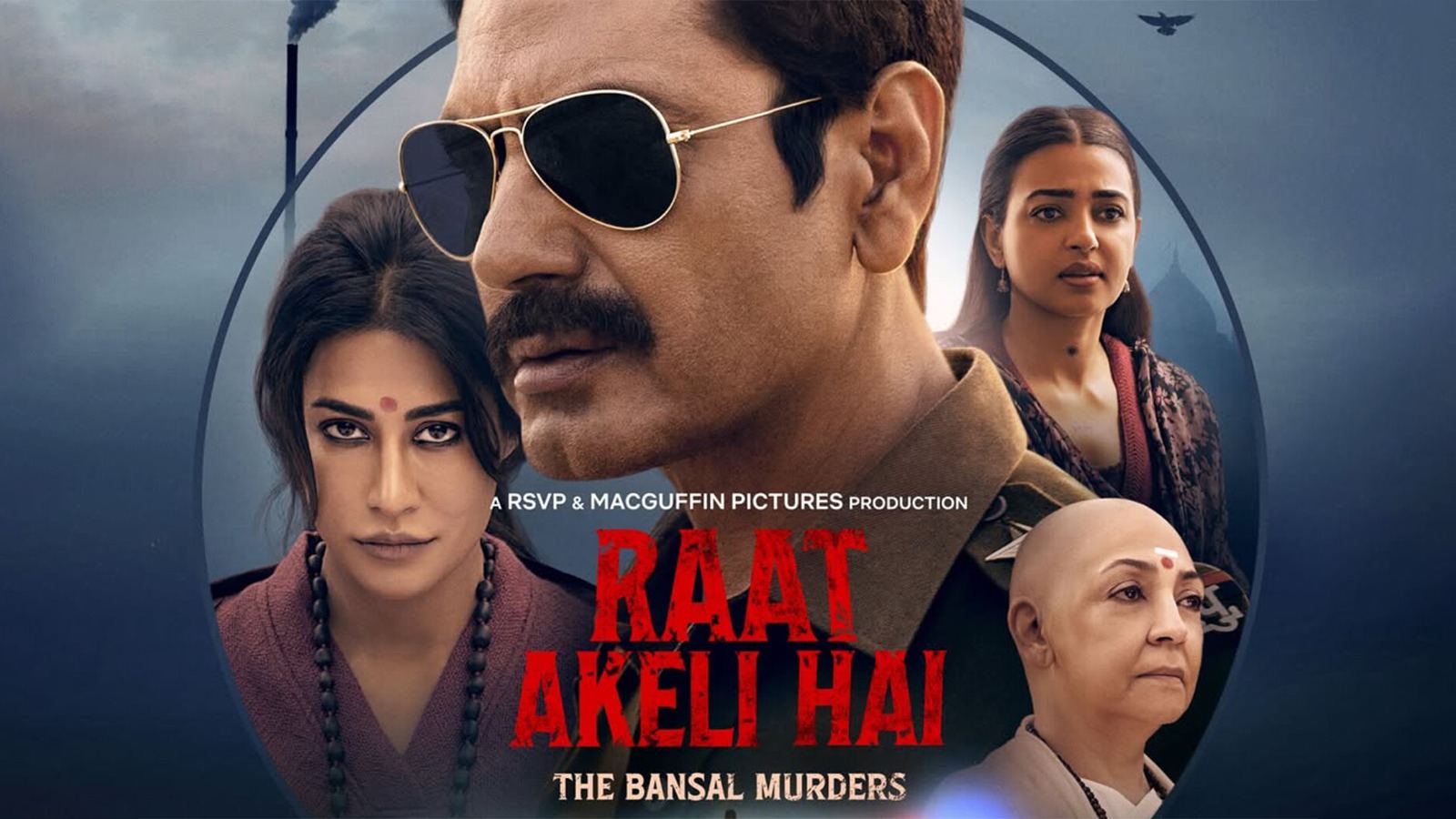
Inspector Jatil Yadav returns to investigate a gruesome mass homicide within the elite Bansal family, owners of a powerful media empire. When most family members are killed overnight, suspicion falls on an estranged, drug-addicted son. However, the cop uncovers a plethora of political conspiracies, blind faith involving a mysterious godwoman, and deep-seated corporate greed.
Performances
Nawazuddin Siddiqui sleepwalks through the role with ease. As much as it is a good character, such portrayals come effortlessly to the actor and his potential is not tested. Chitrangada Singh, playing an entitled woman struggling to digest the suddenness of events around her, maintains the mystery around Meera well.
Analysis
Raat Akeli Hai told a story of a dysfunctional family that leaves you queasy. At the same time, you cannot help but admire its cinematic brilliance, both with the layered writing and how much of its nuance is preserved on the screen. Though it is another investigation drama on paper, it is embedded with an unusual romance and social commentary addressing the toxicity of patriarchy.
When a streaming platform moots a sequel to such a film, you naturally approach it with apprehension, for it is a viewing experience quite hard to recreate. Yet, director Honey Trehan and writer Smita Singh give a good shot at it and, remarkably, come out unwounded. In a nutshell, Raat Akeli Hai: The Bansal Murders, the second instalment in the franchise, works for the major part.
The blueprint of the first film is retained here. There is a high-profile family that guards its secrets close to its chest. When a series of murders rock the household, the fingers are pointed towards the most convenient suspect, a drug addict who himself is no more. The world treats it as an open-and-shut case, but Jatil is adamant that there is more to it than meets the eye.
Given the story is positioned in an elite household, the scale of the film appears enhanced to an extent, yet the strengths of the original in terms of storytelling are notably not tampered with. The atmospherics, the leisurely, unhurried treatment, and the narration with a social conscience, peppered with occasional wit, everything comes together seamlessly in the sequel too. Same same, but different.
The opening sequence, with the death of the crows in the compound, eerily signifies the doom ahead in the house. A child has died mysteriously some time ago. There is tension within the power hierarchy of the Bansal empire. A young man in the house has violent episodes after taking to drugs. All men in the house are suddenly murdered in one stroke, only leaving Meera unscathed.
The presence of a godwoman in the family and her cryptic talk contributes to the tension in the setting. The obligations of the genre are met with as a forensics team takes stock of the crime scene meticulously. There is pressure to handle the case with sensitivity and Jatil Yadav’s superiors are unhappy with his curt ways. How does he find his way out of this maze?
The little nothings in the film also make an impression, like the bitter-sweet dynamic between Dr Panicker and Jatil. Both are sincere to their jobs and yet have their mood swings while tolerating one another. Jatil is yet to marry Radha (from the first part), who takes to academics. Although the godwoman is creepy on one level, she reveals strangely discomforting truths about Jatil during their talk.
The film, surprisingly, inherits some problems of the original too. You get a little impatient in the middle segments where too many details, theories, and names are thrown in, but some of them go above your head. The slow-burn treatment and the silences start getting on your nerves for a brief phase. The heart of the story, also like the first part, is left for the climax and it lingers in your mind.
Despite all the plot machinations, the heartburn of the culprit towards the end feels truly justified and the revelation comes from a place of honesty, addressing the discrimination and classism that gave fodder to his rage. Yet, if one were to pick between the first and the second instalments, you tend to gravitate towards the former, for it is more organic, tense, and enriching than the other.
Raat Akeli Hai: The Bansal Murders is a fine sequel. It stays loyal to the design of the original and also manages to carve its own identity, which is the hallmark of a well-told story that happens to be an extension of the first.
Performances by Others Actors
Deepti Naval’s character starts well, but is under-written overall. Revathi is a breath of fresh air as Dr Panicker, a forensics expert who means business. Rajat Kapoor is impressive, while Sanjay Kapoor adds little value to the proceedings. Radhika Apte, in what feels like a cameo, is a picture of elegance and Ila Arun’s presence, though brief, brings warmth to the tense backdrop.
Music and Other Departments?
Composer Karan Kulkarni, complemented ably by the sound design, comes up with a score that richly builds the eeriness and tension in the ambience, using the varied characters to his advantage. The production design and costumes make their presence felt in the viewing experience too, and the various tonal shifts in the visuals are handled well by the cinematographer Pankaj Kumar.
Highlights?
Refined storytelling – writing and execution
Sharp performances
Retains the strengths of the original
Drawbacks?
Minimal scope for surprises
Uneven pacing in the middle segments
Too many characters, loses focus at times
Did I Enjoy It?
Generally yes
Will You Recommend It?
Yes, likely to work better if you watch the first part and crave for something similar
M9 Reviews vs Box Office: Simple Q & A Guide
Raat Akeli Hai – The Bansal Murders Review by M9
ADVERTISEMENT