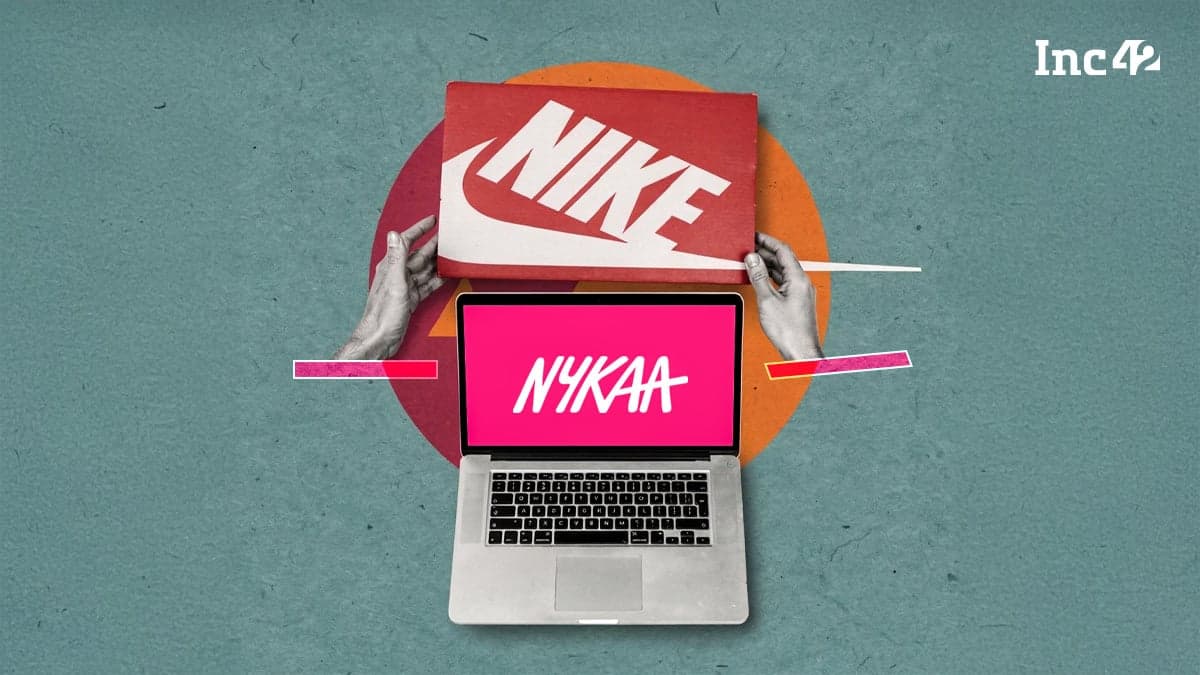
Nike will transfer operations of Nike.in to Nykaa from February 2026, aiming to improve local execution, delivery speed, and customer experience
This comes as Nike faced persistent delivery delays, checkout issues, limited local warehousing, and regulatory hurdles in India, which hampered its D2C strategy and customer satisfaction
The partnership strengthens Nykaa’s fashion vertical, increases platform traffic, and adds a global sports brand to its portfolio, boosting order values and repeat purchases
Global sports giant Nike is set to hand over the operations of its India ecommerce business (Nike.in) to beauty marketplace Nykaa from February 2026.
In a notice to customers, Nike said the move is part of a broader update to its India strategy. Ahead of the transition, Nike.com, which redirects to Nike.in, and the Nike App will be relaunched under the new setup from January 30, 2026.
Once Nykaa takes charge, Nike said customers will get free shipping on all orders, free exchanges on the same product, and faster deliveries, ranging from two days for metro cities to up to four days for other parts of India.
The platform will continue to sell sportswear, sneakers and curated apparel collections. However, several existing features will be discontinued.
Nike Member logins on Nike.com and the Nike App will stop working, though logins for the Nike Run Club and Nike Training Club apps will remain unchanged. Customised products under ‘Nike By You’ and the SNKRS web platform will also no longer be available in India.
Nike also said it is updating its terms of use, terms of sale and privacy policy as part of the transition. Details of the updated terms will be shared on its website closer to the relaunch.
Nykaa, which already runs multiple global fashion and beauty brands in India, will now act as Nike’s local service partner for ecommerce operations in the country. However, Nike will still operate its physical stores.
Nike’s India reset mirrors a broader shift in its global strategy, as the company rethinks its earlier push to go all in on D2C sales. In the US, Nike last year returned to selling directly on Amazon for the first time since 2019, after ending the partnership over concerns around counterfeits and unauthorised sellers.
Globally, the shift comes as Nike works to revive slowing sales after its D2C-led strategy lost momentum after the pandemic. The company has been rebuilding ties with large marketplaces and retailers it previously stepped away from, including Amazon, Dick’s Sporting Goods and Foot Locker.
Per industry watchers the Nykaa move is also a part of a wider correction, where global brands are leaning back on established platforms with strong logistics and local execution to reach customers more efficiently.
Nike’s India Woes
Nike’s move to hand over ecommerce operations to Nykaa also comes after mounting complaints from users in India around online ordering and SNKRS drops.
Notably, SNKRS is Nike’s official app and website for releasing and selling limited-edition, high-demand sneakers, including Jordan Brand and select Converse drops.
It uses a drop-based model, comprising Draws, Shock Drops (surprise releases), and SNKRS Pass (in-store reservations), instead of standard ecommerce inventory. The platform also features product storytelling, design and heritage content, and live events, and is built to reduce bot activity and manage demand for scarce releases.
Over the past few years, Indian customers have flagged repeated delivery delays, failed orders and poor customer support on Nike’s website and app. Several users said orders were accepted but never delivered, with refunds taking weeks despite multiple followups with Nike and logistics partners.
This was largely due to Nike not having its own warehouses in India. Instead, it shipped products directly from Singapore, which acted as its key distribution hub for Southeast Asia, including India. Relying on a single regional hub caused delays in online deliveries.
Pertinent to note that following a major restructuring around 2016 and 2019, Nike had massively scaled back its direct operations in India, closing roughly 35% of its stores at the time to focus on a leaner, more digital-first, or franchise-based approach.
“Users were clearly frustrated, as deliveries often took multiple weeks. At a time when customers are used to getting products within minutes, or at most a few hours, such long delivery timelines were a major pain point,” said Mudit Arora, founder and CEO of sneaker reselling platform Sneakwear.
In other issues, users also reported persistent checkout issues, where the ‘place order’ button remained inactive across payment methods on both the app and website. In some cases, users said the issue continued for days, effectively blocking purchases.
In the past, Nike SNKRS users in India also raised concerns about mechanics behind drop releases and communication for them. During high-demand launches, users said they received no confirmation on whether their bid was selected or rejected, even after the drop ended. Complaints around app crashes, silent failures and missing notifications were common across sneaker communities.
“Nike has clearly struggled to execute in India. From supply issues to weak local operations, the brand has been unable to manage the market at a granular level. In contrast, Adidas has done far better, especially in sneakers and collaborations, and has recently strengthened its India presence by acquiring the Indian jersey rights,” said Ackshay Jain, cofounder and CEO of Culture Circle.
He said the top sneaker brands in India are Adidas, On Running and New Balance.
“Nike is nowhere close to that league. Bringing in Nykaa signals that Nike knows its India strategy hasn’t worked and is now trying to fix execution gaps through a local partner,” Jain claimed.
Alongside technical issues, Nike’s India operations were hit by supply-side disruptions in 2025 following tighter enforcement of quality control rules by the Bureau of Indian Standards (BIS).
The regulator conducted raids at ecommerce warehouses and seized imported footwear that lacked mandatory certification. This led to inventory shortages and delays, particularly for premium and limited-edition products.
Per industry watchers, the combination of regulatory pressure, platform instability and operational bottlenecks strained Nike’s D2C model in India.
The decision to bring in Nykaa as a local ecommerce partner suggests a shift towards tighter on-ground execution, faster fulfilment and fewer compliance risks.
Inc42 has reached out to Nykaa to understand more on the development, the story will be updated based on the responses.
Nykaa Stands To Benefit
Nykaa, meanwhile, stands to benefit from the partnership at a time when its fashion business trails its core beauty vertical. The partnership could also help Nykaa improve inventory churn and platform traffic, while giving Nike access to Nykaa’s logistics, customer base and local execution capabilities.
In Q3 FY26, Nykaa was expecting its fashion vertical to post net sales value (NSV) growth in the mid-twenties, driven by new brand additions, customer acquisition and stronger performance of its core platform.
However, net revenue growth for the segment is likely to remain in the late teens, as the company continues to optimise its owned fashion brands and sees lower content and marketing income.
For Nykaa, the deal fits into its broader strategy of deepening its fashion play, even as beauty continues to drive the bulk of growth and profitability. For context, Nykaa’s fashion business reported NSV growth of nearly 27% in Q2 FY26, with a GMV contribution of INR 1,180 Cr. Revenue from the segment stood at INR 201 Cr, up 21% year-on-year.
While the scale remains much smaller than its beauty business, fashion has emerged as a key long-term growth lever for the company. In this context, the deal to operate Nike’s online store might be a major boost to Nykaa’s fashion business
Nike’s footwear and apparel are expected to boost average order values, improve repeat purchases given the strong loyalty for the brand and strengthen Nykaa’s presence in sportswear and athleisure categories where it has been expanding but lacks a large global anchor brand.
Edited by Nikhil Subramaniam