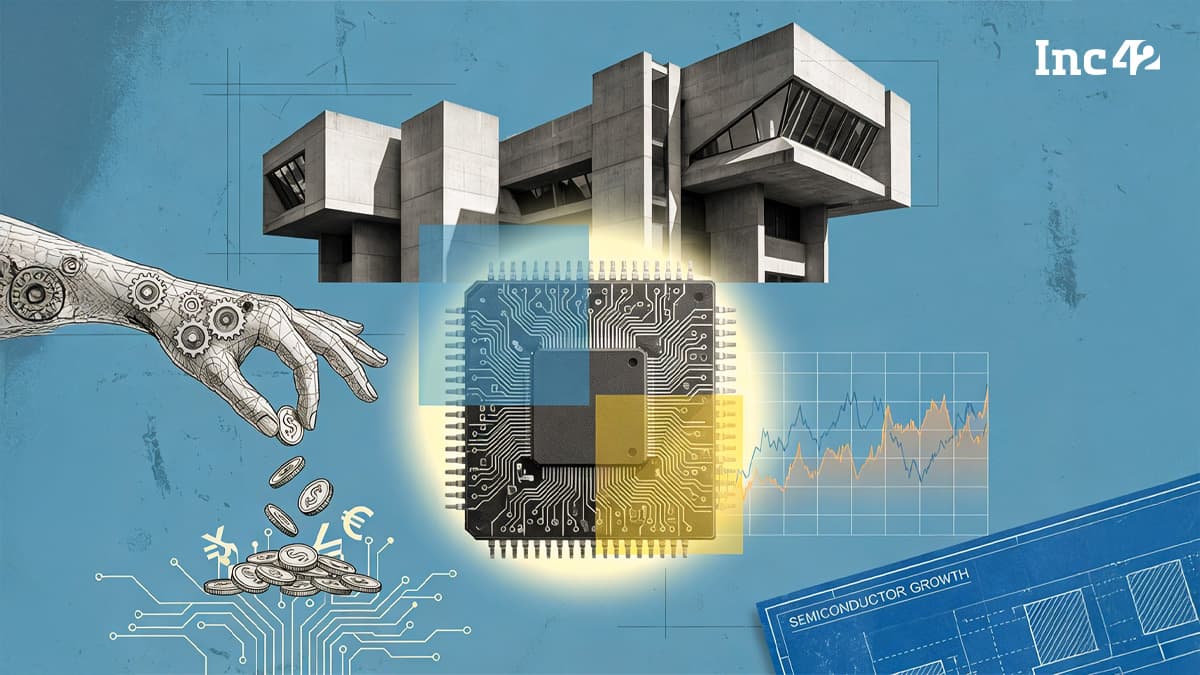
Despite major government incentives and project approvals under the India Semiconductor Mission, venture capital funding in semiconductor startups remains modest due to long execution timelines and the early stage of commercial activity
Semiconductor manufacturing is capital-heavy and better suited to large companies, while startups face a shortage of senior founding talent as experienced engineers prefer stable, high-paying roles at global chipmakers
Investor interest is growing in less capital-intensive areas like chip design and specialised semiconductors, with funding expected to pick up over the next few years as startups hit key milestones and the broader ecosystem matures
On this day a decade ago, Prime Minister Narendra Modi launched the Startup India initiative to nurture innovation, promote entrepreneurship, and enable investment-driven growth in the country. The day, January 16, later came to be recognised as the National Startup Day. In 2026, we are marking the fifth National Startup Day, with a big focus on homegrown AI and semiconductors.
In the last 10 years, the country has grown to over 2 Lakh DPIIT-recognised startups. New sectors have risen to prominence, capital has cycled through multiple waves, and policy priorities have shifted. This shift is also evident in the growing focus on semiconductors, a sector that has long been considered challenging for India to develop.
However, in the four years since the launch of the India Semiconductor Mission (ISM) in 2021, the government has taken steps to advance India’s semiconductor ambitions through policy incentives and project approvals.
The government announced an INR 76,000 Cr incentive package, largely under the Production Linked Incentive (PLI) framework, of which nearly INR 65,000 Cr has already been committed.
The Centre also cleared four new semiconductor projects over the past year alone, involving investments of INR 4,584 Cr, underscoring its intent to anchor chip manufacturing and allied capabilities within India.
This policy push is beginning to find echoes in the startup ecosystem. Indian semiconductor startups note a gradual uptick in investor interest, particularly in chip design, testing, and specialised components.
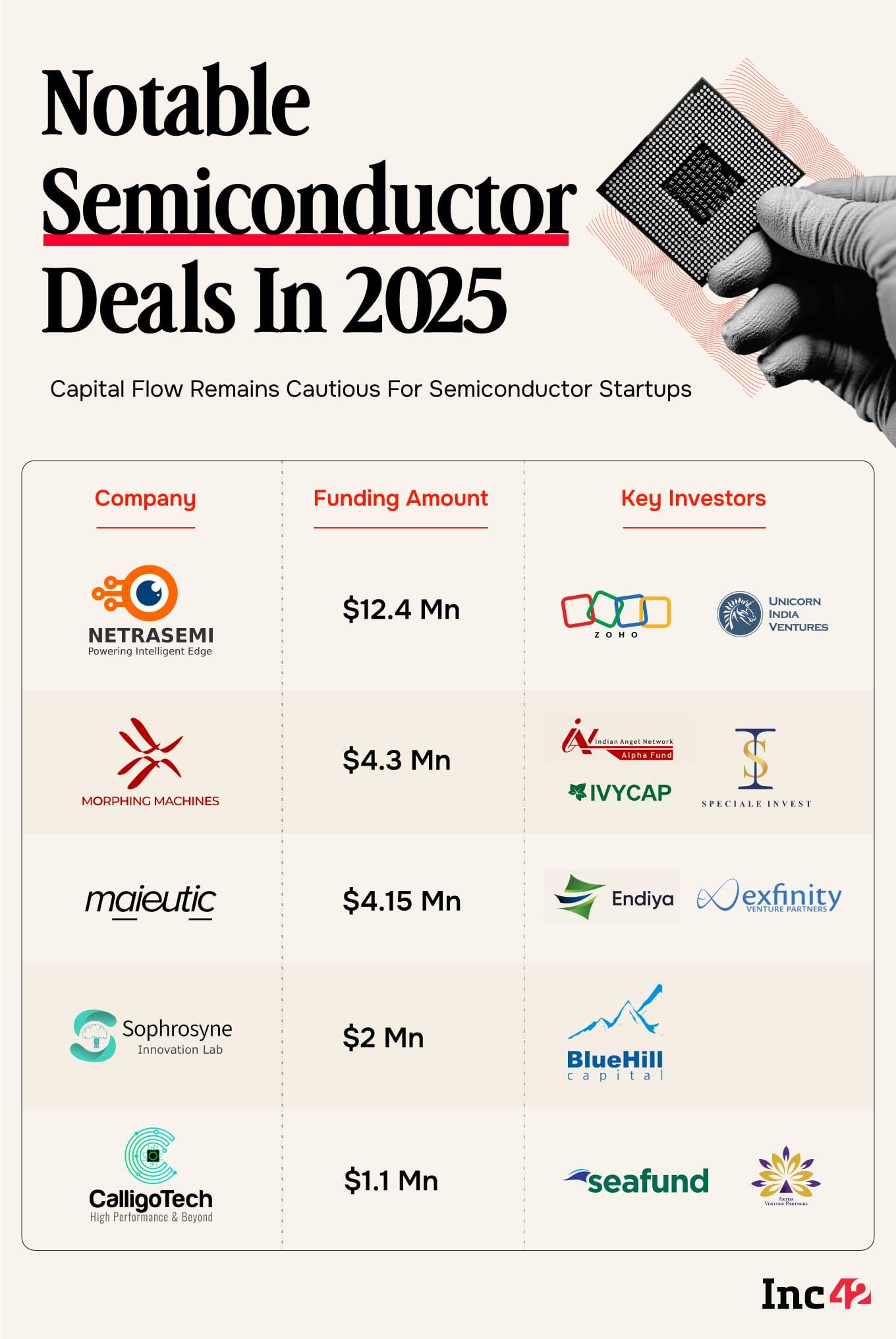
In 2025, semiconductor startups raised roughly $50 Mn, according to Inc42’s annual funding report. In 2024, this amount was $28 Mn+ and a mere $5 Mn+ in 2023.
Yet, despite the growth, funding levels remain low when stacked against other segments. This raises the question: why has VC funding remained limited despite strong government backing and rising global demand for chips?
Policy Momentum Behind Semiconductors; Where’s The Capital
Industry stakeholders point to the time lag between policy announcements and their commercial execution. Much of India’s semiconductor framework is still in its early implementation phase, with approvals, land allocation, infrastructure build-out, and supply-chain alignment underway. By contrast, venture capital usually comes in after there are clear signs of progress — working products, early customers, or strong intellectual property.
“Policy has to translate into activity, and that activity has to mature before funding meaningfully scales,” a semiconductor startup founder said. As a result, most investments so far have been early stage, with relatively small cheque sizes, which shows that VCs are still taking up exploratory bets rather than conviction capital.
A second constraint is the way the semiconductor sector itself is structured.
Much of the current policy push, especially around manufacturing, advanced packaging and fabrication, is geared toward large, established companies rather than startups, Ashwin Raguraman, the founder of Bharat Innovation Fund, said.
These are capital-heavy projects that take years to mature. They naturally attract private equity, strategic investors, or public market capital — not early stage venture funds. In short, semiconductor manufacturing is a large-company game. Big, listed electronics players are leading the charge, using balance sheets and execution capabilities that young startups do not have.
According to industry analysts, many of these incentives are aimed at later stages of the semiconductor value chain, meaning the impact on VC-backed startups will take time to show up.
However, capital intensity alone is no longer the primary deterrent it once was. Newer semiconductor sub-segments such as AI accelerators, RISC-V-based designs, edge computing chips, and specialised ASICs require significantly less capital than traditional fabs. In theory, these areas align more closely with venture economics.
A shortage of talent is another reason deal activity remains limited, according to Ravi Jian, the investment director at deeptech fund TDK Ventures.
India has a deep pool of semiconductor engineers employed by global firms such as Intel, AMD, Nvidia, and Qualcomm. However, persuading senior engineers to leave these roles is increasingly difficult. Compensation at large chipmakers has risen sharply over the past few years, driven by strong stock performance and demand for specialised skills.
“Restricted stock units at global semiconductor firms have appreciated significantly. Leaving that certainty to start a company requires an unusually strong entrepreneurial impulse. The result is a thin pipeline of high-quality founding teams, particularly those capable of building globally competitive semiconductor IP,” Jain added.
According to deeptech VCs, there may be 10 to 15 semiconductor startups operating in India at any given time, but only a small subset meets the bar for institutional venture backing. With fewer contenders, aggregate funding naturally remains subdued.
Funding till now has flowed in two broad buckets.
The first bucket includes startups addressing India-specific use cases, often shaped by government demand or regulatory mandates such as surveillance, defence electronics, or localisation-driven manufacturing needs. These companies benefit from policy tailwinds but operate in relatively narrow markets.
The second bucket comprises startups attempting to build globally relevant semiconductor IP, targeting international customers from day one. These ventures often face longer validation cycles but offer larger upside if successful. However, most remain early stage, raising seed or Series A rounds that keep overall funding figures modest.
2026 & Beyond: What’s In Store?
Most investors expect semiconductor funding to rise over the next two to three years, though few are willing to predict a precise inflexion point. Several startups backed in recent years are approaching critical milestones such as tape-outs, pilot deployments, and early customer wins that could unlock larger rounds.
“Once a chip has taped out, sampled, and entered real-world deployment, the risk profile changes materially,” Raghunathan said. Large commercial orders, especially from Indian electronics manufacturers, could validate the business case for domestic chip design and catalyse follow-on funding.
Another factor is ecosystem formation. As large semiconductor and electronics manufacturing projects come online, they are expected to create downstream demand for smaller, specialised companies, ranging from design services and testing solutions to IP blocks and software tooling. This clustering effect could gradually expand the venture opportunity.
Investors also expect funding to arrive unevenly. Early capital is likely to favour adjacent layers of the stack, electronics manufacturing services, design automation tools, and application-specific chips, before flowing into deeper core IP plays, Raghuraman said. Large Series B and C rounds, potentially running into tens or even hundreds of millions of dollars, may be concentrated in just a handful of companies.
“There may not be many deals, but even one or two large rounds can significantly move the needle for sector-wide funding,” he added.
For now, India’s semiconductor ambition remains policy-led, with venture capital in an observational phase. As India’s startup ecosystem enters a new decade this National Startup Day, semiconductors represent both its most complex challenge and its most strategic advantage.
[Edited by Shishir Parasher]