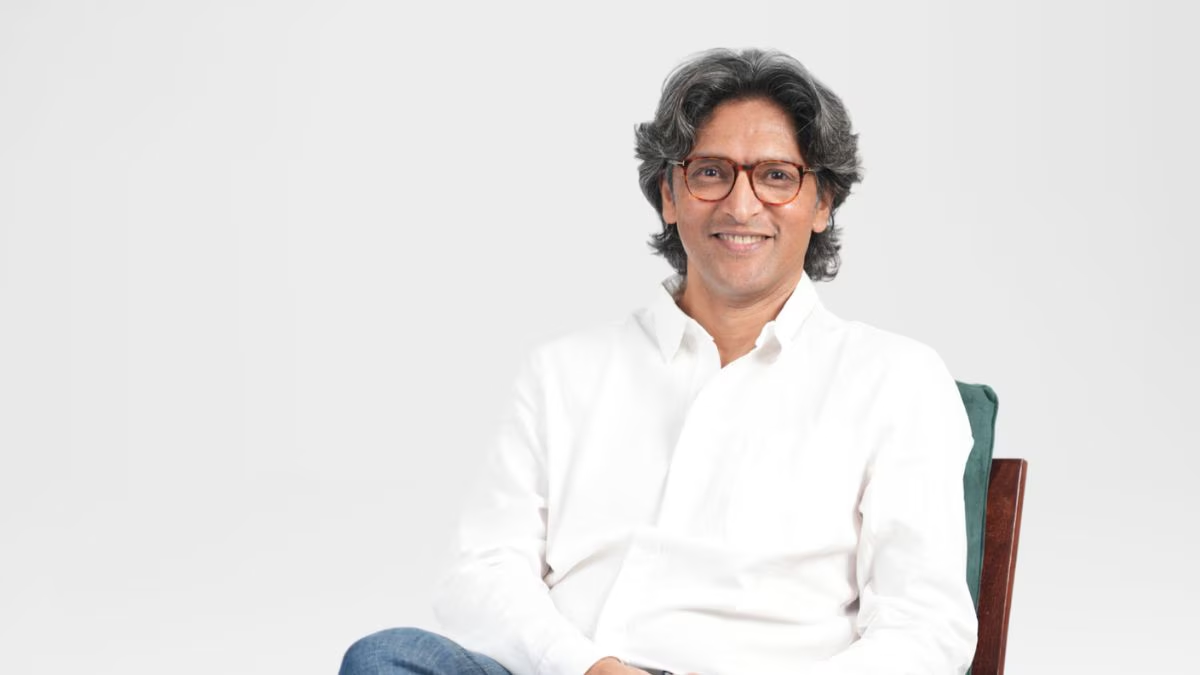
As venture capital activity in India stabilises after the sharp correction of 2021-22, caution is still shaping investor behaviour, says Rahul Chandra, managing director at Arkam Ventures, which has backed startups like KreditBee, smallcase, and Jumbotail. In an interaction with Ayanti Bera, Chandra talks about how investors today are far more conscious of pricing risk, given the lack of visibility on follow-on funding, how global macro disruptions are reflecting in delayed IPO timelines, and how India is emerging as a relatively resilient market amidst all this. Excerpts:
What are the key sectors Arkam Ventures is currently focusing on?
We are broadly focused on three sectors. First is fintech, where we are looking at the underlying building blocks that will enable the next phase of scale, second is AI, across both B2C and B2B use cases, and the third is manufacturing-led deeptech, where we focus on IP-driven opportunities, including areas like space tech and advanced manufacturing.
You recently participated in a $12 million seed round for Optimist. Why such a big check at an early stage?
While it is categorised as a seed round, the company itself is much more advanced. The product is already developed and ready to be launched, and the business involves building a nationwide manufacturing and distribution network in a large category like home appliances. It is also led by a second-time founder with a strong execution track record. So while it appears large for a seed round, the level of uncertainty is much lower than what one would typically associate with early-stage investing.
Overall, what’s your outlook on valuations in the current environment?
The correction that began in 2021-22 is still very much in place. There is now a heightened awareness across the venture ecosystem about not overpaying, largely because of uncertainty around follow-on capital, especially at later stages. Unlike earlier cycles where funding was more predictable, there is now greater caution about when the next round will happen and at what valuation. This has kept valuations broadly disciplined across stages.
How are global macro events impacting venture investing?
In the context of venture investing, these are generally seen as short-term disruptions, given the long-term nature of the asset class. However, there are some immediate effects. Public markets are less conducive to IPOs at the moment, which could delay listings by about a year. At the same time, shifts in global capital flows and geopolitical developments can influence where money is deployed. Interestingly, India stands to benefit in such scenarios, as it is perceived as a relatively stable and resilient market, which could attract more capital over time.
What is Arkam’s approach to exits?
Our strategy is clearly oriented towards backing companies that can eventually go public. We typically invest at the Series A stage, when companies are about two to three years old, and we expect them to be IPO-ready within six to seven years.
Within fintech, what specific opportunities are you excited about?
Consumer fintech adoption in India has already reached significant scale, largely driven by UPI. But, this growth has also created considerable pressure on the banking systems. So, now we are looking closely at infrastructure that can help banks manage this scale more efficiently, whether by distributing system load or reducing reliance on the core banking systems.
You’ve invested in lending firms such as KreditBee and Jai Kisan. But the sector is getting increasingly over-crowded. Is lending still an attractive space for you?
Yes because credit still remains under-penetrated in India. The issue is not a lack of demand but rather concentration risk, where certain segments or geographies receive excessive credit while others remain underserved. Going forward, we expect innovation in more structured and secured forms of credit, which can address this imbalance.
What emerging sectors do you think deserve more attention?
One area that deserves far more attention is digital gold. It has grown into a large and rapidly expanding asset class, with 25-30 million users participating. It enables people to build a savings habit through very small, regular contributions. Despite its scale, the sector lacks regulatory clarity because it does not fit neatly into existing categories like securities or deposits. (The firm has investments in digital gold savings app Jar)
What are some interesting trends you’re seeing in AI right now?
Voice AI is a particularly exciting area in India because of the country’s large base of voice-driven workflows, such as call centres and tele-sales. Consumer AI is also beginning to take shape in interesting ways, including applications in areas like astrology, relationships, and career guidance for Gen Z users. Many of these products are built around micro-transactions, which align well with user behaviour in India.