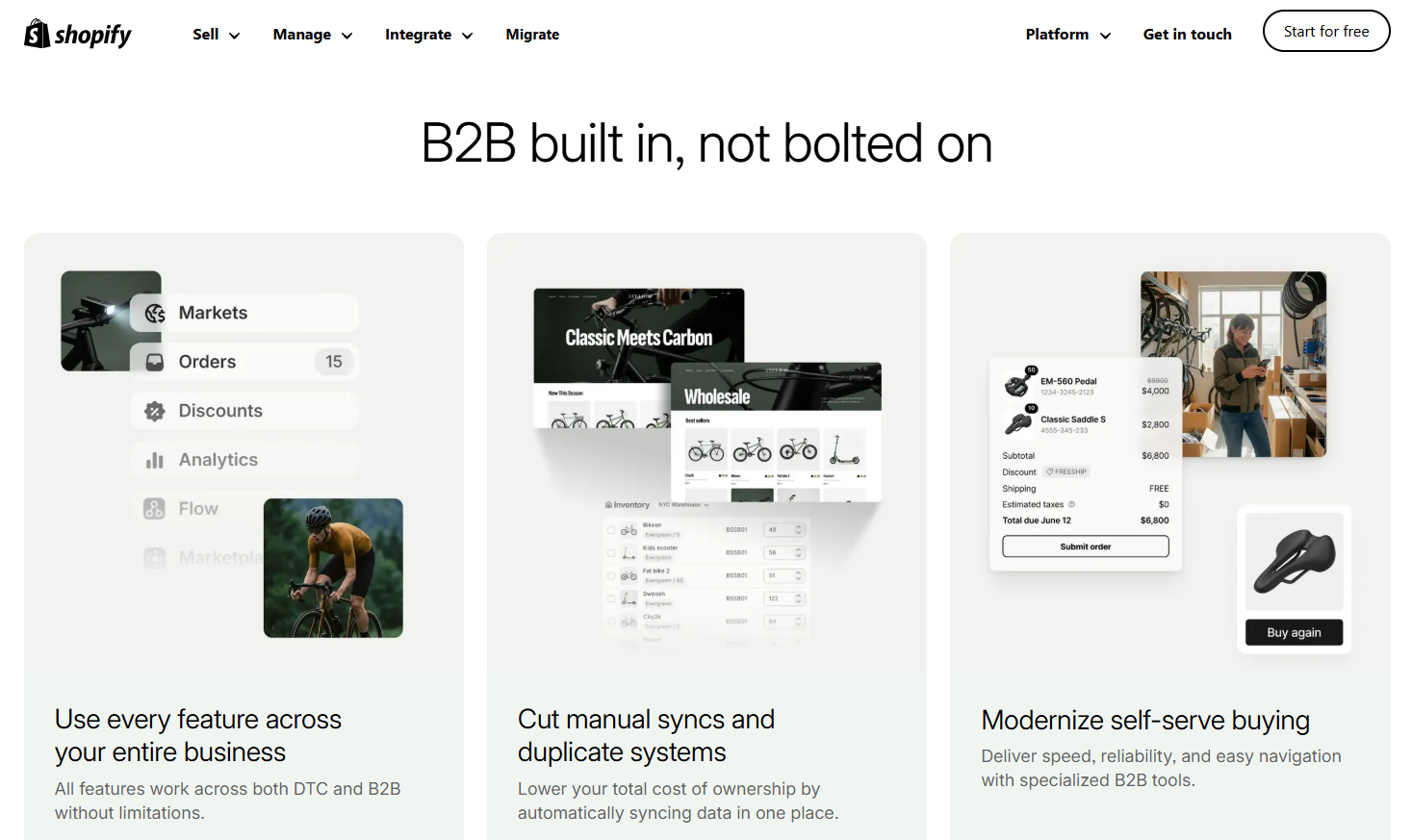
Shopify Inc. announced that it is extending business-to-business (B2B) features to its direct-to-consumer (DTC) merchants.
The ecommerce platform provider said Shopify merchants using its “basic,” “grow” and “advanced” plans now have access to those B2B features “at no extra cost.” Furthermore, it said merchants on plans other than what it calls “Shopify Plus” can now access native features for the first time.
B2B features have “consistently been one of the most requested capabilities from non-Plus merchants,” according to Shopify’s announcement.
“Merchants are telling us wholesale buyers are already asking to purchase their products. But too often, B2B tools have lived outside the systems they use to run their business,” said Samir Pradhan, vice president of product at Shopify, in the announcement. “By bringing these capabilities to more merchants on Shopify, we’re making it easier for them to seize one of their biggest opportunities to grow.”
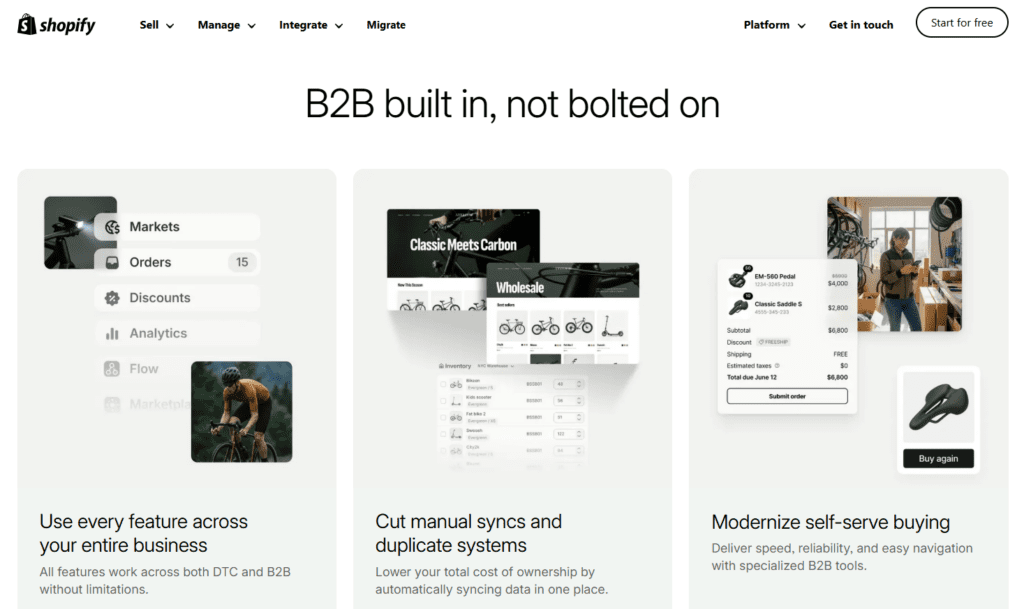
Shopify promotes its increased availability of B2B features on its website. | Image credit: Shopify website, April 2, 2026
About a week prior to the announcement, Shopify shared that its integration with OpenAI’s ChatGPT had gone live. That integration allows Shopify merchants to connect their product catalogs to ChatGPT, where consumers can make purchases.
Currently, 118 of the Top 2000 online retailers in North America use Shopify as their ecommerce platform, according to Digital Commerce 360 data. In 2025, the combined web sales of all Top 2000 retailers that used Shopify’s ecommerce platform reached $10.458 billion. The Top 2000 Database ranks North America’s largest online retailers based on their annual ecommerce sales and more.
Shopify expands B2B features to merchants on all plans
In announcing the expansion, Shopify said all its merchants will have access to B2B features, including:
- company profiles for wholesale buyers
- up to three custom catalogs with tailored pricing
- volume discounts and quantity rules.
- vaulted credit cards
- payment terms
Shopify called these features “key pieces” that it has refined through its Shopify Plus plan over the course of about four years. It added that merchants will have one unified admin account.
Moreover, Shopify said that without B2B features, merchants must “piece together their own solutions.” That can mean locking parts of their stores, managing wholesale pricing through external systems or processing orders manually, it explained.
Shopify said that across its platform, merchants using its B2B features have seen up to a 33% increase in self-serve orders within six months. They have experienced up to a 20% increase in reorder frequency, according to Shopify.
“If B2B and DTC are part of the same business, the software should work that way too,” Pradhan said. “Making commerce better for everyone means removing the artificial lines between how merchants sell.”
Merchants already using Shopify for B2B operations
In the announcement, it cited one of its merchants, DAX Eyewear, as not having needed wholesale when the brand launched in 2019. That changed after one of the founders attended a B2B trade show, according to Shopify.
“If you want a business with staying power, you have to get people to come back,” said Justin Dyson, president of DAX Eyewear, in the announcement. “B2B is kind of like a shortcut to that process.”
Shopify claimed that merchants using its B2B features see up to a 4.1x increase in reorder frequency compared to DTC orders.
“We built B2B directly into the core of our platform, not as a bolt-on or separate product,” Shopify said. “That means if you already rely on DTC features like Shopify Flow, Markets, and Shopify Payments, they’ll now work for B2B too.”
Shopify also described the experience of Snyder Performance Engineering, which began as a home repair shop and is now an automotive parts manufacturer with nationwide wholesale accounts. Before joining Shopify’s merchant base, each of Snyder’s B2B orders required a phone call or email, according to the announcement. That limited the number of accounts it could process.
“Nobody’s going from system to system anymore to check ‘did this actually ship?’” said Amy Snyder, the merchant’s co-founder and chief operating officer, in the announcement. She added that the switch “saved us a ton of money and time.”
Snyder said her business has seen a 25% reduction in the time it spends on back-office tasks. In addition, it has seen a 40% increase in average customer spend.
Sign up
Sign up for a complimentary subscription to Digital Commerce 360 B2B News. It covers technology and business trends in the growing B2B ecommerce industry. Follow us on LinkedIn, X (formerly Twitter), Facebook and YouTube.
Favorite