In 2011, Marc Andreessen, a founding partner at Andreessen Horowitz, one of the world’s most successful venture capital firms, wrote his famous article “Why Software Is Eating the World.” The central argument of the article, published in The Wall Street Journal, was that software was no longer an industry unto itself, but rather something embedded everywhere: the infrastructure on which nearly all businesses are built. That article fired the opening shot for a frenzy of investment funds that pounced on startups developing enterprise software, inflating them into a herd of unicorns at the height of the 2021 bubble.
But 2026 is shaping up to be a year of upheaval. Software may have eaten the world, but now AI is eating software, and perhaps the entire world with it. The rapid adoption of programming solutions based on natural language (“vibe coding”) rather than traditional programming languages, the rise of increasingly user-friendly AI agents, and growing fears about what AI will do to the future of the software market are already hitting stock prices. The stock market is known, on the one hand, for its excessive nervousness, but on the other hand, for identifying trends about six months before they fully materialize. While Wall Street closed 2025 as one of the best years in its history, led by seven technology companies known as the “Magnificent Seven,” the software industry lagged far behind. The SaaS index, representing companies that sell subscription-based software to enterprises, fell 6.5%, compared with a 17.6% rise in the S&P 500. Nearly all the hot names of the past decade, from Intuit and Atlassian to HubSpot, showed sustained weakness throughout last year. In the first two weeks of 2026, the situation worsened further, with most already posting double-digit losses.
2 View gallery
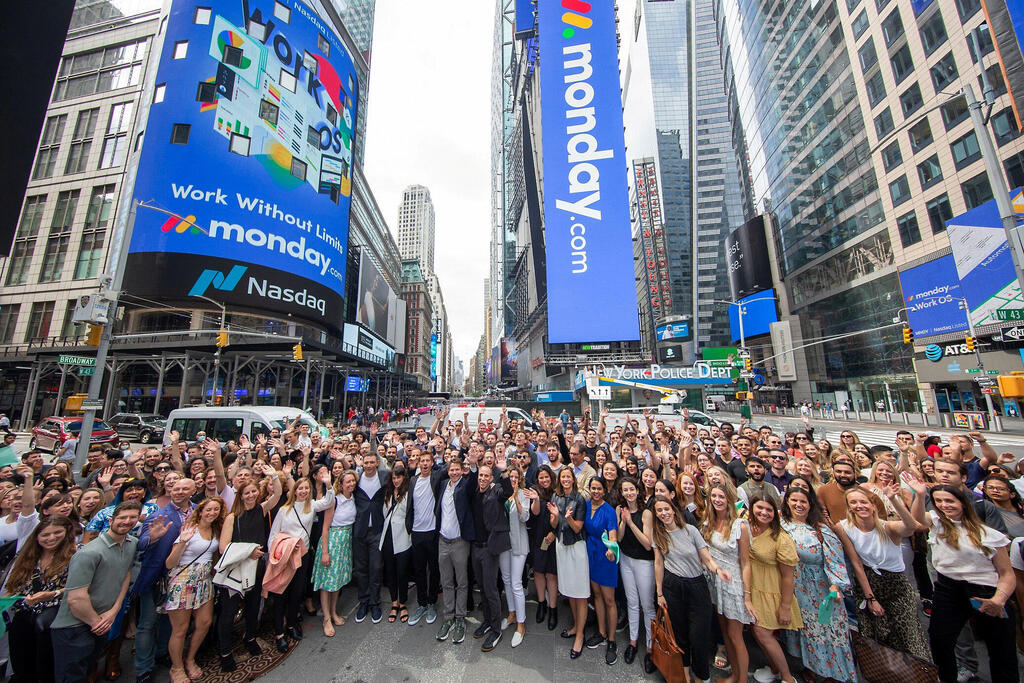
monday.com IPO.
(Photo: Nasdaq)
You don’t have to look far for examples; they are right here at home. Israel’s leading software companies, among the country’s most recognizable names globally, led by Nice, monday.com, and Wix, lost tens of percent of their market value in 2025 and began 2026 on the wrong foot as well. In fact, the reshuffling among the largest Israeli companies traded on Wall Street closely reflects the drama unfolding in the global software market. Three to five years ago, Nice, monday, and Wix ranked near the top, just behind, or sometimes ahead of, Check Point and Teva. Today, no enterprise software companies remain in the top ten, aside from cybersecurity firms, which are effectively a different category. In a telling reflection of the AI era, one that increasingly favors hardware over software, chip-sector companies such as Tower Semiconductor and Nova have replaced the once-dominant software giants. The upheaval has also reached the Tel Aviv Stock Exchange, where dual-listed Nice was the only stock in the TA-35 index to post a negative return in 2025.
Software companies once beloved by investors, from Silicon Valley to Wall Street, are fading as talk of the “death of SaaS” gains momentum. Until recently, much of the threat seemed to come from a handful of trendy vibe-coding startups, platforms that allow non-programmers to build simple applications using verbal commands, such as Maor Shlomo’s Base44. But last weekend, “Claude Code” went viral across the internet. Claude Code, Anthropic’s agent designed to handle a wide range of programming and technical tasks, promises to complete, in minutes, work that many people had postponed for weeks because it felt too technical, unclear, or tedious.
A few instructions in plain language, and the task is done. Shlomo himself tweeted this week: “Just heard of a customer that terminated a $350k contract with Salesforce for a custom solution they built on top of Base44.” In the U.S., a widely circulated story described a former Amazon executive who built an entire CRM system, customer relationship management, one of Nice’s core product areas, over a single weekend. It was not a massive system like Nice’s, but a lean, purpose-built solution tailored precisely to the company’s needs.
The successful launch of Anthropic’s co-pilot reignited panic about the future of software companies. At the beginning of 2025, the median revenue multiple for software firms still stood above 7; today, it has dropped below 5. At the same time, the once-neglected world of hardware, long considered dull by investors and venture capital funds enamored with SaaS for its fast growth, low capital requirements, and high multiples, is heating up and, in some cases, trading at multiples far higher than those of software companies.
As with any revolution, initial enthusiasm in the AI-versus-software battle is intense. In practice, however, “sticky” software, such as ERP and CRM systems that organizations have relied on for years and invested tens or hundreds of millions of dollars into, will not be discarded overnight. Moreover, many experienced programmers now warn that the surge of AI-generated code in 2026 will require extensive cleanup in 2027, as developers hunt down bugs and errors introduced by vibe coding, an effort likely to consume significant time, energy, and patience.
The gap between vision and reality recalls the long-promised autonomous-vehicle revolution, which was supposed to upend the traditional automotive industry, a disruption that has yet to materialize. There is even a scenario in which the use of traditional software increases. For example, a marketing professional who once sent a limited number of outbound inquiries may soon deploy an AI agent that instantly triples that volume, ultimately requiring robust CRM software to manage the flood of responses without being overwhelmed.
AI agents can dramatically increase efficiency, and they will also determine which software platforms are best suited to absorb the consequences of that efficiency gain.
Beyond the conclusions investment funds must draw about software stocks whose IPO prospects on Nasdaq have grown increasingly uncertain, this transformation carries significant implications for Israeli high-tech. Over the past decade, Israel produced a generation of unicorns, most founded around 2015 and focused on enterprise software. Around them emerged an entire ecosystem of employees, investors, and new startups eager to replicate that success, an outcome that now looks far less assured. The SaaS model, whose golden age peaked during the Covid era, worked exceptionally well for Israel: online distribution, no complex installations, minimal training, and per-user pricing. Geography hardly mattered.
Another advantage Israeli companies leveraged was cultural fluency in the language of high-tech, leading many to sell primarily to other tech companies. Today, these same customers are often the first to replace traditional software with internal AI-driven solutions. In a world shifting from software-out to hardware-in, geography becomes more relevant again. Growth is slower, capital requirements are higher, and the sales process looks nothing like a cancellable monthly SaaS subscription. Alongside questions about the fate of public software companies and enterprise-focused startups, an equally pressing question emerges: what will this software earthquake mean for Israeli high-tech?
2 View gallery

Alon Huri (from right), Dean Shahar and Lior Handelsman.
(Photos: Amit Shaat, Calcalist studio)
“An entrepreneur who approaches a venture capital fund today with a SaaS startup won’t even reach the pitch stage,” says Dean Shahar, managing director and head of Israel operations at European fund DTCP, which manages $3 billion. “The SaaS world is dying, not software itself, but SaaS as a business category. AI has turned software into a commodity where sustainable competitive advantage is nearly impossible. Features, UX, and interfaces that once differentiated products can now be replicated quickly by AI agents. The experience is entirely new, rendering traditional dashboards and buttons obsolete.”
The AI agents dominating today’s conversation rely on the same underlying capability: executing tasks based on verbal instructions, whether building a small customer-satisfaction tool or planning a business trip. Tasks once handled by five different paid software tools are now performed, almost for free, by ChatGPT, Gemini, or Claude.
Lior Handelsman, managing partner at Grove Ventures and co-founder of SolarEdge, is less categorical, but no more optimistic. “SaaS isn’t dead, but it faces real challenges in sustaining growth. The market is changing, and the rules are becoming more complex. The stock market tends to overreact, and even now it’s pricing in an exaggerated scenario,” he says. “You still need deep coding expertise, but barriers to entry are falling fast. It’s easier than ever to launch a product and reach proof of concept. At the same time, the market is shrinking: where companies once paid Salesforce for every module, they now try to build smaller tools in-house using AI. Anyone launching a non-cyber enterprise software startup today must ask whether they possess uniquely inaccessible data or a truly differentiated algorithm.”
Alon Huri, co-founder of Next Insurance, sold last year to Munich Re for $2.6 billion, and now a partner at Team8, also believes it’s premature to write software’s obituary. “The question has changed,” he says. “It’s no longer what you give the customer, but how. CEOs of companies with over 500 employees must rethink organizational structures from the ground up, what functions are still necessary, and which are not.”
Huri describes building a startup with three core programmers and a handful of outsourced developers abroad, achieving what once required 30 employees. “That’s the earthquake,” he says. “AI must create a ten-to-one productivity multiplier.” Both Huri and Shahar agree software won’t disappear, but pricing models and performance metrics will change. Huri expects investors to focus on ARR per employee rather than absolute ARR, while Shahar predicts outcome-based pricing tied to customer results.
“The era of hypergrowth is probably over,” Shahar says. “Software companies will grow in single digits, but remain profitable, driving private-equity acquisitions rather than IPOs.” Mature startups, he adds, are rebuilding products around AI agents. “Instead of selling a product, they’ll sell a result.”
Despite heavy reliance on software, optimism persists in Israel, rooted in the country’s deep-tech heritage. “We were good at software, but historically Israel has always excelled in deep tech,” says Shahar. “There’s no reason we can’t succeed again.” Huri agrees: “We didn’t invent the internet, the cloud, or AI, but we’ve always been exceptional at exploiting change.” He cautions startups to build products unlikely to be commoditized by OpenAI or others, such as mortgage advisory systems.
This advice is easier given than followed. Tech giants with vast budgets routinely release new agents that instantly render entire startup categories obsolete.
Handelsman, who focuses on hardware investments, sees opportunity rather than risk. “There’s deep expertise in chips here,” he says. “I see two or three companies every day tackling real physical problems in data centers, power, cooling, connectivity, cabling. These constraints are why AI isn’t a bubble. In 2000, there were no physical bottlenecks. Today, there are queues for electricity, GPUs, and transformers.”
Those constraints, he argues, create opportunity. “Companies on the scale of Nice or monday can be built here, even in hardware, just as SolarEdge, Mellanox, and Tower were.”
This is not the end of the story. We are in the midst of a revolution whose final shape even experts struggle to imagine. Software stocks may have overcorrected, and prices could stabilize as fears subside. Large organizations adopt change slowly, especially when core systems are involved. They will continue buying, albeit more cautiously.
Veteran software companies, flush with cash, are adapting. Nice acquired a German AI startup for $1 billion; monday added AI layers to its products; Wix did both, acquiring Base44 and launching a new AI-enhanced website builder it plans to promote at the Super Bowl.
High-tech firms and startups will likely adopt AI fastest, dampening growth at legacy vendors. But many incumbents remain profitable and may evolve into slower-growing dividend-paying companies.
The harder challenge lies with new software startups once destined for high-valuation IPOs. Here, consolidation looms. Private-equity funds are circling. Orlando Bravo, founder of Thoma Bravo, told CNBC last weekend that the market now offers “unimaginable buying opportunities.”