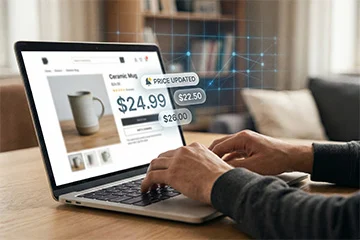
Several American lawmakers have expressed an interest in limiting or prohibiting data-driven price changes. The recent activity dates back to at least 2021 and may stem from inflation concerns and increased AI usage.
For example, in December 2025, Instacart drew strong criticism from Democratic Senator Charles Schumer of New York after it permitted grocery stores to test AI-powered, dynamic pricing.
The experiment showed an average variation of about 7% between the lowest and highest prices for specific grocery items. But there were standouts, according to Consumer Reports, with Wheat Thins ranging from $3.99 per box to $4.89, 23% higher.
Schumer likened the price differences to gouging and asked for an investigation by the Federal Trade Commission.

Personalized dynamic pricing leads to merchant profitability and satisfied shoppers.
Tennessee Bill
Meanwhile, a proposal from Tennessee state representative John Ray Clemmons, a Democrat, illustrates how the dynamic pricing debate could shift from headlines to law.
Clemmons’ House Bill 1468 would prohibit “personalized algorithmic pricing,” which it defines as “dynamic pricing set by an algorithm that uses personal data.”
That definition targets any system that adjusts prices based on information tied to an individual shopper, including purchase history, browsing behavior, loyalty status, location signals, and other attributes. Conceivably, it could include aggregate data applied to individuals.
Tennessee HB 1468’s enforcement mechanism is also notable. It makes personalized algorithmic pricing an “unfair or deceptive act or practice” under the state’s consumer protection statute. That approach gives the state’s attorney general broad enforcement power and exposes retailers to legal liability, even if no consumer can point to a false claim or deception.
For ecommerce merchants, the risk is clear. If bills such as Tennessee’s spread, dynamic pricing could become legally hazardous not because prices are changing, but because the systems doing the changing rely on customer behavioral data — the same data that powers modern online merchandising, email marketing, loyalty programs, and conversion optimization.
Unfair?
The criticism of Instacart’s AI-pricing and the political momentum behind bills such as Tennessee’s HB 1468 incorrectly assumes that prices determined by data and software are somehow less legitimate than those set by a manager with a clipboard.
Put another way, to some lawmakers, dynamic pricing feels unfair.
But not every shopper cares to pay the same price. Consider coupons, which manufacturers and grocery stores routinely issue. Every shopper knows coupons exist. But not all use them, nor do they care that they are paying a different price.
Optimization
And that is the point. Optimization drives ecommerce price changes.
Vaidotas Juknys is chief commercial officer at Decodo, a web data infrastructure provider. He told me, “Dynamic pricing is widely used across modern commerce to help businesses align prices with demand, manage inventory more efficiently, and remain competitive in fast-moving markets.
“Broad restrictions risk limiting those benefits and may ultimately lead to higher average prices if companies lose the ability to adapt in real time.”
To be sure, dynamic optimization results in different prices across shoppers, who can accept or reject offers.
Algorithm-based pricing is likely a key component of ecommerce in the emerging AI world, presenting many opportunities for merchants:
- Relevant discounts. Customer-level pricing enables merchants to offer discounts to shoppers who would not convert otherwise.
- Conversion rate optimization. Algorithms can detect purchase intent signals (repeat visits, cart additions, time on site) and trigger pricing to close the sale.
- No wasted discount. Blanket promotions reduce margins companywide. Personalized pricing can limit discounts to specific segments, preserving profit while still driving growth.
- Customer retention. Pricing tied to loyalty status or purchasing history can reward and encourage repeat customers.
- Inventory efficiency. Merchants can use shopper behavior to promote overstock items to likely buyers.
- Smart acquisition offers. Personalized pricing can support first-time buyer promotions, helping brands compete with marketplaces without permanently lowering prices.
- Boost marketing ROI. Personalized incentives can link to traffic sources, campaigns, and shopper cohorts, helping merchants measure the profitability of paid acquisition at the order level.
Yet shoppers benefit, too. Dynamic systems can reduce prices when supply is abundant and demand is weak. The result is more discounts, better availability, and fewer shortages than a rigid one-price approach.