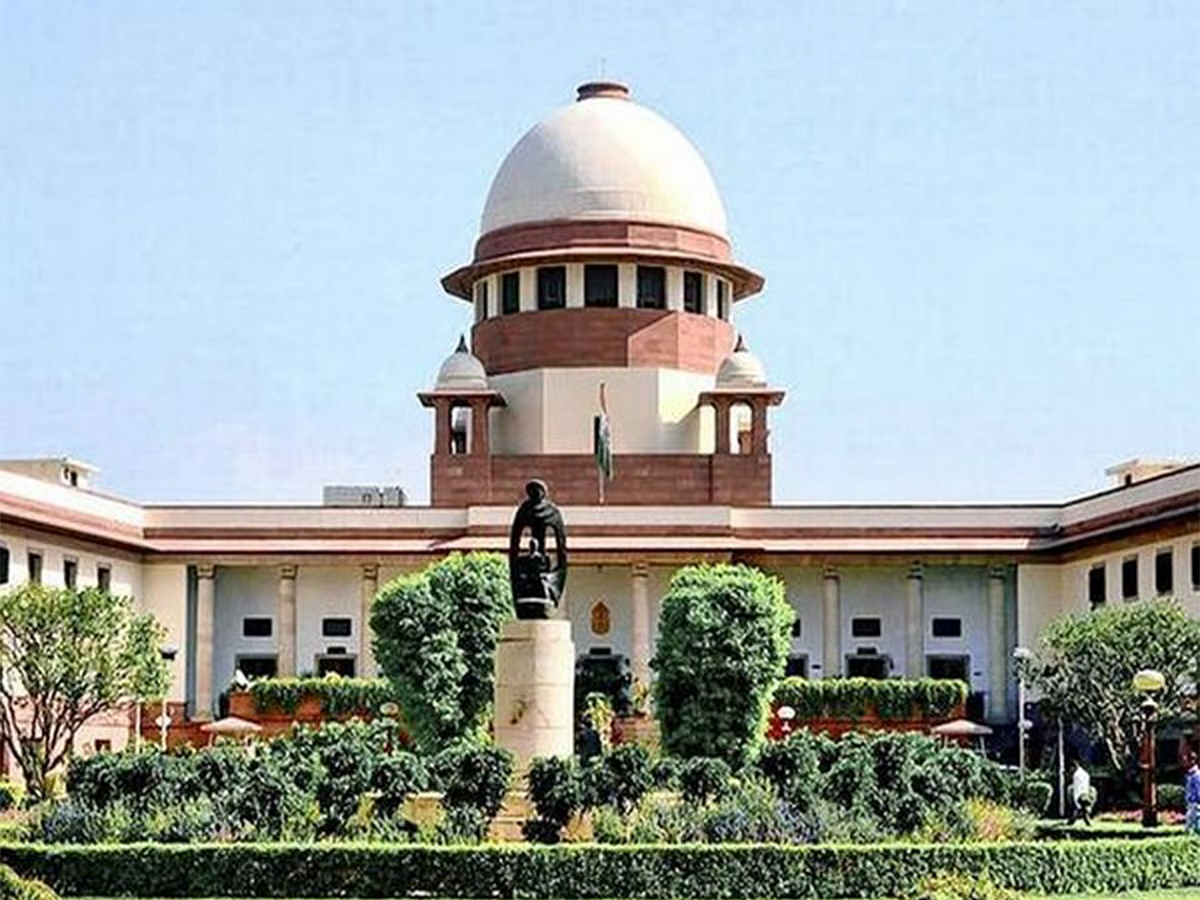
The Supreme Court’s ruling denying tax treaty benefits to Mauritius-based entities of Tiger Global is expected to have far-reaching implications for venture capital (VC), private equity (PE) and foreign portfolio investors, potentially reshaping investment structures, exit valuations and deal timelines in India’s startup ecosystem.
Tax experts said the judgment marks a decisive shift towards a substance-over-form approach in treaty interpretation, significantly strengthening the tax department’s ability to challenge offshore holding structures—including those earlier believed to be protected under grandfathering provisions.
The apex court held that mere possession of a Tax Residency Certificate (TRC) does not conclusively establish entitlement to treaty benefits, nor does it prevent tax authorities from examining whether intermediary entities were interposed primarily to avoid tax.
Impact on exits and valuations
Lokesh Shah, partner at CMS INDUSLAW, said the ruling would prompt PE, VC and FPI investors to re-examine their holding structures and reassess exit-related tax exposure.
“This risk will directly affect transaction structuring and startup exit valuations, including the need for tax gross-up and withholding protections, enhanced indemnities and other risk-allocation provisions. These factors are likely to extend deal negotiations and closure timelines,” Shah said.
Market participants noted that exit pricing—particularly in late-stage deals and secondary transactions—could be recalibrated to factor in potential capital gains tax exposure where treaty protection is uncertain.
Venture capitalists and startup insiders said the judgment would not only discourage holding-company structures in Mauritius or Singapore, but also lead to tighter term sheets and higher fund holdbacks at exit.
“This ruling doesn’t stop investment, but it changes how risk is priced. Treaty structures without real substance will face more scrutiny, longer exits and lower net outcomes,” said a venture capitalist at a domestic innovation fund. “Investors will respond with tighter tax clauses, holdbacks and more conservative valuations. Founders may feel this most in the short term.”
Anurabh Sinha, founder and CEO of UClean, said setting aside a significant portion of exit proceeds in escrow is increasingly becoming standard practice.
“Now that the Supreme Court has made its stance clear, investors would rather be safe than sorry. They are withholding funds or deducting taxes at source during exits to cover potential future tax claims,” he said.
Sinha added that term sheets are likely to become much stricter on tax clauses. “Investors will want clarity on who bears the burden if a tax issue arises later. In several recent deals, that burden appears to be shifting towards founders or the startup itself,” he said.
Substance over form
A key takeaway from the verdict is the court’s clarification that the General Anti-Avoidance Rule (GAAR) can override treaty grandfathering. Experts said this could have significant implications for PE funds, hedge funds and FPIs using Mauritius- and Singapore-based structures, including for pre-2017 investments. The court also underscored the relevance of business intent in determining the substance of a transaction, drawing on principles laid down in the Vodafone ruling.
The judgment empowers tax authorities to independently examine treaty claims rather than rely solely on TRCs, reinforcing substance-over-form principles in cross-border transactions.
Zeel Jambuwala, co-founder and partner at Aurtus, said the court’s observations effectively extend the substance-over-form test to treaty eligibility itself.
“This could significantly impact the PE and VC industry, requiring a detailed review of legacy structures and even closed deals. Tax costs and structuring will now form a critical part of commercial negotiations and valuations going forward,” she said, adding that clarity from tax authorities would be essential to align the ruling with the government’s ease-of-doing-business objectives.
Industry-wide implications
While the ruling does not automatically reopen closed cases, tax experts cautioned that it materially strengthens the tax department’s hand in reassessment proceedings, where permitted by law. The verdict is expected to usher in a phase of heightened uncertainty for foreign investors but could fundamentally reshape how offshore investments and startup exits involving India are structured.
Siddarth Pai, founding partner at 3one4 Capital & co-chair regulatory affairs committee at Indian Private Equity & Venture Capital Association (IVCA), says with this verdict, the floodgates to re-examine past exits and even exits from IPOs has been opened. “The Tax Department will closely scrutinize exits to Mauritius based entities. While many fund managers have pivoted to Singapore, SEBI AIFs or GIFT IFSC, the past presence in Mauritius will need investors and advisors to reexamine their tax risk and make provisions,” he says.
A startup founder told TNIE that if they raise VC funding, they would rather do it under an Indian entity. “Using Mauritius or Singapore purely for tax reasons is no longer worth the risk. It may reduce exit payouts, but it also brings peace of mind,” he says.
Singapore and Mauritius remain the two largest sources of foreign direct investment into India, together accounting for about 46% of FDI inflows in 2024-25. Other jurisdictions that contribute significantly to India’s FDI include the Netherlands, Cayman Islands and Cyprus.