
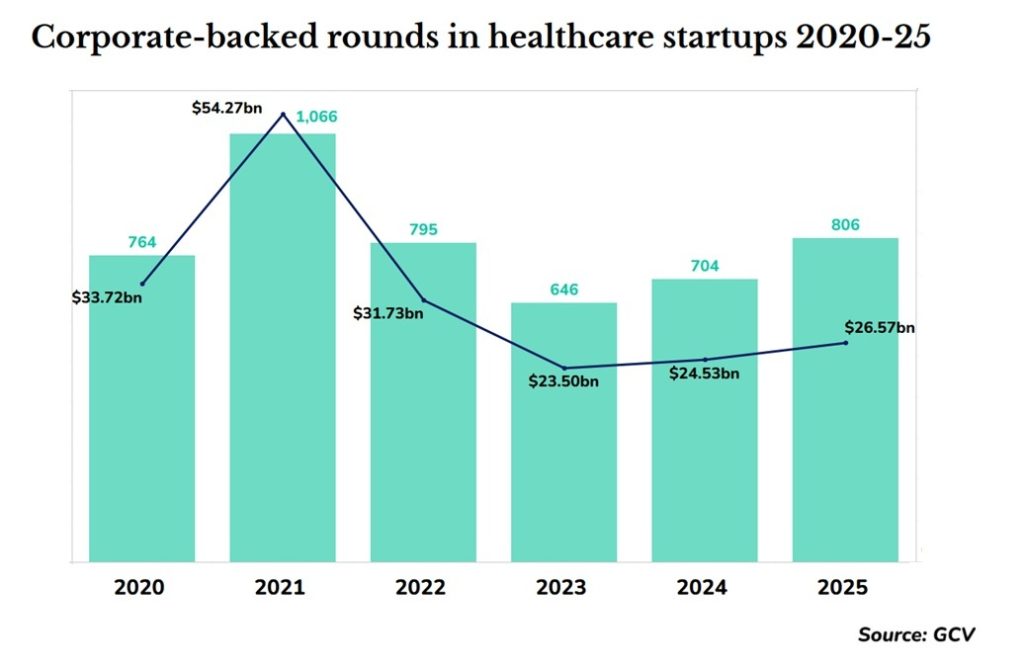
After its post-Covid spike in 2020 and 2022, healthcare was one of the hardest hit sectors when the market cooled, with corporate-backed startup investment halving in dollar terms between 2021 and 2023, and with deal flow falling roughly 40% in that same timeframe.
Since that nadir, investment has been slowly crawling back, with deal flow returning to pre-2021 levels, even if dollars invested haven’t yet, according to GCV data. In 2026, investment in the sector is expected to continue to rebound as exits return.
Between 2024 and 2025 up to mid-December, pharmaceuticals saw a small year-on-year deal flow decrease of 3%, while care provision and on demand services also saw a 13% decrease, according to GCV data. Where there were big gains was in medical devices and diagnostics with 38%, and healthcare IT and administration with 60%.

Investing in healthcare and looking for networking opportunities? The GCV Healthcare council convenes regular in-person and online events.
Find out more about the council here
Early-stage money in pharmaceuticals is still hard for startups to come by, but elsewhere in the space, corporate investors are increasingly keen to put capital behind new data and AI-centric technologies that reduce risk and accelerate near-term revenue visibility.
Money needed at earlier stage
The healthcare VC space has been suffering from a lack of capital at the early stage – many of the startups that were well-funded in the boom cycle failed to produce clinical proofs over the next couple of years and that meant much of the VC money went to later, closer-to-market technologies as LPs were wary of markdowns and long hold times.
“We were actually hoping to see more institutional VC money being invested in earlier-stage preclinical or platform biotechnology companies, and that hasn’t surfaced as of yet. Most of the institutional VC money is still going to later-stage assets or clinical pipelines rather than earlier-stage, high-science, cutting-edge platforms,” says Hakan Goker, managing director at M Ventures.
The corporate VCs, which benefit from more patient capital and a more strategic lens, can make more bets earlier on, but startups still need a critical mass of institutional investors to have a strong a cap table.
Funding and exits
Like with other sectors the VC industry, healthcare is starting to benefit from more startups being acquired or or listing on the stock market.
A major M&A driver for pharmaceutical corporates over the next few years will be the loss of exclusivity on some of their biggest moneymaking drugs. Historically high losses are expected from a concentration of patent lapses over the next three years.