In a world where AI has already begun to infiltrate our daily lives, what will life look like by 2040?
Venture capitalist Vinod Khosla believed in AI long before it became part of the public discourse, and he bet big and early on OpenAI, the leading AI research company that serves hundreds of millions of users a week.
Khosla predicts that within 15 years, AI will completely redefine life as we know it, driving down the cost of living, freeing young people from a future of work, and shifting society from survival to true fulfillment. But his utopian vision hinges on one critical safeguard: governments getting their policies right.
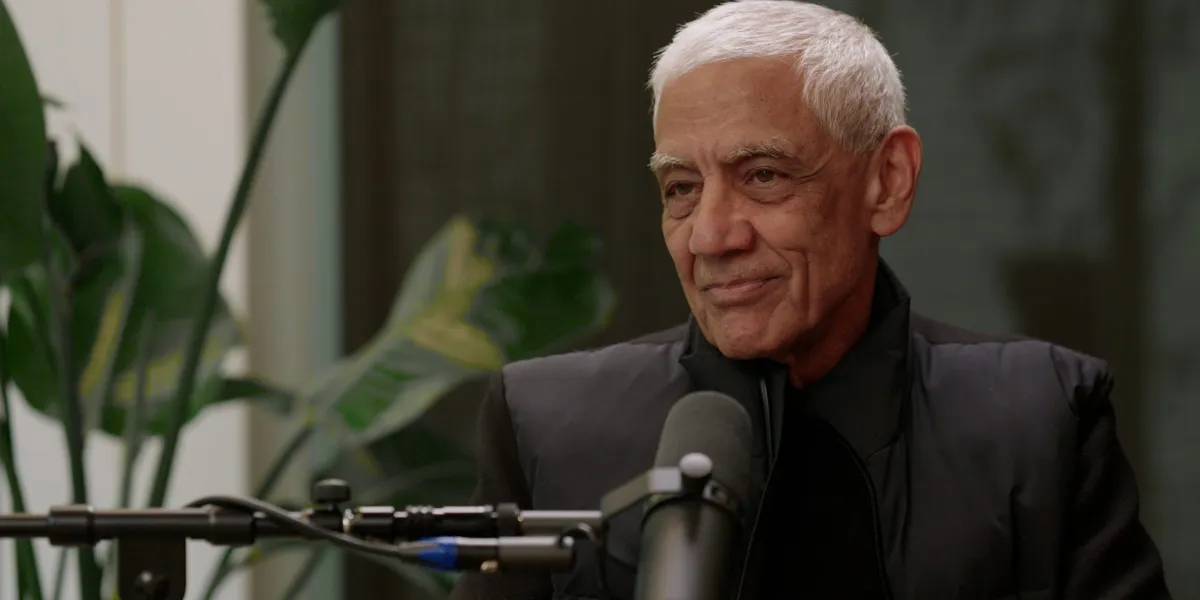
In a new episode of Fortune 500: Titans and Disruptors of Industry, Fortune’s Editor-in-Chief Alyson Shontell sat down with Khosla to discuss his optimism about the AI future. Listen to the vodcast above.
Here’s some of what they discussed during their 35-minute conversation:
On the impact of AI on labor from now until 2040
- Why technological changes from the 1970s to today represent a “magnitude of change” that’s similar to the changes AI will make
- How AI will free people from needing to work to survive
On Khosla’s upbringing in India, early career in America, and venture capital successes
- How growing up with low expectations taught Khosla that his future is in his own hands
- Khosla’s educational background and why he’s never “actually worked for anybody or applied for a job or had a resumé”
- How Khosla scored the biggest return in venture capital history with Juniper Networks
- How thinking outside of the box led Khosla to success
On the best way to replace income from the wealth disparity AI can create
- Why Khosla thinks 80% of all jobs will be replicable by AI by about 2030
- How AI will lead to a deflationary economy where people will need less income to purchase more
- Which services, like education and health care, Khosla predicts can be made free or almost free through AI
On the ways policy can protect the population
- Why Khosla is in favor of an increase in the capital gains tax
- Why he supports removing income tax for those making less than $100,000 per year, starting in 2030
- Why he won’t leave California if a billionaire tax is imposed
On the AI war with China
- Why he believes the U.S. must win the war to control socioeconomic influence over the world
- Why he supports the Trump administration’s aggressive push into AI, even if he disagrees with other policies
On his early investment in OpenAI
- Why he swooped in with funding when Elon Musk didn’t provide the funding he offered them
- Why he sent an apology letter to Khosla Ventures LPs when he made the investment
- Where he thinks OpenAI stands against competitors like Google and Meta in the AI race
- Why he believes in Sam Altman’s “values,” and why he looks for that specifically when backing founders
Read the transcript, which has been lightly edited for length and clarity, below.
A quick message from our sponsor:
What should CEOs consider as they assess and prioritize use cases for AI?
Jason Girzadas, CEO of Deloitte US: This is on the topic of every CXO conversation I’m a part of, and I think the thought process has to be looking for high-impact areas that may not be necessarily the most glamorous or high-profile, functional areas, but are ripe for automation and use of this technology to create efficiencies as well as innovation. And over time, AI agents will also be in customer-facing and growth-oriented domains. In our case, at Deloitte, we’re using it within our finance organization, looking at very mundane processes like expense management and working capital management. We’re seeing other organizations using it in call centers and with software development that can be automated.
What are the key elements for successfully implementing AI agents?
It comes down to intentionality. And so, I think that intentionality, in going functional area by functional area, in concert with business and IT leadership with an enterprise, it needs to be a mainstream business planning effort that’s budgeted, that’s KPIs are developed, and there’s real accountability for actual business outcomes and impact because of agentic capabilities.
What Khosla thinks life could look like in 2040
Vinod, it’s a pleasure to be with you. You’ve had a storied career as both a founder and a venture assistant. As you like to say, you do not like to be called a venture capitalist. And you’re certainly one of the titans of industry. So thank you for being with me today.
Oh, it’s fun to talk about these things.
Absolutely, my favorite thing as well. I love your future outlook. I think it’s really a healthy dose of optimism that people need to hear when it comes to the AI future. Can you just give me a big-picture perspective of what you think life could be like in 2040?
I would say, to imagine the change between today and 2040, you’d have to go back and look at the change between the ’70s and now, when TV still had rotary dials and three channels, there was no such thing as a cell phone, no such thing as the internet. Life was very different. Expectations were very different. I think that magnitude of change is what will happen in the next 15 years?
And what will we be doing? Are we going to be working? Are we going to be using public transportation? Are we all going to have private chauffeurs? What does life look like?
Here’s the thing to imagine: Almost all expertise globally will be free. It’ll raise lots of interesting questions. Do you pay a farm worker the same as an oncologist? Because they happen to have the same expertise, which is the expertise of AI. Almost all labor will be free because we will have robotics, probably for a few hundred dollars a month. The way you pay a few hundred dollars a month for a car, you’d pay for a robot in the house. [It will] definitely make you any style of food you want, any recipe you can ask for or might wish for, or it might even be good at what you haven’t had recently, and predict what you might like for a change. That’s one side of it.
On the enterprise side, functions left for humans to do are very hard to predict. It’s pretty unlikely a 5-year-old today will be looking for a job.
A 5-year-old today will most likely not be looking for a job. So, my daughter. Oh great, good.
If I’m right, you will see a couple of phenomena.
First, the need to work will go away. People will still work on the things they want to work on, not because they need to work. Look at the vast majority of jobs in this country, let alone the rest of the world, which is worse. If you’re an assembly line worker on a GM car line mounting a tire for eight hours a day for 30 or 40 years, if you’re a farm worker here in the Salinas Valley, not far from here, hunched over in 100-degree heat, picking lettuce. Those are not jobs. Those are servitude. I think we will have enough abundance, the need to work will go away.
Khosla’s early life and venture capital success
I think that sounds like a great future in terms of freeing us of servitude—jobs that are just jobs that you have to do because you need a living, as opposed to jobs that you really want to do. Like you—you’re still working. You don’t need to be, but you love it, and I love my job, and it’s a great place to be, but so many people don’t feel that way, and I definitely want to dig into how you think that could be financially viable, and how we can support all these people who aren’t working.
But first, I want to go back in time to your upbringing in India. I know you didn’t come from a well-to-do family. The way that you learned about entrepreneurship—going out and physically renting magazines. I would hope that, at some point, you rented a Fortune magazine, that would be awesome. But I would love to just hear how your upbringing shaped your perspective that you now use today.
Well, a couple of things. First, I would say I grew up with very few expectations. I remember coming to this country in 1976 my family had never had a TV at home. My family had never had a phone at home. So, expectations of what life was like were pretty low. You worked a lot and you survived, [that] was the expectation.
So I started in a very different world, but I also realized very quickly how much you have agency over your own future, how much you can create. And that was very energizing for me—my future was in my hands. And I never really got a regular job. I got my undergrad, my master’s degree in Biomedical Engineering, and then my MBA at Stanford. And then did my first startup, did my second.
I was fortunate. I’ve never actually worked for anybody or applied for a job or had a resume, as they used to call them before LinkedIn. Everybody will have more opportunity to chart their own future, to tie it back.
You know, today with your daughter, you would say to her, go to school, study hard, do well, get into a college. You hope she gets into a college and then she can get a good job and support her family. In 15 years from now, you will say what is bad advice today, or used to be, which is, follow your passion. Following your passion comes second to surviving. I think that surviving part will go away and you’ll tell every 5-year-old, follow your passion.
That would be awesome. And so you clearly followed your passion all the way to the states, to Stanford, where you started Sun Microsystems. And then you went to Kleiner Perkins, and you helped be the brainchild of Juniper Networks, which is one of the greatest returns in venture capital history.
That was fun.
Yeah, I bet it was. A 2,500x return. I would like that. That’s amazing.
2,500x is pretty rare, even for venture capital
100%. I’m wondering how—being a little bit of a contrarian thinker, that’s a signature trait of the most successful entrepreneurs and venture capitalists in the world. What learnings from Sun and Juniper’s success did you pick up to help hone that contrarian view?
Give yourself permission to think out of the box.
You know, when I was in sustainability, I used to say, think outside the barrel, the oil barrel. Almost everybody has it, very few people exercise it. And the most important trait in entrepreneurs, it’s about agency and driving your future and being empowered. I had no resources, I had no contacts, I didn’t have any money. You create agency and you make it happen.
It’s still very hard. [In] the last 40 years, lots of failure points, lots of things that didn’t work, but you power through those and have resilience. And I think [in] 2040, almost everybody will have agency, because they won’t have the constraints of abundance. If government policy allows it.
How jobs—and people who won’t have them—will change amid AI automation
I do want to know your thoughts on that, because most jobs, clearly, people do because they need money, and secondarily, it’s a sense of purpose. You wake up in the morning. You have a responsibility. You go to do it. The loss of both of those things, income and purpose are huge, and I want to know your thoughts on how our brains can adapt to survive that fast transition in both hugely important areas.
You may be out of luck. Your daughter won’t be.
I think younger people will adjust to this freedom to do what they want much easier than older people’s notion of where they have meaning in life. Most people today don’t have enough time to spend with their kids. Most people today don’t have enough time to spend with their aging parents. Talk about two large consumptions of time that are very, very meaningful. If you’re an artist, you’d better get used to working at a restaurant as a waiter or waitress. That’s the reality for most people aspiring to be an artist or a basketball star or a surfer or a musician.
So I do think the room for creativity is very, very large, but we are drilled into a narrow vision of what we are supposed to do, and I think that’s the fundamental thing that will change about humanity. AI will free us to be more human.
How do you think is the best way to replace the income when we have this huge wealth disparity?
Let’s talk about that. I think each country will do things differently, starting in about 2030. Four years away 80% of all jobs, so two-thirds of all jobs, will be capable of being done by an AI. So whether you’re a physician, whether you’re a radiologist, whether you’re an accountant, whether you’re a chip designer, whether you’re a salesperson, AI will do your job better.
And there’ll be an interim period where every professional will have four AI interns they’re training to leverage themselves. And I think the initial model of AI deployment will be AI interns working for somebody who’s already a senior accountant or physician or chip designer. But what happens when all labor is free?
By the way, $15 trillion of US GDP is labor. $15 trillion that will mostly go away. That’s a hugely deflationary economy, something nobody’s planning on. But it’s a different kind of deflation than past deflationary economies. The abundance of goods and services will be very, very large. Prices will be very, very low. So I would suspect by 2040, $30,000 will buy, and maybe $10,000 will buy, much more than you can buy if you have $100,000 income today. So the level of income you need in a deflationary economy will be very different.
What will become free—or very cheap—in an automated society
So you think it’ll cost less for lifestyle?
Look, all education should be
Which means colleges, goodbye?
It’s a real question. It’ll take longer, because people like institutions and the notion of institutions, but you won’t need a college to get an engineering degree. You won’t even need the engineering degree, except if your passion is learning, my passion is learning, that’s why I do what I do.
So, education is free.
Education can be free.
Health care?
Health care, except interventional procedures like heart surgery, will be near free. Labor, whether you’re talking about farm workers or assembly line workers or retail workers or accountants, that’ll be all free. And in a competitive economy, that means declining prices. Now I don’t think we will have dramatically increased GDP, if it’s measured right. GDP, as we measure it, will be a very poor measure of growth, because prices will be declining in this deflationary economy. So there’s an unusual opportunity.
Post-2040, most goods and services will be near free to produce, energy will be free because of fusion and other sources of energy. It won’t be oil based, and will be much cheaper. And there’s complex areas that are hard to predict, like steel. I suspect we’ll have 10 times more steel resources and much less need for steel, but things like housing are the hardest problem.
But you have this world where we have abundance of goods and services. You need food and housing, health care, education, entertainment, almost all free.
Which policies can protect society from financial inequality
I think the internet made so many millionaires happen faster than at any point. And I think there’s a feeling that AI will create more billionaires than at any point. Are we looking at this as you’re either a serf or a billionaire, there’s nothing in between? What does that look like?
It’s very hard to predict, and most of it will depend on government policy. So the current MAGA notion of lower taxes will not work. My politics are clear. I think the minimum level of services governments will be able to provide will be much higher in all dimensions. How that redistribution happens is very hard to tell.
Why are governments inefficient at certain things? Because they hire people who don’t have the right incentive structure. Incentives is what capitalism is about. By the way, capitalism is by permission of democracy, you can’t leave 80% of the population behind. They will revoke capitalism if that happens.
I think we’re seeing that a bit.
We are seeing pieces of that, but policy will see how we handle this set of services. There are simple things short-term, more structural things long-term.
For example, in this traditional battle of—now moving to economics—share of income to labor versus capital, it’ll shift a lot to capital, little to labor. How do you change that in the short term? I think fundamentally, we eliminate the notion of capital gains. All income is ordinary income. Everybody pays the same tax. And the next presidential campaign, I hope, gets behind: Nobody pays income tax below $100,000 a year, starting 2030. That shortfall is made up by increase in the capital gains tax to be the same as ordinary income.
I could go through lots of detailed policy. I’m working on a document on that, but it makes it tax neutral. No more taxes, but much fairer distribution of income. 40% of all capital gains is paid by people making more than $10 million a year. Now that’s a very small percentage. 123 million people, or roughly that, make less than $100,000 a year, and you make all taxes go away for them.
“Four years away, 80% of all jobs, so two-thirds of all jobs, will be capable of being done by an AI.”
Vinod Khosla
So there’s ways—and that’s why I think policy, which will be driven by politics, will drive where we end up on this equation in the short term. And I think it’ll start in the early 2030s, this massive drive for structural change. People have proposed AI taxes, robot taxes—I think some sort of wealth fund for a nation. Norway has an Oil Fund. Alaska has an Oil Fund. We won’t have oil, but we will have other sources of wealth creation that should be. And these are some raw ideas, they have plenty of flaws in them, but they will be refined. And something structural has to happen. It could be universal basic income. It should be a wealth fund. It could be services that are near free. Any of these things. I don’t want to go too far into areas that are still in process in my thinking.
I think it’s the right innovative thinking and approach. And I think a lot of people who are making under $100,000 would really support a lot of that.
And they’re the voters, they will vote for a candidate who says no taxes if you make less than $100,000. Let’s tilt the equation towards labor and not capital.
Khosla on the proposed billionaire tax in California
I’m sitting here with a billionaire in California. Lots of billionaires are starting to plot to leave California because of a potential wealth tax on them. I know you’ve had thoughts about what’s right and the wrong way to tax billionaires to be most effective for still creating innovation here. What are your thoughts, generally, on the right way to tax billionaires, and why is the current proposal potentially wrong? And do you have plans to leave California?
I have no plans to leave California. In fact, people would generally have left on January 1 or before January 1. But it doesn’t structurally solve the problem beyond the one time shot of income. One time. It’s silly, and so many entrepreneurs who own 20% of their company, are talking about leaving now in case somebody takes another shot, because junkies come back for another shot.
If at the federal level, we doubled capital gains tax or made it all uniform, then we will equalize and balance between economic profitability and economic growth and investment. That’s the reason for capital gains, is increased investment and more equitable distribution of income. That’s just one idea. That’s a structural change that would make sense. I’d be surprised if that doesn’t happen before 2040.
Now, capitalism was about economic efficiency, but if the need for efficiency goes away because of extreme abundance, then why focus on efficiency? Let’s focus on equity. Every country will be different. It’s very unlikely [that] business in Germany, for example, with strong participation of labor on their boards, will allow AI to replace jobs. China will, they’re very much on that trajectory.
Khosla on the AI war with China and the Trump administration
The feeling from the Trump administration is the U.S. must win. David Sacks, the AI Czar, is saying, I’m afraid pessimism of AI in the states is going to hold us back. China is ahead in energy, even in EVs. How do you think what’s happening there, and what’s happening here, will affect the future?
We are in a techno-economic war with China, and we shouldn’t call it anything other than a war. Because whoever wins this AI race, and though I mostly disagree with the Trump administration and I’m on their s***list, I mostly agree with their policy on AI. We have to win that race.
Whoever wins the AI race will win the economic race and will win the race for socioeconomic power and influence globally, whether you’re talking about Southeast Asia, Latin America, or Europe. All of that depends on who wins the AI race, because it’s such a pivotal technology.
So I absolutely agree, and I think it’s important that we win. And I think the Biden administration was pretty good about it, the Trump administration, I agree with all of their policy on AI and aggressiveness on AI.
And the importance, is it ideological where China’s viewpoint could be put into products, or is it more like war devices?
I think it’s fundamentally about socioeconomic influence all over the world, which political system prevails. I happen to like democracy over the Chinese system. They’re literally forcing more equality, and they think it can be centrally governed with Qi in power. I couldn’t argue that that’s a bad system, I just don’t like it. Maybe I’m too brainwashed.
I think a lot of Americans would agree with you.
Yeah, I like democracy. I like this system, especially in the world of abundance.
That’s contrarian to a lot of VCs I see right now, who would be saying, we need to support the administration. They’re good for little tech. They’re good for our LPs, for our returns, depraved values be damned. How do you square that?
It depends on what you care about. I care about my freedom. My first startup, I made enough to never need money again. That was my first startup in 1980, and I decided I would do what I want…
…and say what you want…
…and say what I want, and I want to feel good about where I stand. And I would say, most people don’t have that luxury. I think it’s almost an indulgence to be able to do what I do. I can’t be fired. I’ve never worried about a career. I don’t need more money at age 71. Health permitting, the next 25 years I’ll be doing exactly the same thing, because I like working 80 hours a week, learning, and nobody can take that away from me.
So, if I speak up for the right thing, it’s because I have this immunity from—maybe they’ll put me in jail, I wouldn’t put that past this administration. If Don Lemon can be arrested, well, who knows. But I do think if people don’t speak up, we are more likely to head down this authoritarian path, because people are optimizing their short term advantage by getting in with the administration.
I have the luxury, so I definitely owe it to speak up in a country that’s been really good to me. I think most Americans don’t know how good they have it in this country and how much they control their own fate and agency. And it doesn’t matter what Elon thinks, what I value, neither he nor Trump can take it away, I don’t think.
Khosla on his early investment in OpenAI and thoughts on Elon Musk
Elon was an interesting way that you came into OpenAI as the first institutional investor. If I recall, he was a cofounder with Sam. There was money, I think, that was supposed to be kind of delivered in a hand basket by Elon that didn’t happen, and you swooped in. Can you just take me back to that initial investment and about how you became the first?
First, I would say, on Elon, I’m happy to call him when he needs to be called, which is often. I’m also an admirer of Elon as an entrepreneur. He’s created so many interesting companies and makes the future happen, which is a real contribution to society. Electric vehicles wouldn’t have happened without Elon. Private space would be—I’m very proud of our company, Rocket Lab, which is worth $45 billion or something—but SpaceX, clearly Elon pioneered the way. He’s pushing in other areas, robotics for example. I’m not optimistic he’ll win that race, but it’s an open race.
AI is an open race. He’s definitely participating the right way, and with a lot of courage and boldness. It’s hard to bet against Elon, because he’s such a good entrepreneur. Having said that, he had committed a billion dollars to OpenAI, and then he reneged because he wanted to be in control, as far as I can tell. I wasn’t privy to the battles pre-us investing in OpenAI, so take that with a grain of salt. But he wanted to be CEO. He wanted to run the AI company. It seems like he wanted it like a private fiefdom, with him in charge, instead of what he claims—the public benefit company it is now. He essentially was holding the team, Sam and Greg and others hostage, and Sam had to look for other sources of money. There was no other source.
My personal view was, Google had good AI. Baidu had a facility just round down the road from Google here in Silicon Valley, stealing all their best people by overpaying them and developing Chinese AI. That’s where the AI battle started, in my view, and I thought there needed to be another AI effort in the West.
I’m pretty well known for my hostility to China, and I don’t wish them ill. I think they can be successful. I just don’t want them to dominate us with their AI. And so I thought it was important to support OpenAI. I was also certain when AI happened, the consequences of success would be consequential, and that was OpenAI as a bet. I placed the largest bet I’d placed in 40 years by a factor of two for an initial bet.
And it was $50 million yes at a $1 billion valuation?
Yes, in a company that was a nonprofit…
…and is now worth a few $100 billion dollars…
…I’ll let you do the calculation. But my point is, it took a lot of conviction, it took a lot of courage too.
And you apologize to all your LPs, you said, sorry!
In fact, in 20 years in Khosla Ventures, it’s the only time I made an investment and sent an apology letter to my LPs, saying I’m doing it anyway, but I realized how foolhardy this looks. But it takes courage to do that, and I’m proud of our team that everybody got behind it to place the largest initial bet we had ever placed by a factor of two.
Now there’s no denying OpenAI is the clear frontrunner. It’s got something like 800 million users actively on it. That is getting chipped away at by things like Gemini. I think Demis Hassabis is a very worthy opponent in Google, and what they’ve been shipping there has been pretty remarkable over the last year. Do you ever worry that OpenAI could be the first mover disadvantage? We’ve seen that with Napster, with MySpace, there are all these companies. They defined a category, and then they went, poof.
You know what I would say to you is, the race is far from over, so I can’t guarantee you OpenAI will be successful. I will say the following: Demis is great. He has a great talent team. So Google is a great effort, Anthropic is a good effort. It’s a good team. I would venture to guess one of the key areas of competition will be who has the most compute. And I think OpenAI is betting more on compute. Meta is betting a lot, others are.
I also think OpenAI is doing as much or more research than any of the other major players in terms of things that aren’t going into a product immediately. So many people are focusing on catching up to OpenAI and trying to make short term bets. I think OpenAI is placing more longer term bets. And who has the lead in the best current model I think will shift a lot, probably every six months. And so I don’t think the battle is over. I wouldn’t count out Elan with xAI, but they’re far behind.
You have a track record of picking raw talent early, spotting it, even in founders that have not proven themselves yet. Sam Altman was pretty unproven, looped Y Combinator. He had some successes, but not great. Jack Dorsey, he had just been fired from Twitter when you backed Square.
Not only had Jack been fired from Twitter, I like to tell people he had had four failed startups, if you look on Wikipedia before we backed him. Look, there are a couple of things that matter. More than anything else, even more important in the world of AI, values matter. People’s values matter. Jack has great values. I think Sam has great values. You know, he didn’t take any equity in OpenAI despite many chances to do that, that’s not why he’s doing it.
You mean initially?
Even now.
No equity in OpenAI?
Yes, people say, that’s pretty amazing. Nobody believes it. You don’t believe it, but it’s true. As far as I know, it’s true, but it’s not why he’s doing it. It’s not a financial incentive, and people who grew up on Wall Street think it’s the only incentive in life. And I think Wall Street has a really bad set of ethics in general.
I think values matter a lot in picking founders who are on a mission to change things, and I think values will be what AI will let us have without being distracted by the urgency of expediency or supporting your family. I hope that’s where humans go. High values, being able to speak their mind, being able to not do everything for money. And I think that’s what the world of abundance will offer us.
I do think it’s an important characteristic of entrepreneurs for one important reason: entrepreneurs with good values build better teams, and better teams is what you need to build a great startup.
You’ve also spoken about how you believe that the future will be a utopia. It could be, but it could become a dystopia if we do the wrong things. What do you think is most important for us to get right to achieve the utopia versus dystopia future?
So I’ll give you my favorite example. Today, 2026, robots are not allowed to work in retail on Sundays in Germany. That’s like the stupidest policy you could do, and more of that will assure self-destruction for Germany. By the way, retail workers aren’t allowed to work on Sundays, so robots aren’t allowed to work on Sunday. It’s just mind-blowingly stupid, but it’s the power of labor in Germany, and that may prevent them from progressing. This is the piece of policy that will be determined by the politics of a country that is very hard to predict.
So I think 2030 to 2040, the period I didn’t talk about, will be really chaotic, and country by country, different. One thing that’s very clear, starting 2030 to 2040, those who use AI will clearly beat those who don’t use AI. It doesn’t matter whether it’s a company, whether it’s a country, or a government. And if we restrict its maximum use and maximum benefit, it’ll be a problem.
Silicon Valley loves to talk about disruption, and it’s fun if you’re disrupting things. It’s not a lot of fun if you’re being disrupted, and if we don’t pay attention to the people who are being disrupted—and the current administration is flawed there. It’s very good about less regulation and wanting to win, very poor about taking care of the people who need taking care of. I think we’ll have chaos in society and maybe the breakdown of social norms, and it’ll be very much country by country and politics.
Well, Vinod, thank you so much for diving into so much of this. It’s really exciting to hear your abundant future concepts, and I know you’ll be there helping to shape it, so we appreciate and we’ll be watching.
Well, thank you. Sorry for being so verbose. But I’m really passionate about these ideas, and frankly, as I said, I have the freedom to pursue these ideas without needing to worry about all the things most people have to worry about. So I’m glad I can exercise that.
You’ve earned it. I mean, you’re the definition of successful capitalism. So congratulations on that.
Thank you.