India’s venture capital has more than 300 active funds chasing deals, and access to capital is no longer the primary constraint for founders.
What remains scarce, however, is execution.
“Capital is abundant. Operational support at pivotal stages is still scarce,” says Sayan Ghosh, Founder of Ortella Global Capital (OG Capital).
Over the past decade, across more than 500 fund evaluations at the World Bank’s investment arm and direct support for over two dozen startups, Ghosh has observed a recurring pattern: well-funded companies stumble not from a lack of capital, but for lack of execution discipline.
That observation underpins OG Capital, a Rs 300 crore early- and growth-stage fund that positions itself as a “VC 2.0” platform, one that embeds alongside founders rather than operating at arm’s length.
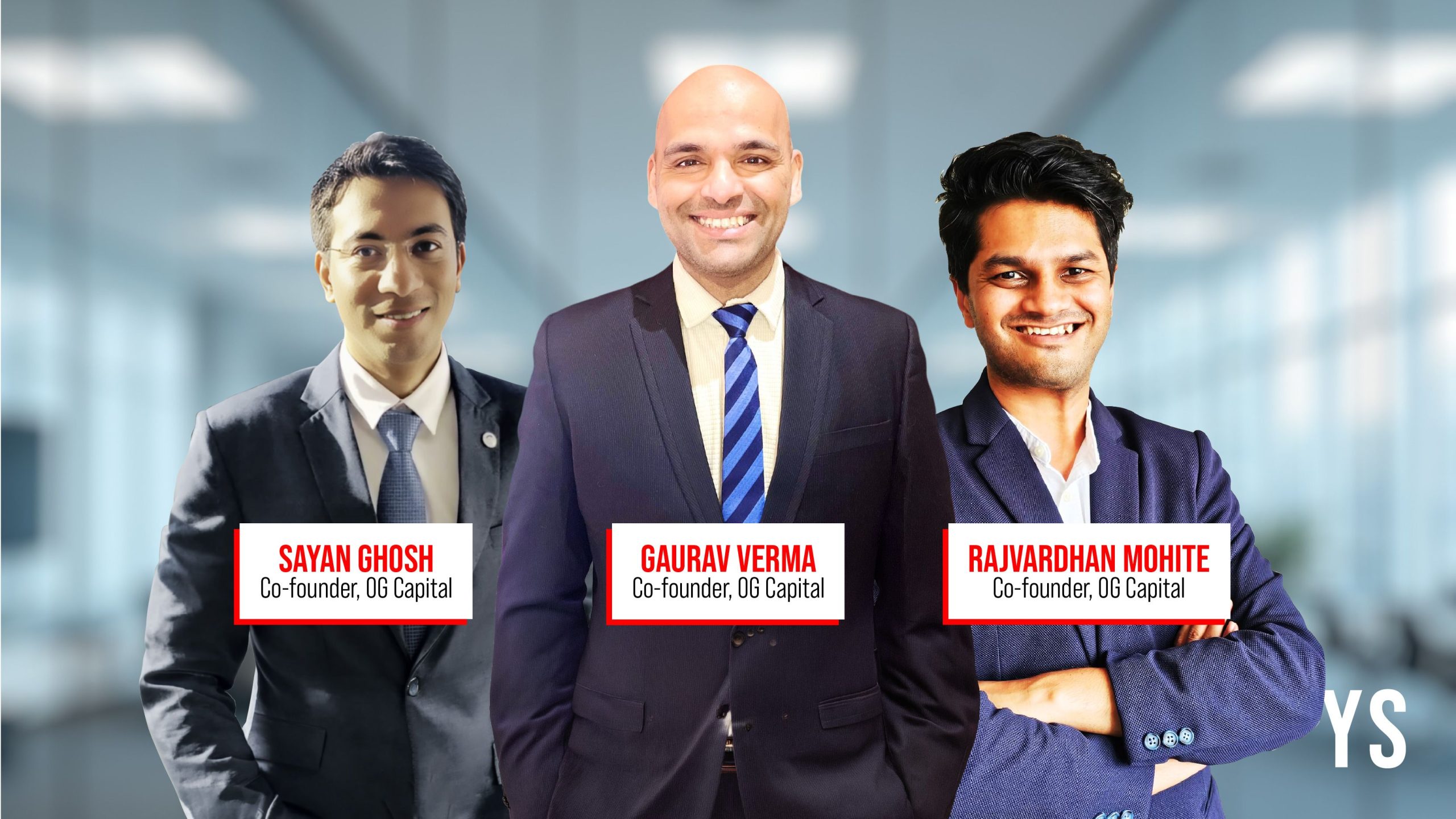
Founded along with Gaurav Verma and Rajvardhan Mohite, the firm is building what it describes as an execution-first model, deploying operators across go-to-market, product, and organisational design.
The fund invests selectively, just two to three companies a year, prioritising depth over scale, and measuring success through revenue growth, profitability, and internal rate of return rather than deal volume.
So far, the firm has made three investments and plans to back more than 20 companies, with ticket sizes of up to Rs 15 crore.
In an interview with YourStory, Ghosh discussed the limits of traditional venture capital, the mechanics of “co-building,” and why he believes the next generation of companies will be built “in the war room, not the boardroom.”
Edited excerpts:
YourStory [YS]: What motivated you to launch OG Capital? Was there a specific gap in the ecosystem or a personal inflection point?
Sayan Ghosh [SG]: Over the last decade, I’ve evaluated more than 500 venture, growth, and private equity funds, assessed thousands of startups, and backed companies both directly and indirectly across markets. One structural gap stood out consistently: capital is abundant, but operational support at pivotal stages is still scarce.
Nearly 70% of early-stage founders cite lack of execution support as their biggest challenge, despite the presence of hundreds of funds and operator platforms.
On a personal level, I’ve invested in over 25 startups with an 80%+ success rate and multiple exits. Combined
with the operating experience of my co-founders, that reinforced a simple belief: when investors work alongside founders as quasi co-founders, outcomes improve meaningfully.
That conviction led us to build OG Capital as a co-building platform, what we call VC 2.0.
YS: Why adopt such a hands-on model instead of the traditional VC playbook?
SG: Because we’ve seen the limits of that playbook up close. Capital alone doesn’t change outcomes, execution does.
Many companies fail not due to lack of opportunity, but because they struggle with product-market fit, go-to-market precision, scaling technology, or operational bottlenecks.
We built OG Capital from the founder’s lens, not the fund manager’s. The ecosystem doesn’t need another capital provider, it needs execution partners.
Boardroom advice can only go so far. Real companies are built in the trenches, on sales calls, in product reviews, in customer meetings. That’s where we operate.
YS: What infrastructure have you built to support this model?
SG: We’ve designed OG Capital as an execution engine. Our operating team includes former founders and specialists across GTM, product, brand, and organisational design, who embed directly into portfolio companies.
We also use a quarterly phase-gating system. At each stage, we assess operational, financial, and organisational risks before moving forward. This includes structured reviews of revenue quality, unit
economics, customer concentration, team readiness, and product-market fit.
This approach allows us to intervene early and course-correct before issues compound. Across our portfolio, it has reduced execution cycles by 30–40% and created a repeatable playbook from early validation to profitable scale.
YS: Co-building limits scale. Why prioritise depth over breadth?
SG: We’re not optimising for AUM or deal count. We invest in two to three companies a year and go deep.
Each company gets access to a full-stack operating bench GTM teams, product leaders, organisational designers, and financial operators working directly within the business.
This level of involvement isn’t possible in a traditional “spray-and-pray” model. But it allows us to build more resilient businesses. Today, 65% of our portfolio is already profitable.
YS: How many companies can you realistically support with this model?
SG: Our bandwidth allows us to take on one to two companies per year in each of our core segments, consumer and enterprise.
We work closely with each company for the first 18 months, building foundations and scaling profitably. After that, we transition to structured operating support while moving to newer investments.
For us, scale is defined by outcomes, not volume.
YS: How has your experience as an LP shaped your approach as a GP?
SG: As an LP, I saw hundreds of fund managers operate across cycles. The best weren’t always the most visible, they were disciplined, clear in strategy, and willing to adapt.
Today, I think less like a dealmaker and more like a portfolio architect, balancing risk, concentration, and the potential for outsized outcomes.
The biggest takeaway, however, was governance. The strongest firms operated with rigour, clear reporting, structured decisions, and zero tolerance for grey areas. That’s foundational to how we’ve built OG Capital.
YS: What does “co-building” actually look like in practice?
SG: It’s shared execution, not advisory.
In the early stages, we help map initial customers, refine value propositions, design pricing experiments, and expand GTM channels while optimising CAC and retention.
We get involved in hiring, drafting job descriptions, structuring interviews, even participating in evaluations.
We’ve helped rehearse investor pitches, rebuilt onboarding flows, and opened new revenue streams.
We’re present during critical moments, whether that’s peak sales events or enterprise deal negotiations.
In essence, we operate as an extension of the founding team until the company builds its own execution muscle.
YS: Who are your limited partners?
SG: Our LP base consists largely of operators, founders, CEOs, and senior executives from firms like HCL, Meta, McKinsey, Bain, BCG, Morgan Stanley, Hindustan Unilever, L’Oréal, and IFC.
We also have participation from alumni networks such as FMS Delhi, alongside professionals from global investment institutions and family offices.
Importantly, many of our LPs are active contributors. They support portfolio companies through introductions, strategic guidance, and market access. In that sense, our LP base reflects our philosophy—builders backing builders.