
Client Alert | February 26, 2026
Covered “venture capital companies” must register with the DFPI beginning March 1, 2026, and, by April 1, 2026, must submit an annual report covering in-scope activity for 2025.
California’s venture capital founder diversity reporting regime, the California Fair Investment Practices by Venture Capital Companies Law (FIPVCC) [1], as discussed in our prior client alert, is moving into its first reporting cycle, now administered by the California Department of Financial Protection and Innovation (DFPI). Covered “venture capital companies” must register with the DFPI here beginning March 1, 2026, and, by April 1, 2026, must submit an annual report covering in-scope activity for 2025.
The below decision tree sets forth how to determine if the FIPVCC’s reporting requirements apply to an entity.
Covered Entities Subject to the Reporting Requirements
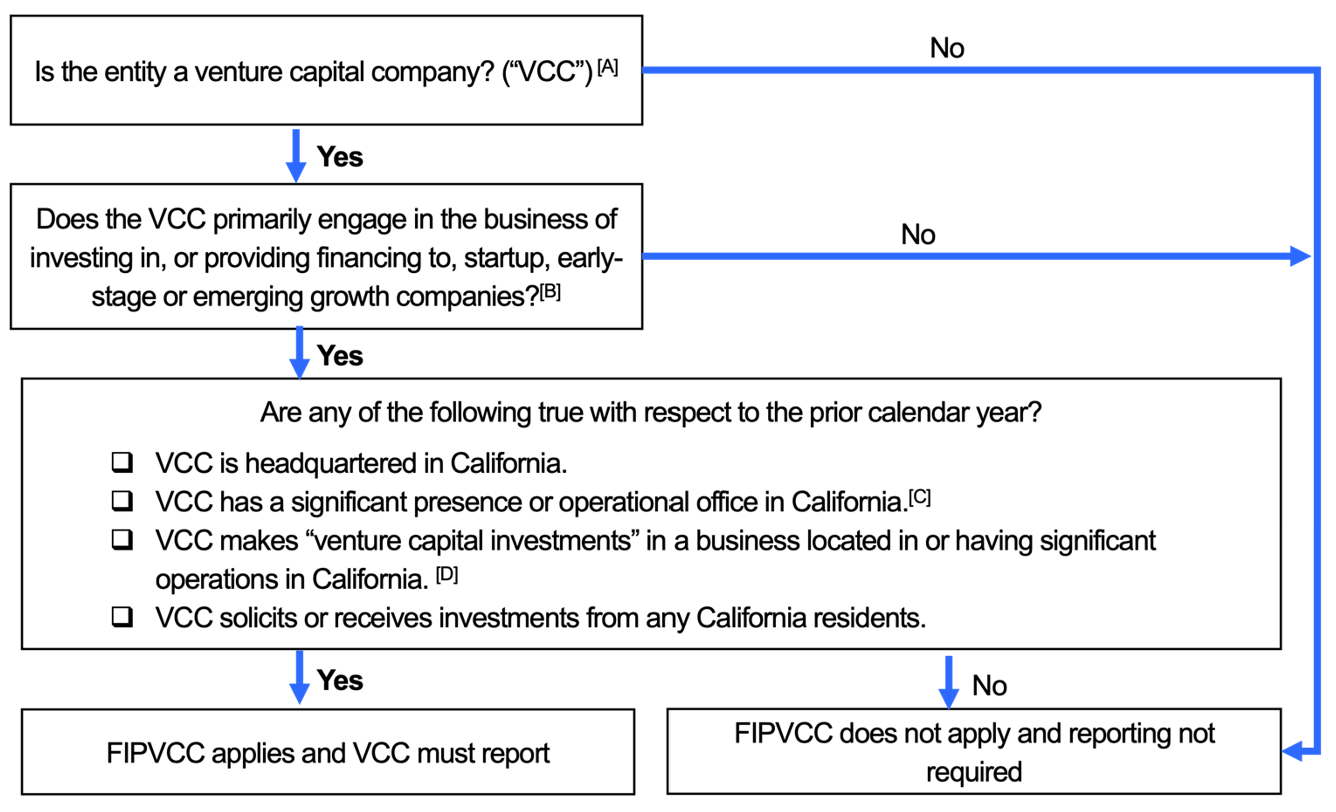 |
Chart Footnotes
A. The California Code’s definition of a “Venture Capital Company” is complex, and whether an entity will be considered a VCC merits a case-by-case analysis. In simple terms, an entity generally will be a VCC in California if it is: (i) a “Venture Capital Fund” as defined by the SEC, meaning it is a private fund that (1) holds itself out to investors as pursuing a venture capital strategy, (2) holds no more than 20% of the fund’s commitments in non-qualifying investments, including non-convertible debt, secondaries, public issuances, other private or registered funds, certain digital assets, or leveraged buyouts, (3) does not borrow or otherwise incur leverage in excess of 15% of the fund’s commitments, and then only on a short-term basis, and (4) limits investor redemption rights to “extraordinary circumstances”; (ii) a “Venture Capital Operating Company” as defined by the Department of Labor, meaning 50% of fund assets (valued at cost) must be invested in operating companies or derivative investments in which the fund has direct contractual management rights and the fund must exercise such management rights with respect to at least one portfolio company; or (iii) if 50% or more of the entity’s assets are “Venture Capital Investments” or related derivatives per Section 260.204.9 of the California Code at any time in a given reportable year. “Venture Capital Investment” means an acquisition of securities in an operating company as to which the investment adviser, the entity advised by the investment adviser, or an affiliated person of either has or obtains management rights, or the right to substantially participate in, to substantially influence the conduct of, or to provide (or to offer to provide) significant guidance and counsel concerning, the management, operations or business objectives of the operating company in which the venture capital investment is made.
B. No guidance or cross-reference has been given regarding the definitions of “primarily engage,” “early-stage” or “emerging growth companies” under the FIPVCC.
C. No guidance or cross-reference has been given regarding what constitutes a “significant presence” in California under the FIPVCC, and sponsors will need to make a subjective determination regarding the same.
D. See footnote [A] for the definition of Venture Capital Investment. No guidance or cross-reference was given regarding what constitutes “significant operations in California” under the FIPVCC, and sponsors will need to make a subjective determination regarding the same.
Reporting Requirements
Under the FIPVCC, covered entities are required to provide portfolio companies the opportunity to provide demographic data on a prescribed form, and then make annual reports to the DFPI with respect to portfolio companies in which they have made venture capital investments over the prior calendar year on the (i) founding team demographics of their portfolio companies and (ii) investments each covered entity makes in portfolio companies with diverse founding teams. “Founding team members” include any individual designated as the chief executive officer or president, as well as individuals who: (A) owned initial shares or similar ownership interests of the business; (B) contributed to the concept of, research for, development of, or work performed by the business before initial shares were issued; and (C) were not passive investors in the business.
In connection with a new venture capital investment, a covered entity must provide founding team members with the DFPI survey after execution of the investment agreement and the first transfer of funds. Participation in the survey is voluntary, and covered entities may not encourage, incentivize, or influence participation; declines and non-responses must be included in the aggregate results.
Demographic data of portfolio company founding teams that must be reported under the FIPVCC on an aggregated and anonymized basis, to the extent it was provided by the covered entity, includes:
- Race;
- Ethnic identity;
- Individuals who identity as LGBTQ+;
- Gender identity, including nonbinary and gender-fluid identities;
- Disability status;
- Veteran or disabled veteran status; and
- California resident status.
Investments made in the prior calendar year in portfolio companies with diverse founding teams must also be reported as a percentage of the covered entity’s aggregate venture capital investments. The FIPVCC requires both aggregate reporting and categorical reports for each enumerated group above. Additionally, the covered entity must report the dollar amount of its venture capital investments for the prior calendar year and the principal place of business of each portfolio company. Once an entity is determined to be subject to FIPVCC reporting, the information must be provided with respect to all portfolio companies in which venture capital investments were made, regardless of whether the portfolio company has a California nexus. The FIPVCC allows the DFPI to publish this anonymized information online and collect fees for the administration of the FIPVCC, which are currently set at $175 per report.
Consequences of Non-Compliance
The DFPI will notify any covered entity that fails to comply with the registration or reporting requirements and will provide a 60-day period to cure the noncompliance. If the deficiency is not remedied within that time, the firm may be subject to penalties of up to $5,000 per day, in addition to the required filing fees, with the potential for higher penalties for reckless or knowing violations.
Manager-Level Reporting
The FIPVCC suggests that a sponsor that controls multiple covered entities may be permitted to submit a single, consolidated report on behalf of all its controlled funds. This may simplify the reporting process for larger platforms. However, final guidance on the mechanics and eligibility for consolidated reporting has not yet been issued. Firms considering this option should be prepared to submit reports on a fund-by-fund basis if required.
Recordkeeping
The FIPVCC specifically requires that all records related to compliance – including survey responses, aggregated demographic data, investment records, and annual reports – be retained for a minimum of five years from the date of filing each annual report. Covered entities should ensure that their recordkeeping systems are designed to meet this five-year retention period and that records are readily accessible in the event of a DFPI examination or request. Data should be stored securely and access should be limited to authorized personnel to protect the privacy of founding team members.
Industry Developments
Industry groups, including the National Venture Capital Association, have requested that the DFPI delay the initial compliance deadline to allow firms more time to implement the necessary data collection and reporting systems. As of the date of this alert, the deadlines remain in effect. Firms should monitor DFPI announcements for any updates.
Next Steps for Covered Firms
In light of the upcoming April 1, 2026 deadline, covered firms should consider taking the following actions:
- Confirm Coverage. Analyze which entities within the structure met the definition of a “venture capital company” and had the requisite California nexus in 2025.
- Identify Reportable 2025 Activity. Compile a list of in-scope venture capital investments made during calendar year 2025 to determine which portfolio companies should receive the DFPI survey.
- Implement Founder Survey Process. Establish a workflow for delivering the DFPI survey to founders, tracking responses and securely storing the collected data.
- Establish Internal Controls. Implement policies and procedures to ensure the accuracy of reported data, retain required books and records and maintain the confidentiality of sensitive information.
- Determine Reporting Strategy. Decide whether to report on a fund-by-fund basis or to pursue a consolidated, manager-level report, pending potential DFPI guidance.
[1] Senate Bill 54, Ch. 594, 8 October 2023 available here.
Gibson Dunn’s lawyers are available to assist with any questions you may have regarding the issues and considerations discussed above. Please contact the Gibson Dunn lawyer with whom you usually work, the author, or any of the following leaders and members of the firm’s Investment Funds practice group:
Carolyn Abram – Dubai (+971 4 318 4647, cabram@gibsondunn.com)
Kevin Bettsteller – Los Angeles (+1 310.552.8566, kbettsteller@gibsondunn.com)
Albert S. Cho – Hong Kong (+852 2214 3811, acho@gibsondunn.com)
Candice S. Choh – Los Angeles (+1 310.552.8658, cchoh@gibsondunn.com)
Shannon Errico – New York (+1 212.351.2448, serrico@gibsondunn.com)
Blake E. Estes – New York (+1 332.253.7778, bestes@gibsondunn.com)
Marian Fowler – Washington, D.C. (+1 202.955.8525, mfowler@gibsondunn.com)
A.J. Frey – Washington, D.C./New York (+1 202.887.3793, afrey@gibsondunn.com)
Shukie Grossman – New York (+1 212.351.2369, sgrossman@gibsondunn.com)
James M. Hays – Houston (+1 346.718.6642, jhays@gibsondunn.com)
Kira Idoko – New York (+1 212.351.3951, kidoko@gibsondunn.com)
Duncan K. R. McKay – New York (+1 212.351.2603, dmckay@gibsondunn.com)
Gregory Merz – Washington, D.C. (+1 202.887.3637, gmerz@gibsondunn.com)
Eve Mrozek – New York (+1 212.351.4053, emrozek@gibsondunn.com)
James O’Donnell – London (+44 20 7071 4261, jodonnell@gibsondunn.com)
Roger D. Singer – New York (+1 212.351.3888, rsinger@gibsondunn.com)
Edward D. Sopher – New York (+1 212.351.3918, esopher@gibsondunn.com)
C. William Thomas, Jr. – Washington, D.C. (+1 202.887.3735, wthomas@gibsondunn.com)
Kate Timmerman – New York (+1 212.351.2628, ktimmerman@gibsondunn.com)
© 2026 Gibson, Dunn & Crutcher LLP. All rights reserved. For contact and other information, please visit us at www.gibsondunn.com.
Attorney Advertising: These materials were prepared for general informational purposes only based on information available at the time of publication and are not intended as, do not constitute, and should not be relied upon as, legal advice or a legal opinion on any specific facts or circumstances. Gibson Dunn (and its affiliates, attorneys, and employees) shall not have any liability in connection with any use of these materials. The sharing of these materials does not establish an attorney-client relationship with the recipient and should not be relied upon as an alternative for advice from qualified counsel. Please note that facts and circumstances may vary, and prior results do not guarantee a similar outcome.