Global ecommerce leaders say brands are under unprecedented pressure to satisfy rising consumer expectations while managing cost, complexity, and competitive disruption — leading many of these executives to embrace artificial intelligence (AI) as a strategic imperative rather than experimental technology, according to new research.
The findings come from “From Insights to Execution in AI-Powered Commerce,” a survey commissioned by ecommerce accelerant Pattern. Censuswide conducted the survey in September of 1,018 senior business leaders in the United States, United Kingdom, United Arab Emirates and Germany. Participants came from marketing, sales, finance, legal and operations roles at companies reporting at least $3 million in annual ecommerce revenue.
Ecommerce leaders report mounting operational pressures. Nearly eight in 10 (78%) said expectations for next-day delivery are straining supply chains, and 76% said maintaining brand control across multiple digital channels is increasingly difficult — signaling growing friction between consumer demand and logistical capability.
How ecommerce leaders are tackling AI integration
The survey highlights a strategic shift in where and how consumers shop. About 79% of respondents said social commerce platforms such as TikTok Shop are reshaping purchasing behavior by blending entertainment and commerce. At the same time, 77% believe ultra-low-cost marketplaces are fueling a race to the bottom on price, intensifying competition and pressuring traditional retailers.
Faced with these pressures, brands are accelerating investment in artificial intelligence.
The report notes that ecommerce companies surveyed spent an average of $291,626 on AI technologies over the past year. It projects spending will rise to $323,886 in the coming year. These trends align with broader forecasts that the global AI-enabled ecommerce market could grow to $22.6 billion by 2032. That would be up from an estimated $8.6 billion in 2025 — driven by adoption of tools that improve personalization, forecasting and operational efficiency.
“AI agents aren’t a future interface,” said Ryan Byrd, chief technology officer at Pattern, in commentary reported alongside the research. “They’re a new operating layer for commerce. Brands that treat agentic AI like just another marketing channel will fall behind.”
About one-third of ecommerce brands surveyed said they have already deployed AI-powered shopping agents, while a larger share is actively exploring use cases tied to search and discovery.
AI adoption by region
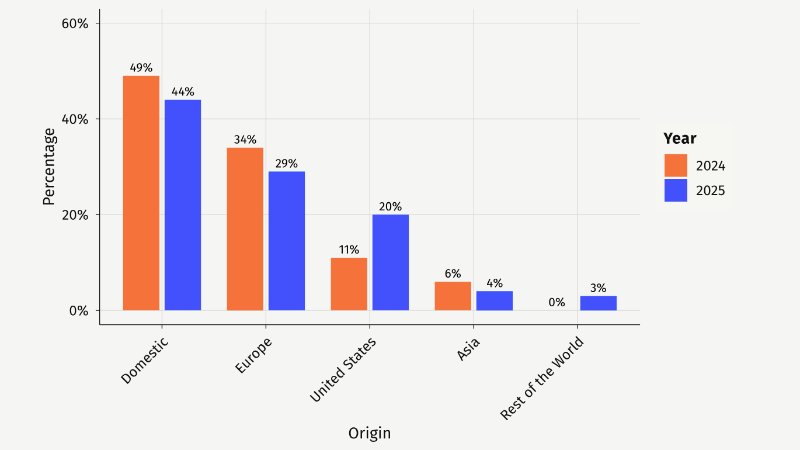
The report found clear regional differences in AI adoption. In the United Arab Emirates, AI is advancing with government backing and national initiatives. Meanwhile, in the United Kingdom, regulatory frameworks and ethical concerns are shaping a more deliberate approach. And in the United States, private-sector demand, especially for personalization and logistics automation, is driving much of the early adoption.
Despite varied maturity, about three-quarters of respondents believe their industry will look unrecognizable in five years due to AI, marking a shift from experimentation to strategic deployment.
Executives reported that AI is already generating measurable impact:
- Marketing: Generative AI and predictive analytics are enabling hyper-personalized campaigns and real-time optimization.
- Sales: AI-driven forecasting tools are improving demand predictions.
- Customer Service: Conversational AI is reducing resolution times, allowing human agents to address more complex issues.
- Fulfillment and Operations: Data-driven insights are improving efficiency and responsiveness.
Across functions, leaders say AI is essential for staying competitive, improving operational efficiency and enhancing customer experience.
While enthusiasm for AI is strong, about 75% of ecommerce organizations said government attitudes or regulations have influenced their adoption strategies, suggesting that concerns over compliance, data privacy and responsible use are shaping technology deployment.
As brands face simultaneous pressures from consumer expectations, logistical complexity and competitive pricing, the survey reflects a broader industry transition: AI is no longer an optional enhancement but a core foundation of modern ecommerce strategy.
Sign up
Sign up for a complimentary subscription to Digital Commerce 360 B2B News. It covers technology and business trends in the growing B2B ecommerce industry. Contact Mark Brohan, senior vice president of B2B and Market Research, at mark@digitalcommerce360.com. Follow him on Twitter @markbrohan. Follow us on LinkedIn, X (formerly Twitter), Facebook and YouTube.
Favorite