[ad_1]
The firm, which has backed companies such as Anthropic, Anduril, and Zepto, is accelerating its shift from traditional venture investing to a broader platform-led, company-creation model, amid a reset in early-stage funding globally.
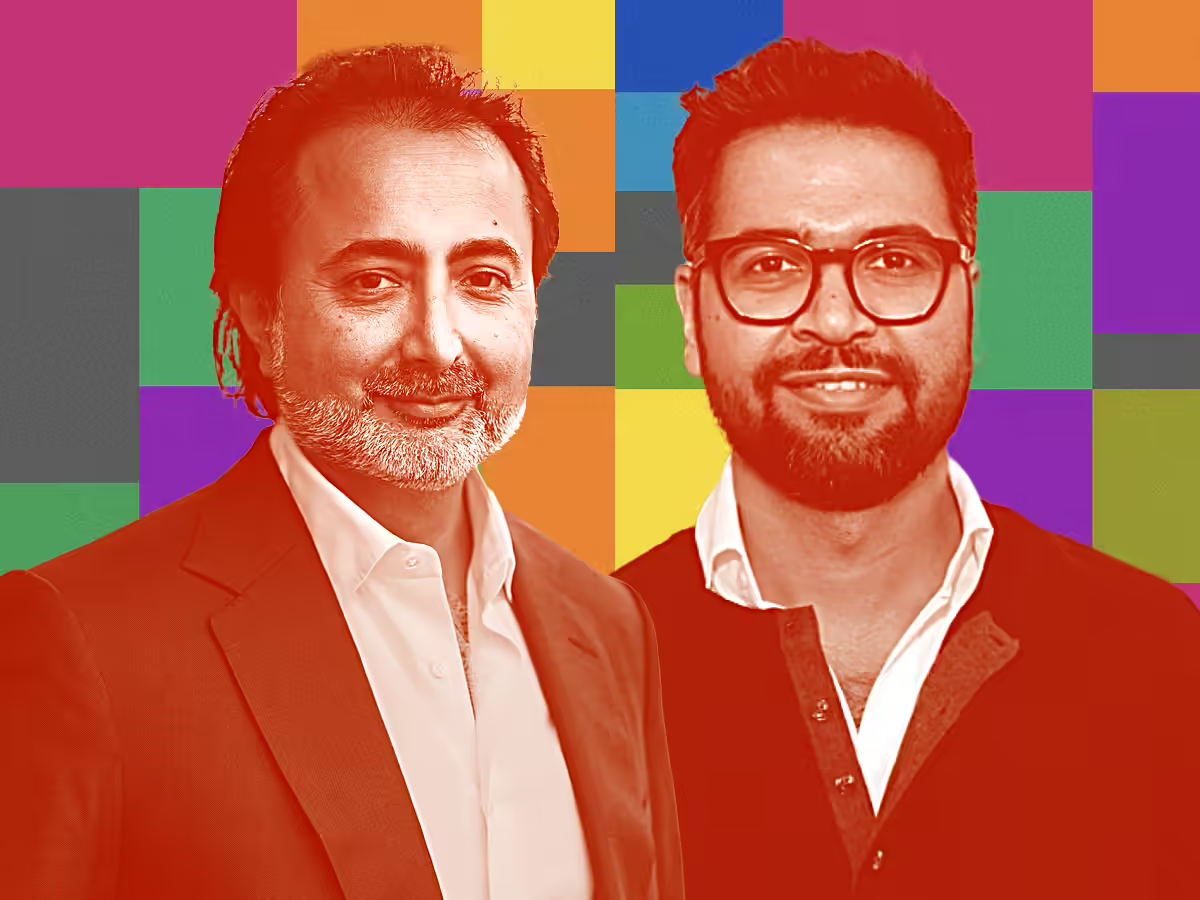
In an exclusive interaction with ET, chief executive Hemant Taneja and Neeraj Arora, CEO for India and MENA (Middle East and North Africa), outlined plans to blend early-stage investing with growth bets and roll-up strategies, deepen partnerships with Indian conglomerates and policymakers, and back applied AI as the defining opportunity for India’s next wave of entrepreneurship. Edited excerpts:
How will the $5 billion be deployed and across what time frame? Will this be traditional early-stage investing or growth bets?
Taneja: It’s going to go towards major sectors — AI, defence, healthcare, industrials — areas where the Indian economy is creating opportunities to build global market leaders.
We’re going to get more aggressive. In terms of investment strategy, we’re obviously doing early-stage investing but we also have a strategy around creation, where we roll up companies.
Arora: We’ll mimic our global platform, focus on the early stage, as we do across Europe, the US and India, but support companies all the way through growth. Some bets we’ll take at the later stage as well, like we did with Zepto.
This is similar to your global positioning…
Arora: We have a creation vehicle in the US that has been doing roll-ups, including AI roll-up strategies. It will not be a clone of that. It will be specific to what India needs. We’re working on one idea right now in manufacturing, which we’ll talk about in a couple of months.
We’ll continue to invest in consumer companies because the growth is immense and the space continues to expand. We’re also doing resilience-related investments: defence, where we’ve already had a couple of large deals; healthcare, where we have a large portfolio; fintech, which remains very important for us globally.
We’re starting to see collaboration across geographies. A defence company in India can work with the rest of our portfolio internationally. Healthcare companies here can plug into our network in the US and Europe. That becomes a huge differentiator. It’s all coming together within the GC platform, but adapted for India.
How is General Catalyst’s India portfolio shaping up?
Arora: We are actively investing across stages, from seed to growth, and currently have around 50 companies in our fairly diversified India portfolio, which includes firms like Spinny, Farmart, Loop Health, and Zepto,.
I’ve been taking over some of the relationships which were from investments before I came on board in 2024. I’ve joined the board at Spinny, for instance. It takes time to deeply engage across such a wide portfolio, but that’s the intent: to be closer to founders and strategic decisions. For investments like PB Health, we’ve doubled down with a $50-million cheque. The idea is not just to invest but to help create platforms.
Also Read: AI is helping organisations scale faster, resulting in sharp valuation gains: General Catalyst CEO Hemant Taneja
You haven’t been part of some of the notable AI breakouts from India, like Emergent or Neysa. How do you assess that?
Arora: We’ve been leaning heavily into early-stage bets. Our latest investment is in Bolna, which operates in the voice LLM orchestration layer tailored to Indian use cases. They’re already processing a few million minutes every month.
Right now, we’re backing companies early, knowing a handful will eventually break out. We’ve been in conversations with many of the firms you mentioned. The advantage of our platform is flexibility — we can partner with companies at any stage. We don’t have to restrict ourselves, but we’re making a range of early bets that helps us understand what’s gaining traction and where India can build products for a global market.
Why shift towards a platform play now?
Taneja: It goes back to our global thesis on resilience. Every region has to figure out how to build resilience in key industries — defence, industrials, energy. You want local supply and local capability.
With AI, the big opportunity is transformation. Which is about taking AI capabilities and creating ecosystems of companies that can transform industries. In scope, that is much bigger than typical venture capital.
We partner with ambitious founders building category-defining companies. But then the question is: what do you do with them?
For us, it’s about working with those companies to transform industries in different regions. Because you need to collaborate with industry and build platforms that wouldn’t exist naturally.
Venture capital by itself is not enough. You need a platform mindset if you’re truly going to transform industries in a world where every region wants resilience and AI is diffusing into those industries.
Also Read: Discord, Snap investor Niko Bonatsos departs General Catalyst, plans new VC firm
Does this mean deeper collaboration with large Indian groups?
Taneja: If you want impact at scale, the conglomerates in India are very entrepreneurial. They’re willing to take on new opportunities aggressively. Their scale, married with the innovation of the young companies we back, is a powerful combination. We’re very keen on partnering with them.
Arora: On the AI side, we’re working on a framework to bring all stakeholders together — large companies, our portfolio firms, and the government.
The idea is to make sure that India is ahead of the curve in AI diffusion. That work is underway. We’ll talk about the formal structure when it’s ready.
AI requires billions in capital. Where can India realistically compete?
Taneja: If you look at the stack, there’s digital infrastructure, models, and applications.
On digital infra, India needs to make significant investments. If work that used to be done by labour turns into AI workloads, and those workloads are owned by non-Indian companies, you lose onshore productivity gains. That affects Indian prosperity.
In the model layer, we have frontier labs in the US and open source largely in China. India has to invest in this layer because otherwise you’re dependent on either American technology or Chinese open source, which creates strategic risk. But you don’t need the biggest models for everything. You can build efficient smaller models. That doesn’t require billions of dollars.
Digital infrastructure is capital-intensive. Applied AI doesn’t need that level of investment because software does much of the work. What used to take a thousand engineers can now be done by ten. This layer is about unleashing entrepreneurship.
Arora: The goal isn’t to go head-to-head with frontier labs, but to work alongside them while strengthening India’s own capabilities. Much of the AI work happening, and likely to happen, in India doesn’t require the largest models.
Smaller models, especially those designed for Indian languages and edge devices, like Sarvam’s, can handle many of these use cases effectively. For India-specific workloads, Sarvam can play a meaningful role, and that doesn’t demand billions in capital. At the same time, the government must ensure India is not cut off from partnerships with frontier labs such as OpenAI, Anthropic, and Gemini, while we keep building Indian capabilities.
Beyond ChatGPT, there hasn’t been a breakout consumer AI app. When does that change?
Taneja: There’s experimentation… AI therapists, AI companions, healthcare use cases, but nothing at scale yet.
The same thing happened with the internet. The money was in infrastructure first. Consumer applications came later. The shift towards consumer spend will happen. AI makes offerings cheaper and more convenient. But it requires deeper integration with the physical world — travel, logistics, infrastructure. We’re early in that cycle. The last big consumer wave was Uber and Airbnb. We’ll see another one.
Which layer will General Catalyst double down on?
Taneja: Our interest is in the applied AI layer — across industries, manufacturing, supply chain, and others.
Cloud infrastructure is really infrastructure finance (heavy upfront capex, long payback periods). That’s not a traditional venture. But we would look at semiconductors.
We’re open-minded. We would look at starting a company, investing in an early-stage company, or buying a business. But we wouldn’t buy a company just to cut costs and sell it. It has to generate venture-type outcomes through transformation.
What happens to SaaS in an AI-native world, we have seen how the sector has been pummelled of late…
Taneja: SaaS companies are embedding AI into their products. That’s very different from building something from scratch designed for AI. Some companies will make that transition well. Many will struggle.
Will SaaS companies enjoy the aggressive multiples they had in the past? It’s hard to see that happening. AI is deflationary. Infrastructure software is a very hard place to invest in right now because models are going to absorb a lot of that value.
The applied layer, companies that help enterprises rethink operations and workflows with AI — that’s vibrant. We think that’s the replacement for traditional SaaS.
Where does India fit in this transition?
Taneja: India has an enormous IT services industry with deep enterprise relationships. If those companies transition from labour arbitrage to AI-led transformation, there’s a huge opportunity. The ones that make that shift successfully will become much more valuable.
What are the job implications?
Taneja: India has a young demographic and wants to create jobs. AI is deflationary. That creates a massive reskilling challenge. In the short term, we may need more people to drive AI-led transformation. In the medium term, we need to think about new kinds of jobs.
AI can do basic tasks more effectively. The question is how we move human ingenuity to higher-order work. You will see displacement of jobs. It will be hard to fight. It’s better to lean into it and shape the transition while reskilling along the way.
Also Read: General Catalyst to ramp up investments in manufacturing, AI
[ad_2]