[ad_1]
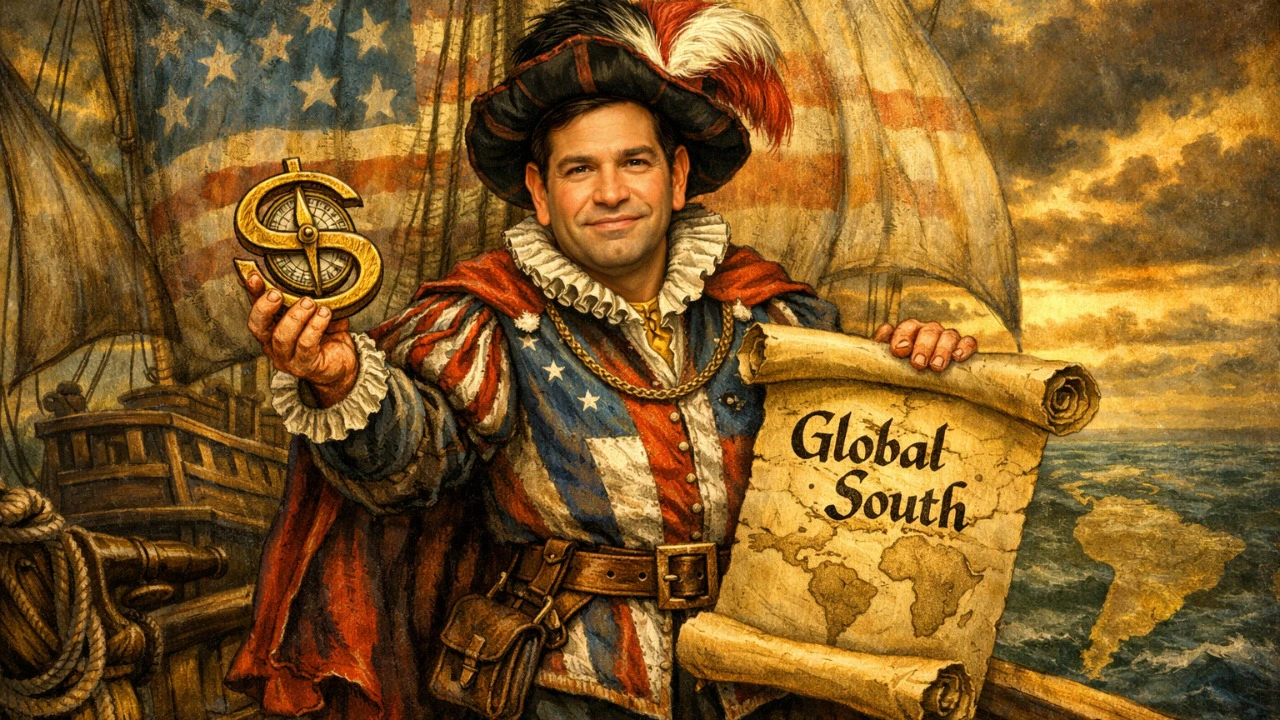
For much of the 18th and 19th centuries, European powers carved up Asia and Africa in a race for markets and raw materials. Railways were laid, and ports were built. Extracted resources were not used to develop local industry but shipped to Europe. These came at great human and economic cost. Now, centuries later, US Secretary of State Marco Rubio called on the West to compete again, this time to win “market share in the economies of the Global South”. Experts see this as the Trump administration’s bid at colonisation, and have asked countries like India to slam it.
Marco Rubio, addressing the Munich Security Conference, framed it as part of building a “new Western century”.
The Munich Security Conference is one of the world’s most influential annual forums on foreign and security policy. It brings together hundreds of heads of state, ministers, military chiefs, diplomats, and policy experts from over 70 countries to debate global security challenges.
Rubio’s approach has made many ears perk up as the wounds from being colonised are still fresh in much of the Global South. A big question—Does the Global South face a fresh phase of economic domination? And this time, it might not be led directly by Europe, but by what Rubio himself described as the “Child of Europe”, the United States. The Global South refers to a diverse, non-monolithic group of developing nations, primarily in Africa, Latin America, Asia, and Oceania.
PRESIDENT TRUMP RAISING A NEW EAST INDIA COMPANY?
“It was not the British government that seized India at the end of the 18th century, but a dangerously unregulated private company headquartered in one small office, five windows wide, in London, and managed in India by an unstable sociopath – Clive,” wrote William Dalrymple in his book, The Anarchy: The East India Company, Corporate Violence, and the Pillage of an Empire.
The English East India Company extended its tentacles across the world, including in China, Southeast Asia, Persia, the Arabian Peninsula, and parts of Africa, which forms much of the Global South today.
After returning to power, Trump has been treating US foreign policy almost like a family enterprise, and in many ways the administration appears to be functioning that way. A crypto council stacked with his family members inked a deal with the Pakistanis. Maduro’s kidnapping, without wider consultation, must have been an obvious choice for him. His efforts in Gaza come with his own informal Board of Peace. His decisions are centralised and privately driven.
Rubio’s expansionist speech comes just weeks after the US kidnapped Venezuela’s President Nicolas Maduro and his wife, and took control of the oil-rich country’s energy trade. Just like the London-based East India Company in the 18th Century, the DC-based Trump administration is trying to dictate global trade. The US imposed sanctions on India for buying crude oil from Russia, and wants New Delhi to buy Venezuelan oil, which it is controlling. India has asserted that its energy security will determine its oil trade and partners.
Geopolitical expert Brahma Chellaney said that by framing the “West’s future through the lens of identity and civilisational restoration, Rubio sought to give intellectual form to the Trump administration’s nativist and identitarian currents that echo themes found in White supremacist discourse”.
“Put simply, the vision Rubio outlined does not just seek a balance of power; rather it seeks the restoration of a global hierarchy that is inherently exclusionary and reminiscent of earlier eras of European imperialism and Western hegemony,” Chellaney wrote on X.
Reacting to Rubio’s address, French entrepreneur and geopolitical commentator, Arnaud Bertrand, said, “It is one of the most revisionist and imperialist speeches I’ve ever seen a senior American official make, and that’s saying something”.
“And just to ensure you’re clear about what he means. He wants to restore the building of ‘vast empires extending across the globe’ and blames ‘anti-colonial uprisings’ for what they did to ‘the great Western empires’,” Bertrand posted on X.
WHAT RUBIO ACTUALLY SAID ON GLOBAL SOUTH AT MUNICH SECURITY CONFERENCE?
More than being a civilisational appeal, the tone of Rubio’s address on Friday (February 14) was unapologetically expansionist. He said that “we are part of one civilisation, the Western civilisation”. He spoke about rebuilding industry, controlling borders, and reclaiming sovereignty.
Rubio traced the arc of Western power back to the end of World War II. He said that “for five centuries, before the end of the Second World War, the West had been expanding,” with “missionaries, its pilgrims, its soldiers, its explorers pouring out from its shores”. He argued that in 1945, “for the first time since the age of Columbus, it was contracting”, as Europe lay in ruins and empires entered “terminal decline”. He added that this decline was “accelerated by godless communist revolutions and by anti-colonial uprisings that would transform the world”.
He framed the process of decolonisation as the West’s “retreat”.
In that context, he said the new alliance should focus on “creating a Western supply chain for critical minerals not vulnerable to extortion from other powers; and a unified effort to compete for market share in the economies of the Global South”.
Rubio, in the American quest for dominance, sought the help of European allies in Munich. He placed the Global South explicitly within a competitive framework. Not as a partner. But as an economic space where the West must regain ground.
“Together we can not only take back control of our own industries and supply chains, we can prosper in the areas that will define the 21st century,” Rubio said on February 14.
Rubio’s emphasis on regaining ground in the Global South was strategic, commercial, and in line with US President Donald Trump’s ambitions. Rubio’s statement on the Global South, even if it aligns with Trump’s ambition to make America great again, cannot by any measure be framed as development cooperation. It looks like the total opposite.
WHY COMPETITION IN GLOBAL SOUTH SOUNDS LIKE COLONISATION
Yes, there is a difference between market competition and colonisation. Rubio might not have called for territorial control and spoke of regime change in the Global South. He spoke about supply chains, minerals, industrial policy, and economic leverage. But, isn’t that how European Colonialism started, with trade as the fulcrum. This time the difference is, it’s “Europe’s Child” that is leading the charge and urging the mother to march along.
Rubio’s broader framing matters. It is about dominance. He argued that the West must no longer “place the so-called global order above the vital interests of our people and our nations”. That suggests a harder edge to economic engagement where Western interests would be the and strategic leverage would be used openly.
For many Global South countries, this sounds familiar. In the past, Western competition meant a race for resources and asymmetric trade. Today, Rubio has seemingly turned the Global South into a battleground for critical minerals, digital infrastructure, AI, and energy.
The method has changed. The language has changed. The question over intent remains.
Kolkata-based global security analyst Debabrata Bhaduri called Rubio’s address, “insane!!”
“US Secretary of State Marco Rubio just gave one of the most explicitly pro-colonialist speeches I have seen in the 21st century. The US Empire wants Europe to help it recolonise the Global South,” Bhaduri wrote on X.
WHY RUBIO’S STANCE ON THE GLOBAL SOUTH MUST BE CALLED OUT?
Unlike the colonial era, Global South countries today are powerful sovereign states. They negotiate. They diversify partners. They pursue their strategic autonomy. They are not passive territories waiting to be divided. They bargain themselves.
Moreover, modern economic engagement operates through contracts, loans, trade agreements, and corporate investment. The times of imperial charters and gunboat diplomacy are gone and must not return.
US-based investigative journalist Jason Zaharis said Rubio’s address “should completely erase any notion that the Western Bloc is civilised or ever upheld the principles of international law, democracy or freedom”.
Author-commentator Sanjaya Baru said, “As the beacon of anti-colonialism, India should condemn this speech by Rubio with the contempt it deserves. It should be clear to all what this antediluvian Western Project is”. Antediluvian means ridiculously old-fashioned.
Still, some would argue that Rubio’s words are harmless and reflect a call for strategic competition. But history says that when the West speaks of regaining market share in the Global South, the shadow of colonisation is never too far behind.
– Ends
Tune In
[ad_2]