[ad_1]
Following the expiry of a nuclear arms pact, the New START Treaty, the United States accused China of conducting a secret nuclear test on June 22, 2020, just days after the deadly clash in Ladakh’s Galwan Valley killed 20 Indian soldiers.
The treaty, which limits the US and Russian missile and warhead deployments, was signed in 2010 by then-President Barack Obama and his Russian counterpart, Dmitry Medvedev.
The accusations levelled by the US at a Disarmament Conference in Geneva pointed out serious tensions between Washington and Beijing at a crucial moment in nuclear arms control.
“I can reveal that the US government is aware that China has conducted nuclear explosive tests, including preparing for tests with designated yields in the hundreds of tons,” US Under Secretary of State for Arms Control and International Security, Thomas DiNanno, said at the conference.
He alleged that the Chinese military tried to hide the testing by creating confusion around the nuclear explosions because “it recognised these tests violate test ban commitments”.
DiNanno further stated, “China has used ‘decoupling’, a method to decrease the effectiveness of seismic monitoring, to hide their activities from the world.”
ALSO READ | US-Russia key nuclear pact has expired. Should the world be worried amid global uncertainty?
China had conducted one such “yield-producing test” on June 22, 2020, DiNanno added.
Just a week before this date, on June 15, 2020, Indian and Chinese soldiers had a face-off in the Galwan Valley in eastern Ladakh. The clashes left 20 Indian soldiers, while Chinese casualties were reportedly said to be more than 30. However, Beijing officially acknowledged the death of only four of its soldiers.
Earlier, he also took note that the New Start’s limits are no longer relevant in 2026, “when one nuclear power is expanding its arsenal at a scale and pace not seen in over half a century and another continues to maintain and develop a vast range of nuclear systems unconstrained by New START’s terms”.
DiNanno also stated that while all of America’s nuclear forces were subject to the treaty’s limitation, only a fraction of Russia’s “much larger stockpile” was placed under the curbs.
“Exact zero Chinese nuclear weapons were covered by New START,” the US official claimed.
HTEditorial | ReSTART for arms control
Not constrained by the treaty anymore, and in response to the “destabilising behaviour of these other countries”, DiNanno said, the US can “finally” take steps to strengthen deterrence on behalf of the American people and its allies.
“This confluence of factors – serial Russian violations, growth of worldwide stockpiles, and flaws in New START’s design and implementation – gives the United States a clear imperative to call for a new architecture that addresses the threats of today, not those of a bygone era,” the Under Secretary wrote in a post on X.
DiNanno said that the US has long sought strategic stability and arms control arrangements that are “verifiable, enforceable, and contribute to the security” of the United States and its allies. He added, “What we are proposing is not talks for the sake of talks — with this effort, the United States is looking for meaningful progress based on concrete actions.”
Earlier, on the online publishing platform ‘Substack’, US Secretary of State Marco Rubio stated that Russia and China “should not expect” the United States to stand still “while they shirk their obligations and expand their nuclear forces”.
“We will maintain a robust, credible, and modernised nuclear deterrent,” Rubio added.
What China said about nuclear test claims
While China did not directly address the charges levelled against it by the US Under Secretary, it had always acted responsibly on nuclear issues.
China’s ambassador on disarmament, Shen Jian, said, “China notes that the US continues in its statement to hype up the so-called China nuclear threat. China firmly opposes such false narratives. It (the US) is the culprit for the aggravation of the arms race.”
DiNanno had also said at the conference that China will have more than 1,000 nuclear warheads by 2030.
WATCH: China denies U.S. claim of secret nuclear test as New START expires | Trump
In response, Shen reiterated that his country would not participate in the new negotiations at this stage with the US and Russia. Previously, Beijing highlighted that it has a fraction of its warhead numbers, around 600, compared to about 4,000 each for Moscow and Washington.
However, diplomats at the global conference in Geneva raised concerns over the new allegations brought in by the US.
ALSO READ | Are we back to nuclear weapon tests? Trump-Putin rivalry signals a new arms race: Here’s why that matters
Furthermore, both China and the US have signed the Comprehensive Nuclear Test Ban Treaty (CTBT), which bans explosive nuclear tests, but neither has ratified it. Meanwhile, Russia signed and ratified it, until it withdrew the ratification in 2023.
What is New START Treaty?
In 2010, then-US President Barack Obama and his Russian counterpart, Dmitry Medvedev, signed the New START Treaty, restricting each side to no more than 1,550 nuclear warheads on no more than 700 missiles and bombers — deployed and ready for use.
The treaty was originally supposed to expire in 2021, but was extended for five more years.
In February 2023, Russian President Vladimir Putin suspended Moscow’s participation, saying that his country could not allow US inspections of its nuclear sites at a time when Washington and its NATO allies openly opposed it in view of the war in Ukraine.
ALSO READ | China denies Trump’s explosive secret nuclear weapons testing claim
However, the Kremlin also pressed that it was not withdrawing from the pact entirely, pledging to respect the limitations on nuclear weapons.
In September, Putin noted that the treaty’s expiration would be destabilising and could even fuel nuclear proliferation, offering to abide by the New START’s curbs for a year to buy both sides some time to negotiate a successor pact, news agency PTI reported.
New START was one of the last remaining agreements in a long series of pacts between the US and Russia to limit their nuclear arsenals, starting with the SALT I in 1972.
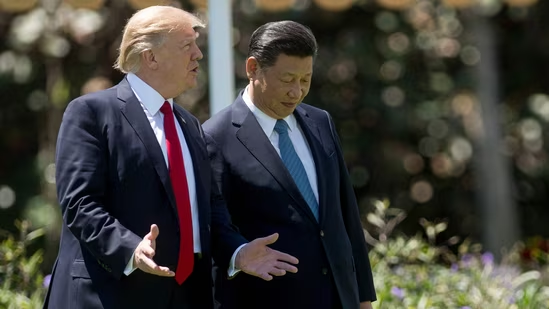
Trump wants to involve China in new treaty
US President Donald Trump has suggested that he would like to keep limits on nuclear arsenals but wants to involve China in a potential new treaty.
“I actually feel strongly that if we’re going to do it, I think China should be a member of the extension. China should be a part of the agreement,” Trump told the New York Times last month.
Trump had tried to push for a three-way nuclear agreement involving China.
“China’s nuclear forces are not at all on the same scale as those of the US and Russia, and thus China will not participate in nuclear disarmament negotiations at the current stage,” Chinese foreign ministry spokesperson Lin Jian said on Thursday.
Jian added that China regrets the expiration of New START and calls on the US to resume nuclear dialogue with Russia soon. He said that the US should also respond positively to Russia’s suggestion that the two sides continue to observe the treaty’s core limits for the time being.
[ad_2]