[ad_1]
Before we begin, please make yourselves comfortable—no rush. Thank you both for your time. To start, I’d like to discuss beauty and wellness. Japan’s approach to skincare is often described as highly effective, uncompromising in quality, and refreshingly simple compared to the more elaborate regimens popular in Korea or the West. With that in mind, what do you see as the advantages and disadvantages of so-called “J-Beauty”?
The essence of Japanese beauty care is simplicity combined with deep respect for the body’s natural ability to heal and regenerate. Human cells are constantly working to repair themselves and to stay healthy. If we overload the skin with too many layers of products, it can actually weaken these innate functions. Over-reliance on external treatments makes the skin lazy, so to speak.
Our philosophy is to support, not to replace, the body’s own systems. This applies to skincare in general and to collagen care in particular. We aim to help the skin regain its vitality by gently supporting its natural renewal processes. That is why our approach is deliberately straightforward. The power of simplicity—working in harmony with nature—is the foundation of all our product development.
That philosophy is fascinating. Let’s widen the lens and talk about Japan’s demographic challenge. Nearly 28% of the population is already over 65, and projections show that will rise to around 33% by 2035. By 2040, a worker shortage of roughly 12% is anticipated. How do these trends create opportunities and challenges for Eminet, and what is your outlook?
Japan is on the front line of global demographic change. We are the first country to face this scale of aging, so in many ways we are a laboratory for solutions. In 2024 alone, about 700,000 babies were born, while roughly 1.6 million people passed away. That represents a net population decline of about 900,000 people ー equivalent to losing one and a half times the population of Tottori Prefecture.
This is not unique to Japan. China and South Korea are beginning to confront similar realities. Meanwhile, regions such as Africa, the Middle East, and South America continue to grow and also accept immigration more readily. In contrast, Japan’s population is expected to fall below 100 million by 2050—possibly as soon as 2045.
At Eminet, we focus primarily on consumers over 50, because they represent both today’s and tomorrow’s core market. But we look beyond age: men, for example, are showing growing interest in beauty and anti-aging care. Young men in particular are now as engaged—or even more so—than women in some cases. Our strategy is to serve these evolving demographics at home while also preparing to reach new generations as they enter their 50s and 60s.
Internationally, we are exploring Asia, the Middle East, Europe and, in time, perhaps Africa. These markets face their own demographic changes, and Japanese expertise in healthy longevity can offer real value.
You mentioned men as a growing segment. Many companies are starting to see men’s skincare and wellness as a strong future market. What proportion of your current sales comes from male customers, and how do you expect that to grow?
Men are also a key focus. I personally use all our products—collagen drinks, serum, soap, gel—because I believe in them. While we have not yet disclosed an exact percentage, our goal is to significantly increase the male share of our business. We see strong potential among younger men who are beginning to embrace beauty and anti-aging as part of daily life.
Turning to e-commerce: the global share of online retail is now around 22%, and Japan is the world’s fourth-largest e-commerce market. How is Eminet using digital channels and subscriptions to build stronger, longer-lasting relationships with customers?
Eminet was founded in March 2000, and from day one we chose not to sell through general retailers. We committed instead to direct-to-consumer e-commerce. For over a decade we have been upgrading our systems to keep pace with technology and customer expectations. Our latest platform was completed this April and is now fully operational.
Social media is central to this model. About 98% of our new sales are linked to channels such as Instagram, LINE, and Facebook. We also adopted a subscription system from the very beginning—25 years ago—because beauty and wellness require consistency. True benefits come from sustained daily care, and subscriptions help customers maintain that healthy habit.
Beyond online platforms, have you changed how your teams work internally—particularly after the pandemic?
Yes. The pandemic accelerated our shift to flexible work. Today, many of our colleagues work remotely, including team members based in Tokyo. This has allowed us to expand our talent pool and maintain operational continuity while staying close to customers through digital channels.
Japan’s shrinking workforce is another concern. With a projected 12% labor deficit by 2040, how is Eminet planning to sustain growth? Will you rely on international hiring, or are automation and AI more central to your strategy?
We are approaching this challenge from multiple angles. Artificial intelligence and digital transformation (DX) are absolutely essential. We are creating systems where people and AI work side by side—in service, marketing, product development, and more—to raise productivity even if the workforce becomes smaller.
At the same time, we remain open to bringing in talent from overseas. But the key will be smart integration of people and technology to create better services and stronger innovation.
Your corporate mission is to “connect people and nature with smiles.” It’s a striking statement. Could you elaborate on what it means in practice?
Our home base of Tottori prefecture is Japan’s least populated prefecture, blessed with untouched forests, mountains, and sea. You can reach the ocean or the mountains in just 30 minutes, and in season you can still see fireflies—proof of a healthy environment. We believe our products would not exist without the gifts of nature: clean air, pure water, fertile soil.
People often take these blessings for granted. If you had to choose between one trillion yen and clean air, which would you pick? The answer is obvious, yet we forget how essential these natural elements are.
“Connecting people and nature with smiles” expresses our desire to protect these resources while sharing their vitality. A smile is more than an expression; it is energy that spreads from person to person. Our name, Eminet—“Emi” means smile in Japanese, “Net” means network—symbolizes a living network of nature and human happiness.

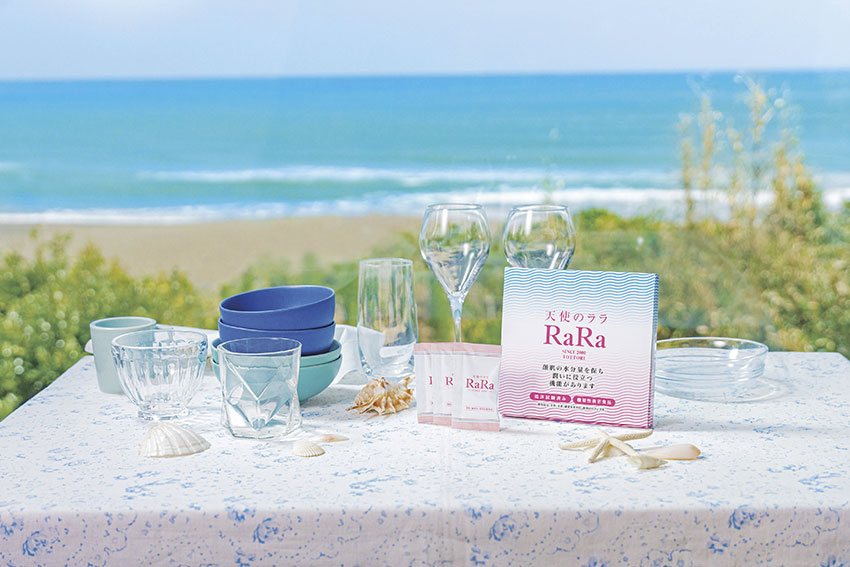
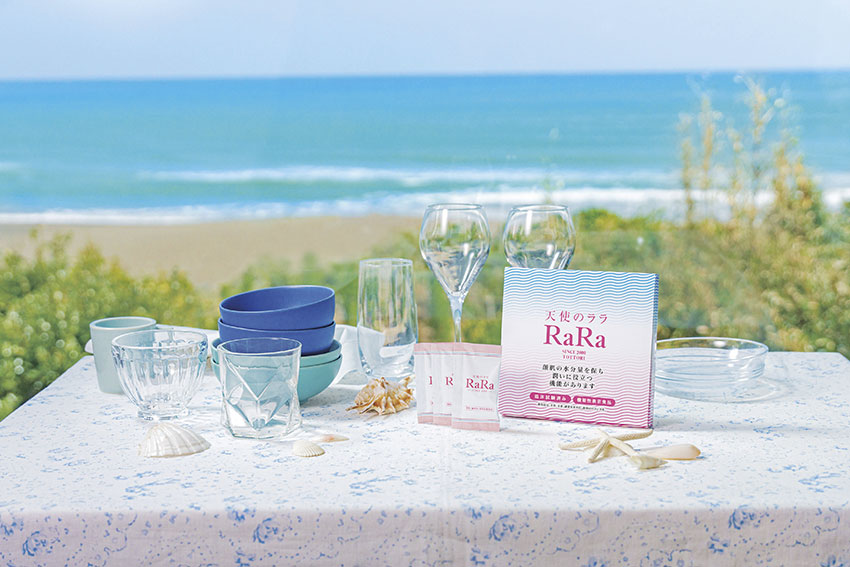
One of your flagship products is Tenshi no RaRa, a collagen supplement that has established a strong reputation in Japan’s beauty and wellness market. Collagen drinks often face issues with taste and consistency. How does Tenshi no RaRa overcome those challenges, and how is it backed by science?
From the outset, we wanted to create a collagen product that is easy to continue using, because lasting results require daily intake. We designed Tenshi no RaRa to be odorless and flavorless, which pairs with any cuisine. Customers can mix it into coffee, tea, juice—even whiskey or beer—hot or cold, at home or while traveling. Low calories and portability make it easy to maintain the routine. In Japan, it blends seamlessly into everyday lifeーmuch like bowl of white rice.
But convenience alone is not enough. We insisted on rigorous scientific validation. In 2019, Tenshi no RaRa received approval under Japan’s “Foods with Function Claims” system, which requires clinical and safety tests and publication in peer-reviewed journals. Most functional foods—over 90%—are certified based on a single active ingredient. We took a more challenging path: testing the final product as a complete formula, with independent third-party trials and long-term safety studies.
This multi-year process set Tenshi no RaRa apart and ensures consumers can trust both its efficacy and its safety.
A follow-up on format: some consumers value that your collagen is effectively “tasteless.” Do you view that as a competitive advantage because it can be combined with virtually any beverage and food?
Yes, but we do not consider that sufficient. The idea is to remove every barrier to consistency. By making the product neutral in taste and smell and packaging it in small, portable sachets, customers can add it to whatever they like—hot or cold—wherever they are. Sustainability of the routine is everything; without continuity, there is no benefit. That is why we embraced subscriptions from the very beginning and prioritized convenience, portability, and low calories.
You referenced moisturization and products like Moisture Gel and serums. Why is hydration such a central theme in your R&D?
About 60-70% of the human body is water. Moisture is fundamental to life and immunity. Yet modern living constantly depletes it. Strong UV rays break down collagen, while air conditioning—used even while sleeping—dries the skin and respiratory system. People may feel they are fine because they sweat, but internally they are still drying out.
True moisturization is not simply drinking water. It requires protecting and replenishing the body inside and out, including the hair and even the mind. We view hydration as essential to supporting natural defenses and maintaining vibrant, youthful skin.
Looking ahead, are there new product variations or formats in development that you can hint at?
We are experimenting quietly with several possibilities, including format tweaks that preserve our core benefits while offering new ways to use the product. It is early, so I cannot share details yet, but prototypes are in progress.

Tottori landscape
As you expand internationally, different regions have different climates, beauty habits, and skin types. Will you adapt your products for local markets, or keep them exactly as they are?
Cultural contexts and messaging differ greatly from country to country, and we are moving forward while learning along the way. Each country has unique conditions and beauty cultures. In the near term, we are exporting our current products, because Japanese quality enjoys strong trust. However, as we gain experience in places like Thailand, Vietnam, Malaysia, and Singapore, we may refine formulations or formats—perhaps adding subtle flavors or different packaging—to suit local preferences.
Interestingly, our liquid, additive-free format already fits well with daily routines in Southeast Asia. In the United States, where consumers are accustomed to tablets, we will evaluate different approaches. Flexibility will guide our long-term strategy.
And what will your expansion strategy look like in practice? Will you partner with local companies, focus on online channels, or open physical locations?
Japan’s domestic business is built on direct-to-consumer sales. Overseas, we will adopt a hybrid model. We plan to combine real stores with strong online and omnichannel platforms, tailored to each market. Our teams are already exploring partnerships and retail opportunities to complement digital commerce.
Finally, let’s look ahead. If we were to meet again for an interview in five years, what achievements would you most like to share?
That is a challenging but exciting question. In five years, I expect to have passed the baton to the next generation of leadership, and I would love for you to interview my successor. By then, I hope Eminet will have grown into a truly global network—perhaps with thriving operations in Southeast Asia or beyond—while staying true to our mission of connecting people and nature with smiles. Our goal is a company that continues to make people healthier, more beautiful, and genuinely happier, wherever they are in the world.
For more information, please visit their website at: https://www.emi-net.co.jp/user_data/eng
To read more about EMINET, check out this article about them.
[ad_2]