The market’s expansion is driven by policy mandates, digital wallets, and mobile-first consumer behavior
Middle Eastern B2C Ecommerce Market
Middle Eastern B2C Ecommerce Market
Dublin, Jan. 12, 2026 (GLOBE NEWSWIRE) — The “Middle East B2C Ecommerce Market Size & Forecast by Value and Volume Across 80+ KPIs – Databook Q4 2025 Update” has been added to ResearchAndMarkets.com’s offering.
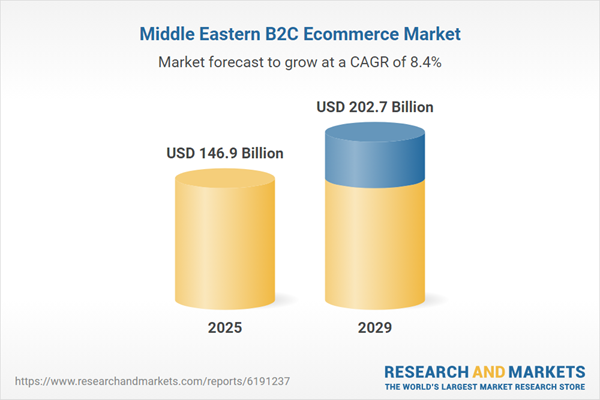
The ecommerce market in the Middle East and Africa (MEA) is positioned for substantial growth, with expectations to expand by 10% annually, achieving a market size of approximately US$146.9 billion by 2025. The region has displayed notable growth from 2020 to 2024 with a compound annual growth rate (CAGR) of 7.4%. Forecasts suggest a continued upward trajectory at a CAGR of 8.4% from 2025 to 2029, scaling from US$133.5 billion in 2024 to US$202.7 billion by 2029.
Key Trends and Drivers
Cashless Payments Propel Ecommerce Growth
Several MEA markets are moving from cash-on-delivery to digital payments. In Saudi Arabia, e-commerce spending through the mada card network hit SR29.86 billion (~$8bn) in July 2025, marking a 79% year-on-year increase. The shift towards cashless transactions is notable, with electronic payments constituting 79% of retail transactions in 2024.
Egypt’s InstaPay app scaled significantly, from 11.5 million users and $3.6bn in transactions in its first year to an annual transaction value of $53bn by 2024. Financial inclusion in Egypt rose to 74.8% of adults using transaction accounts, supported by national initiatives like the Meeza scheme.
Mobile wallets such as M-Pesa in Kenya are now the leading preference for payments and remittances, broadening access and adoption of ecommerce.
State Digital Strategies
Government digital strategies are integral, with the UAE aiming to increase the digital economy’s share of non-oil GDP. Nigeria’s ICT sector contributed approximately 20% of GDP in Q2 2024, showcasing the embedding of digital services across commerce.
Economic diversification agendas in Saudi Arabia, the UAE, and Nigeria promote less reliance on commodities. There is a significant drive to enhance digital skills and SME enablement to tackle youth unemployment.
Social and Conversational Commerce
WhatsApp, TikTok, and Instagram have become crucial channels for initiating ecommerce transactions in MEA. Nigerian merchants rely heavily on WhatsApp for sales without a full ecommerce infrastructure.
Platforms like TikTok Shop and Instagram Shopping enable direct sales integration, empowering merchants in Egypt, Nigeria, and Kenya with ecommerce capabilities without standalone websites.
Marketplace Consolidation and Logistics
Key platforms like Jumia and Takealot are expanding while facing competition from global entrants like Amazon, which launched in South Africa in 2024.
Logistics scalability, including automation and personal shopper networks, is crucial to market penetration and addressing competition pressures.
Consolidation is anticipated as smaller platforms and specialist services become acquisition targets against the backdrop of intensified cross-border competition.
Competitive Landscape
Amazon, Noon, Talabat, and Jumia are dominant players, steering aggressively into new territories with enhanced logistics, expanded assortments, and integrated services.
The market is characterized by both mature GCC markets and swiftly digitizing African nations, against a backdrop of increasing competition and regulatory oversight.
This analysis explores the comprehensive ecommerce ecosystem across MEA, offering insights into market performance, structural trends, and growth dynamics within the region’s digital retail landscape. The bundled offering includes 13 detailed reports on key MEA markets, equipped with over 800 tables and 1,200 figures, providing a data-enriched perspective on ecommerce across segments from retail shopping to technology services.
Reasons to Buy
Gain comprehensive market intelligence and detailed insights into the B2C ecommerce landscape in MEA, spanning key metrics like gross merchandise value and channel performance.
Utilize robust segmentation analysis to understand how ecommerce segments evolve across various categories.
Benefit from detailed consumer behavior profiles, aiding in strategic planning.
Access data-driven forecasts for over 80+ ecommerce KPIs, facilitating informed decision-making and strategic alignment.
Key Attributes
Report Attribute
Details
No. of Pages
1430
Forecast Period
2025-2029
Estimated Market Value (USD) in 2025
$146.9 Billion
Forecasted Market Value (USD) by 2029
$202.7 Billion
Compound Annual Growth Rate
8.4%
Regions Covered
Middle East
For more information about this report visit https://www.researchandmarkets.com/r/78cbsn
About ResearchAndMarkets.com ResearchAndMarkets.com is the world’s leading source for international market research reports and market data. We provide you with the latest data on international and regional markets, key industries, the top companies, new products and the latest trends.
Attachment
CONTACT: CONTACT: ResearchAndMarkets.com Laura Wood,Senior Press Manager press@researchandmarkets.com For E.S.T Office Hours Call 1-917-300-0470 For U.S./ CAN Toll Free Call 1-800-526-8630 For GMT Office Hours Call +353-1-416-8900
[ad_1] New Delhi: US e-commerce major Amazon on Wednesday announced to invest more than $35 billion across all its businesses in India through 2030. The […]
[ad_1] Ankur Shrivastava is the founder and managing partner at Momentum Capital, where he focuses on investing in mission-driven startups in the Indian climate tech […]