[ad_1]
Gangwon’s long-planned venture capital initiative has now crossed the line between policy and execution. With KRW 44.3 billion in sub-funds activated and local operators set to begin investments in March, the province’s move is being closely watched across Korea’s innovation landscape. The outcome from the Gangwon Regional Venture Fund will test whether regional venture decentralization can translate from policy intent to tangible startup growth.
Gangwon Signs Investment Agreement, Kicks Off ₩44.3B Fund Operations
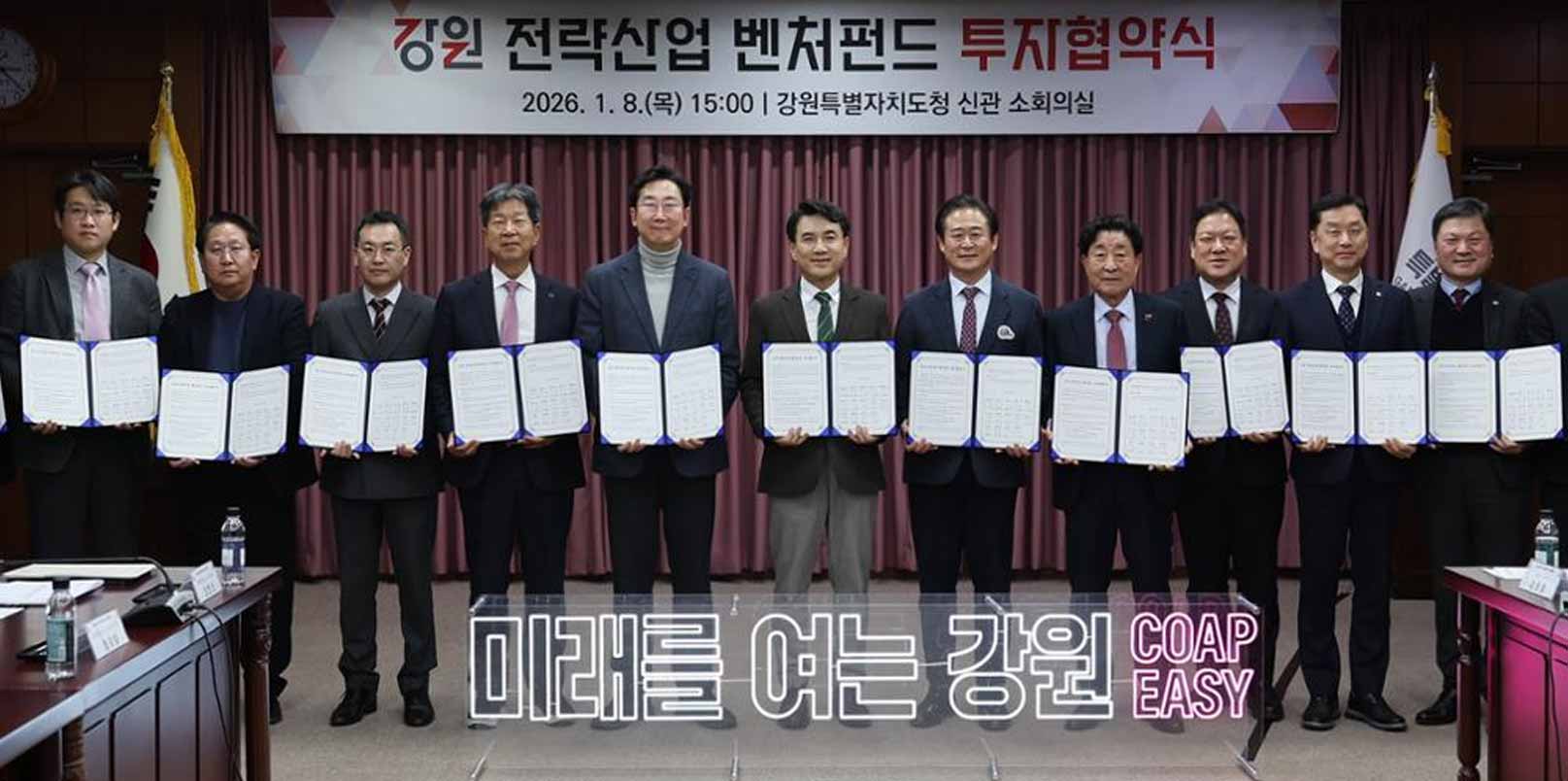
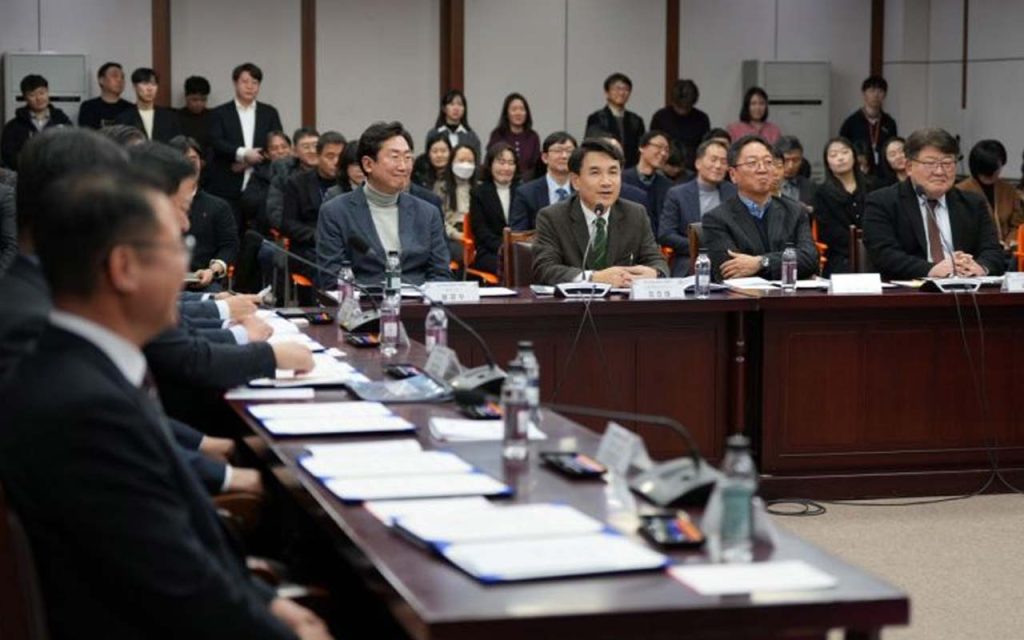
Gangwon Special Self-Governing Province held an investment agreement ceremony on January 8, marking the official start of the Gangwon Strategic Industry Venture Fund’s investment phase.
The event, hosted at the provincial government building in Chuncheon, brought together Governor Kim Jin-tae, the mayors of seven participating cities and counties — Chuncheon, Wonju, Gangneung, Hongcheon, Hoengseong, Taebaek, and Samcheok — and representatives from the selected fund management companies.
The province, along with local municipalities and private operators, confirmed a collaborative investment structure targeting Gangwon’s seven designated future industries: semiconductors, biohealth, hydrogen energy, future mobility, food tech, defense, and climate technology.
Four fund operators — Gangwon Center for Creative Economy and Innovation, Warf Investment–JKP Partners Consortium, Pathfinder H, and Kangwon National University Technology Holdings–Trigger Investment Partners Consortium — have collectively formed KRW 44.3 billion in sub-funds.
The first investments into promising small, venture, and startup companies within the province are scheduled to begin in March 2026.
Governor Kim stated that the broader KRW 150 billion (~USD 115 million) venture fund plan will be realized progressively, with new operators selected each year to maintain continuity and competitiveness in fund performance.
A Year After Launch, Gangwon’s Regional VC Strategy Enters Execution
This operational milestone follows Gangwon’s establishment of its KRW 105.6 billion regional mother fund in September 2025, supported by Korea’s Ministry of SMEs and Startups (MSS), the Korea Fund of Funds, and seven municipalities.
At the time, the initiative was hailed as a model for regional venture decentralization, marking Gangwon as the third province after Chungnam and Busan to operate a government-backed mother fund. The program’s design was intended to align local capital with national growth objectives, enabling regions beyond Seoul to foster high-tech industries with localized investment capacity.
The sub-fund activation now represents the first tangible test of that design — moving policy capital into the hands of local investors and founders.
Stakeholder Statements: Focus on Execution and Local Impact
Governor Kim Jin-tae emphasized that this phase is about results, not rhetoric:
“When we first announced the KRW 150 billion venture fund, some doubted its feasibility. This time, it’s about action, not words. A strong start is the most critical part of ensuring long-term success.”
Won Kang-soo, Mayor of Wonju, underlined the importance of timing in regional investment:
“Companies can only grow when the right investment arrives at the right moment. As Gangwon’s economy gains momentum, venture funding will act as the turbo engine that powers its next stage of growth.”
Shin Young-jae, Mayor of Hongcheon, and Kim Myung-gi, Mayor of Hoengseong, expressed similar expectations, describing the initiative as a turning point that can “give regional enterprises the wings they need to scale.”
Ecosystem Significance: From Seoul-Centric to Regionally Distributed Capital
Gangwon’s sub-fund activation signals a meaningful evolution in Korea’s regional investment policy. While Seoul remains the country’s dominant venture hub, government-backed funds like Gangwon’s are designed to correct geographic imbalance by fostering localized innovation clusters.
The KRW 44.3 billion in sub-funds forms the first operational layer beneath the mother fund’s structure — translating policy capital into investable liquidity for early-stage companies. Each operator brings a specialized role:
- The Gangwon Center for Creative Economy and Innovation focuses on seed-stage discovery and startup incubation.
- Venture capital consortiums such as Warf Investment–JKP Partners and Pathfinder H specialize in scaling early- and growth-stage companies in deep tech and advanced manufacturing.
- The Kangwon National University–Trigger Investment Partners partnership integrates academic R&D pipelines with private investment channels.
This multi-operator design not only diversifies investment risk but also reinforces Gangwon’s position within Korea’s seven-future-industry roadmap, including semiconductors, biotech, and climate innovation.
Regional Reform on Trial: Can Policy Capital Turn into Market Impact?
Gangwon’s next phase will determine whether Korea’s regional venture reform can sustain momentum beyond its initial announcement phase.
Analysts point out that regional funds face a dual challenge — maintaining investment speed and quality while balancing public accountability. Gangwon’s structure, which relies on annual operator selection, could ensure adaptability but also risks fragmentation if fund cycles overlap without continuity.
If successful, the model could become a blueprint for future decentralization efforts, proving that coordinated provincial and central funding can drive industrial diversification outside Seoul’s established venture corridors.
However, its real measure of success will be in deal flow and startup outcomes. By March, the province must demonstrate that policy-backed funds can convert administrative planning into capital that founders can actually access.
A Critical Test for Korea’s Regional Venture Ambitions
Gangwon’s venture fund is now beyond theory. With four operators, seven local governments, and KRW 44.3 billion in active sub-funds, the province has created a live experiment in policy execution and regional investment maturity.
Whether this fund generates real startup growth or simply becomes another well-intentioned initiative will depend on how effectively it bridges government capital with entrepreneurial risk.
The coming year will show if Gangwon’s ambition to be Korea’s “future industry province” can move from financial infrastructure to tangible startup success — and if Korea’s broader regional VC reform can truly balance innovation between its capital and its periphery.
– Stay Ahead in Korea’s Startup Scene –
Get real-time insights, funding updates, and policy shifts shaping Korea’s innovation ecosystem.
➡️ Follow KoreaTechDesk on LinkedIn, X (Twitter), Threads, Bluesky, Telegram, Facebook, and WhatsApp Channel.
[ad_2]