[ad_1]
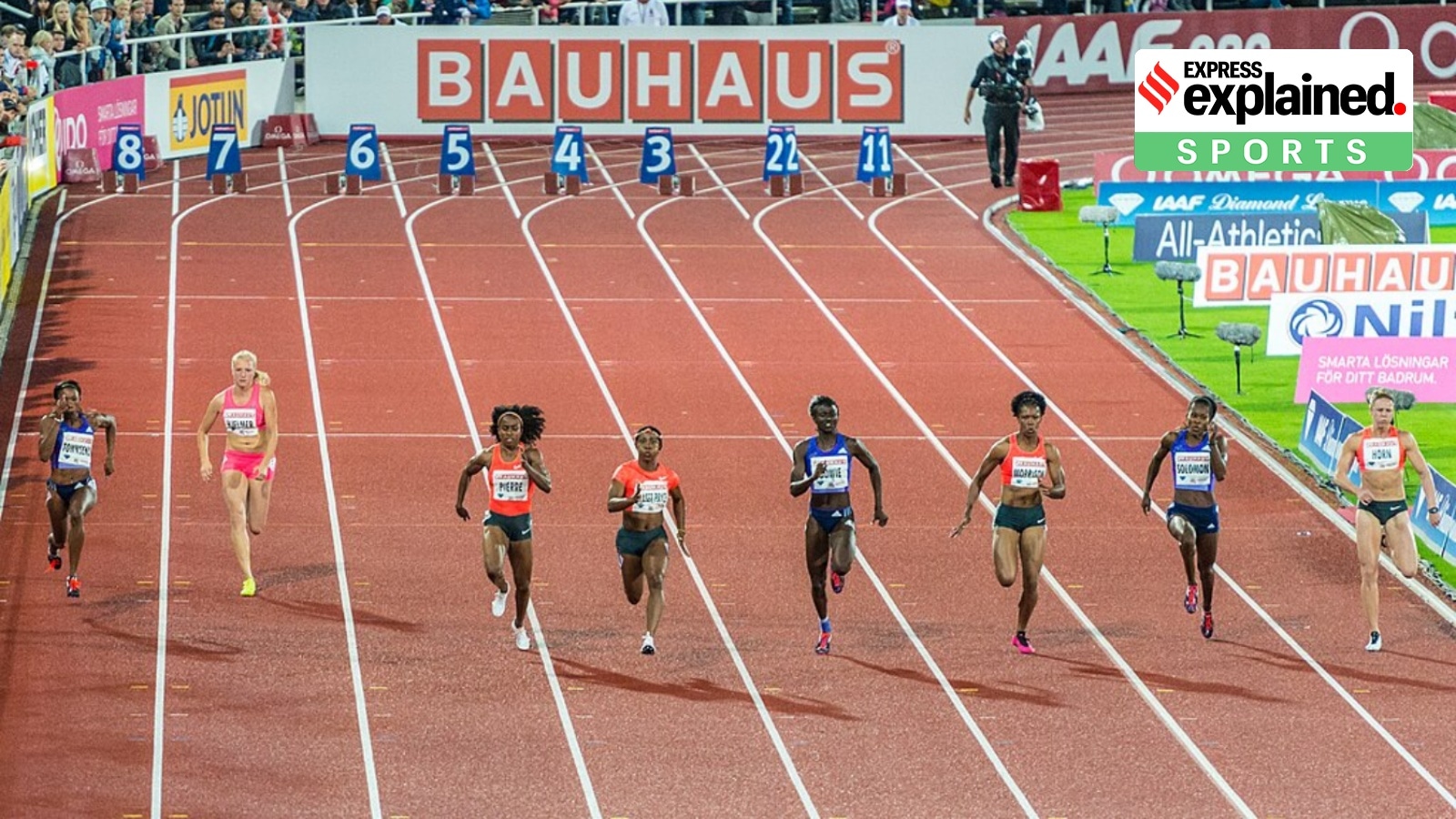
Jamaican sprinter Shelly-Ann Fraser-Pryce is just 5 feet tall. But her achievements — three Olympic golds and 10 World titles — have elevated her to a level possibly surpassing other 100-metre Olympic champions from the nearly century-old history of women’s sprinting.
How did Fraser-Pryce, who won the 100-metre Olympic gold in 2008 and 2012, make such great strides in a sport dominated by taller athletes and set the blueprint for successful track and field athletes such as Sha’Carri Richardson (five feet 1 inch)? The legendary sprinter reveals the methods behind her dominance in an interview with The Indian Express.

A field of tall competitors
First, it is instructive to note the kind of athletes that competed in sprinting before Fraser-Pryce came along.
Betty Robinson, the inaugural short dash winner in 1928, was nearly 5 feet 6 inches. Wilma Rudolph, the champion at Rome in 1932, was 5 feet 11 inches. The 1936 winner, Helen Stephens, was 5 feet 11.5 inches.
Somewhat of an exception was Gail Devers (5 feet 3 inches) who took gold at Barcelona 1992 and Atlanta 1996.
Fraser-Pryce’s major influences, too, were tall. Sample these: Jamaican pioneer Merlene Ottey (5 feet 9 inches), Fraser-Pryce’s immediate predecessor Veronica Campbell Brown (5 feet 5 inches) and her American rival Carmelita Jetter (5 feet 4 inches).
The last two Olympic champions leading into Beijing 2008 — the year Fraser-Pryce won her first Olympic gold — were Marion Jones in 2000 (5 feet 10 inches, gold medal later forfeited) and Yulia Nestsiarrnka in 2004 (5 feet 8 inches).
Story continues below this ad
When she retired after her last individual 100m race at the 2025 Tokyo World Championships at age 38, she ended as the most decorated women’s sprinter in the world.
Lightning starts
Many experts and opponents attribute the success of the five-footer to her lightning-quick start. She was off the blocks in a flash. At the Bajaj Pune Marathon earlier in December, Fraser-Pryce recalled her earliest motivation to run. An earthquake had struck Jamaica and she ran from her school to her home. The daughter of a sprinter mother, she was all of four at the time.
But the iconic blink-starts came after she worked minutely with her high school coach on cues, detailing training on the microseconds to cut the reaction time to a minimum. This always put her in the lead in the first 10 metres.
Story continues below this ad
But how did she hold off rivals with larger strides from cutting into that lead as the race progressed?
“I never saw my height as a disadvantage. I just knew I had to take a lot more steps. You can’t get rid of your height,” she laughs. Or magically add to it. “The strides just needed to be big and long,” she says.
Efficient strides
Fraser-Pryce credits plyometrics — the science of jumping — for how she won races ahead of a field that tended to be almost always taller than her.
Story continues below this ad
She counted her steps as everyone did. “I knew my steps. The race had to be completed in 54 steps or below. We worked hard on plyometrics. Once you put your mind to it, there’s no limits, certainly the height factor never once bothered me,” she tells The Indian Express.
Fraser-Pryce knew her race was going kaput if she felt she was “popping up” — jumping/hopping too high in her stride. That was like all the energy evaporating north, she jokes. It’s why she viewed some of her taller contemporaries as “having awkward, tall strides”.
Her implication: tall does not equate long, and can actually be counterproductive.
“Once I got off the blocks, I needed to ensure that my steps, the jumps in the strides were not popping up. I was moving forward — in the horizontal plane, not too high in the vertical one. Us short sprinters, stay compact,” she explains.
Story continues below this ad
It was like a plane taking off from a runway — it doesn’t seek altitude right away, but builds acceleration by pushing forward. “I mimicked a plane often. That was the science,” she says.
So, off the blocks, she would lean forward as much as she could, without toppling forward. “Start low and — I can’t repeat enough — move forward, not up,” she says.
When the strides drop, the first leg hits the ground and decides the groove of the other one.
Building core strength
Fraser-Pryce worked on her core — once her weakness — to gain the strength and stability to stay centred (that word “compact” again).
Story continues below this ad
“It’s like a roiling, rolling ball of force rumbling forward. If the core isn’t strong, you can drift sideways and lose speed — because, remember, the aim was to move forward,” she says.
Since Robinson in 1928, every Olympic women’s 100 metre champion till 1980 was a minimum of 5 feet 6 inches. Florence Griffith-Joyner was 5 feet 7 inches.
Even those following Fraser-Pryce were somewhat taller than her — Elaine Thompspn-Herah (5 feet 6 inches) and now Melissa Jefferson Wooden (5 feet 4 inches).
Ever since the time of Devers (5 feet 3 inches), cutting-edge plyometric training has helped shorter sprinters chow down more metres of the track, and not lose energy in limbs flaking off. This has gone some way in debunking the simplistic notion that longer limbs equal greater speed.
Bolt an exception
Story continues below this ad
Of course, Usain Bolt skewed all the causation-correlation theories, and his anthropometry (6 feet 5 inches height, with long legs) was indeed a case of stride length accentuating the stride frequency.
But most sprinters now know that a long stride actually leads to decreased frequency (slowing down). This is something Fraser-Pryce was acutely aware of, while magically winning at the same era as Bolt. Jamaicans just knew to optimise whatever gifts they had. “100 percent, you work with what you are given,” Fraser-Pryce reiterates.
Bolt averaged 41 strides over 100 metres and Fraser-Pryce around 54. Both won gold. “My 5 feet was my superpower,” she says.
[ad_2]