[ad_1]
The eCommerce industry in 2026 is shaped by faster delivery expectations, hyper-personalised experiences, immersive technologies like AR, and real-time customer conversations. With 70% of shoppers expecting same-day or next-day delivery and 63% preferring personalised shopping experiences, brands that invest in speed, experience, and engagement will outperform the rest.
The eCommerce industry has witnessed exponential growth over the last decade, and 2026 continues this upward trajectory. Online shopping is now deeply embedded in everyday consumer behaviour, driven by convenience, wider product choices, and faster fulfilment.
However, with more brands competing online, customer expectations have never been higher. According to recent eCommerce delivery studies, 70% of online shoppers now expect same-day or next-day delivery (Gitnux). Speed is no longer a differentiator—it’s a baseline expectation.
To stay competitive in 2026, businesses must align with trends that enhance customer experience, delivery speed, and trust.
Top eCommerce Trends to Follow in 2026
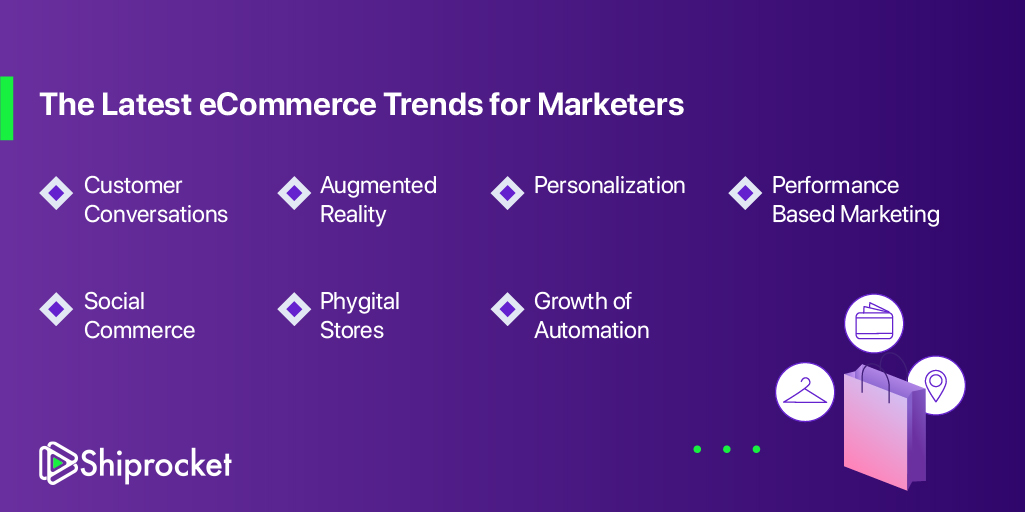
1. What Is Phygital Commerce and Why Is It a Major Trend in 2026?
Phygital commerce, which blends physical and digital retail, has become a core growth strategy in 2026.
Leading brands such as Myntra, Nykaa, FirstCry, and Lenskart continue expanding physical stores alongside their digital platforms. These stores now function as:
- Brand experience centres
- Local fulfilment and pickup points
- Return and exchange hubs
Why phygital retail works in 2026:
- Builds customer trust through physical presence
- Enables faster, hyperlocal deliveries
- Reduces return rates
- Strengthens brand recall
In 2026, successful eCommerce brands don’t operate online or offline—they operate seamlessly across both.
How Is Augmented Reality Reshaping eCommerce in 2026?
Augmented Reality (AR) has moved from experimentation to execution.
With AR-powered tools such as 3D product views, virtual try-ons, and immersive previews, customers can:
- Visualise products in real-life environments
- Try fashion and beauty products virtually
- Make more confident purchase decisions
Industry research consistently shows that AR helps reduce uncertainty, leading to higher conversions and fewer return orders. In 2026, AR plays a critical role in bridging the gap between customer expectations and product reality.
Why Is Hyper-Personalisation Critical for eCommerce in 2026?
Personalisation has evolved into hyper-personalisation in 2026.
According to customer experience studies, 63% of consumers prefer shopping from brands that offer personalised experiences (ZipDo). This makes personalisation a direct driver of conversions, repeat purchases, and loyalty.
How personalisation works in 2026:
- AI-driven product recommendations
- Behaviour-based landing pages
- Contextual offers and dynamic pricing
- Personalised communication across channels
For example, if a shopper browses sportswear from a particular brand, future visits should surface relevant collections, offers, and recommendations automatically.
Hyper-personalisation directly impacts:
How Are Customer Conversations Driving eCommerce Growth in 2026?
Customer conversations are no longer limited to support—they are now a growth lever.
In 2026, brands actively engage customers through:
- Live chat
- WhatsApp and social messaging
- AI chatbots with human escalation
Studies show that 66% of consumers say fast responses and delivery influence their purchasing decisions (Gitnux). Early, meaningful conversations help:
- Build trust at the top of the funnel
- Capture real-time feedback
- Increase repeat purchase frequency
Customer journeys in 2026 extend well beyond checkout—from discovery to post-delivery engagement.
Why Is Next-Day Delivery the Standard Expectation in 2026?
Fast delivery has become a non-negotiable expectation.
Research indicates that 60% of consumers prefer brands that offer multiple and flexible delivery options (ZipDo). Next-day delivery significantly reduces cart abandonment and increases purchase confidence.
How sellers meet delivery expectations in 2026:
- Distributed fulfilment networks
- Third-party logistics partnerships
- City-level and zone-based delivery promises
Faster fulfilment leads to:
- Higher conversion rates
- Better customer satisfaction
- Stronger brand loyalty
How Is Motion and Animation Enhancing eCommerce UX in 2026?
Static user experiences are being replaced by motion-led interfaces.
In 2026, brands use subtle animations and short videos to:
- Guide users through product journeys
- Highlight offers and CTAs
- Improve storytelling and engagement
Motion enhances usability when used strategically—especially on mobile—without overwhelming the customer.
Conclusion: What Should eCommerce Businesses Focus on in 2026?
The trends shaping 2026 clearly show that growth lies at the intersection of:
- Speed and reliability
- Personalised customer journeys
- Immersive product experiences
- Strong post-purchase engagement
Tracking the right metrics—such as ROI, delivery performance, repeat purchases, and customer lifetime value—will help businesses identify what’s working and scale effectively.
Phygital commerce, augmented reality, hyper-personalisation, conversational commerce, next-day delivery, and motion-led UX are the most important trends.
Because 70% of shoppers expect same-day or next-day delivery, and delivery speed directly influences purchase decisions.
Nearly 63% of consumers prefer personalised shopping experiences, making personalisation essential for conversions and loyalty.
Yes. AR improves product understanding, increases confidence, and reduces return rates.
By using SaaS tools, third-party fulfilment partners, and automation platforms without heavy upfront investment.
[ad_2]