[ad_1]
A week later, Singh noticed the order had been marked cancelled, allegedly because she had failed to answer calls from the delivery partner. But no one had called, and when she tried the phone number listed on the app for clarity, no one picked up. After raising a ticket, she received the number of a senior employee for her area. He admitted frankly that she was not at fault—the delivery partner assigned to her wasn’t even in the system.
“Delays are fine. But cancelling the order with the wrong reason and giving no updates is not acceptable,” she told Mint. She got refunded a few days later, but by then Singh had decided she was done with CityMall.
Singh isn’t the only one. When Ruby Kumari placed an order in Hajipur, Bihar, she was taken aback by the company’s response after she complained about receiving an item past its expiry date. “I got a refund,” she recalled, “but the customer care executive told me that I should check the order on delivery, and that they wouldn’t refund the money again as per their internal policy. What if I’m ordering for my parents and they can’t read?”
E-commerce in India’s tier-2 and tier-3 towns has long been a difficult market to crack, constrained by low order values, fragmented demand, costly last-mile logistics and uneven digital comfort among consumers. Many have ventured down this path earlier, including Dealshare, but have failed to make headway or have fallen by the wayside.
At the same time, Meesho, another company built around tier-2 and tier-3 consumers, though largely for lifestyle categories, has made a strong debut on the markets after a stellar initial public offering (IPO), underscoring both the opportunity and the volatility in this market. Meesho popularized fashion and home products, turning unbranded lifestyle goods into a massive market by enabling small entrepreneurs, particularly women, to share catalogues and earn margins.
CityMall, like Dealshare before it, hopes to emulate Meesho’s success. The startup, which sells groceries (80% of its business) and lifestyle products, is attempting to build a low-cost supply chain designed specifically for smaller towns to tackle their unique challenges. Like Meesho and Dealshare, it started out with a social commerce gambit, relying on community leaders to generate demand and aggregate grocery and daily-need orders. Dealshare has since ended its social commerce model and scaled down, while CityMall has tweaked its operating model over the last couple of years to generate demand directly.

View Full Image
Social commerce is essentially buying and selling that happens through social networks, community groups and informal digital interactions. Community leaders are mostly people who are well known in a neighbourhood.
CityMall is still a minor contender, but it has ambitions of one day becoming the default grocery delivery app for smaller towns, at least in the North. On paper, the potential appears limitless, but on the ground, it is still trying and, at times, struggling to deliver on the promise—like the two instances above state.
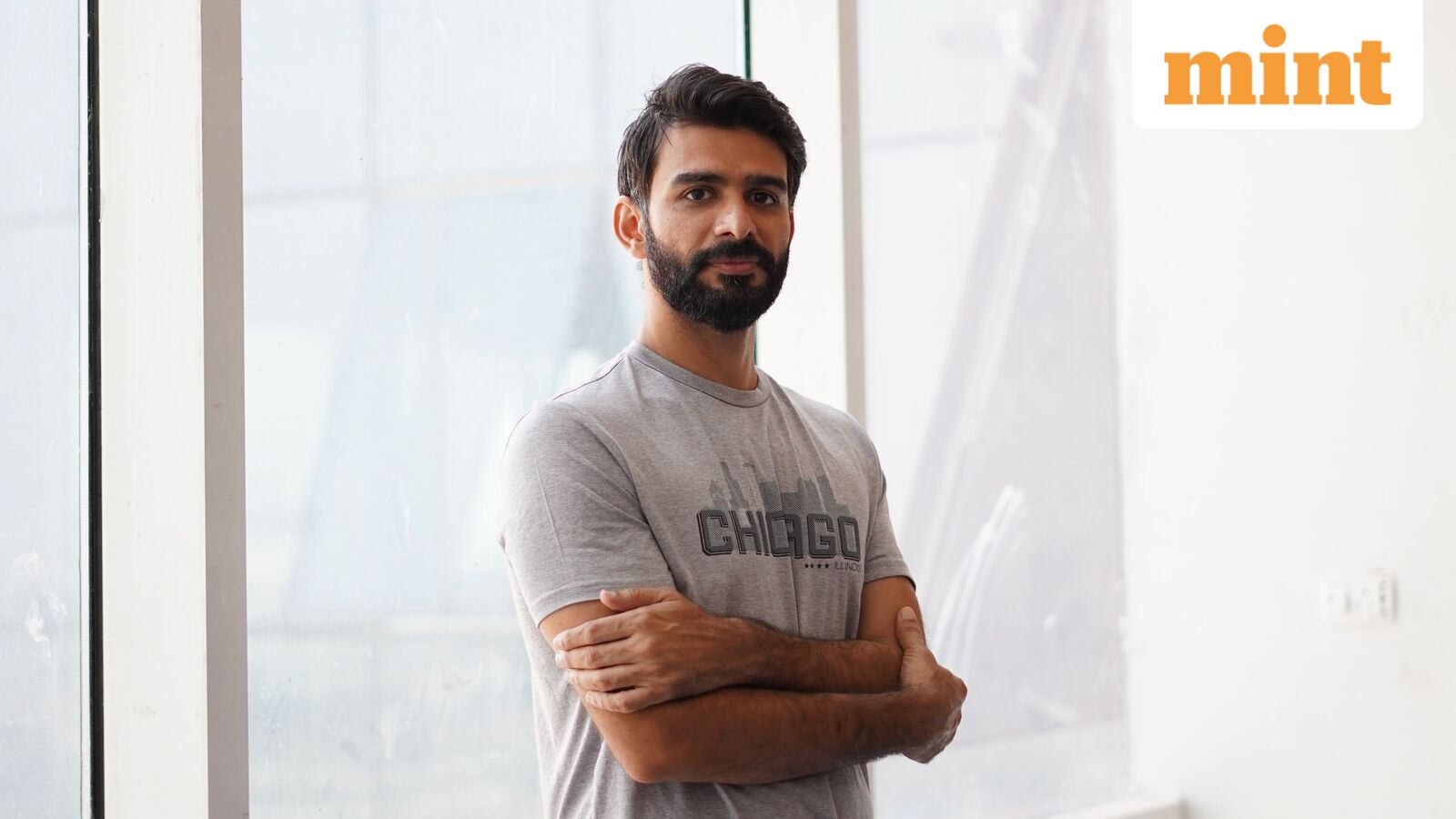
Co-founder Angad Kikla did not clarify what went wrong in the first instance, but admitted that these were “under-capacity issues” in different legs of the supply chain, like in the number of warehouses and delivery partners. “We are trying to solve it by our three new warehouses,” he said.
The company currently operates seven warehouses. The three new ones Kikla speaks about are in Patna in Bihar, Bahadurgarh in Haryana, and near Noida in Uttar Pradesh.
In short, CityMall’s capacity expansion fell way behind its rate of business growth.
Eye on Bharat
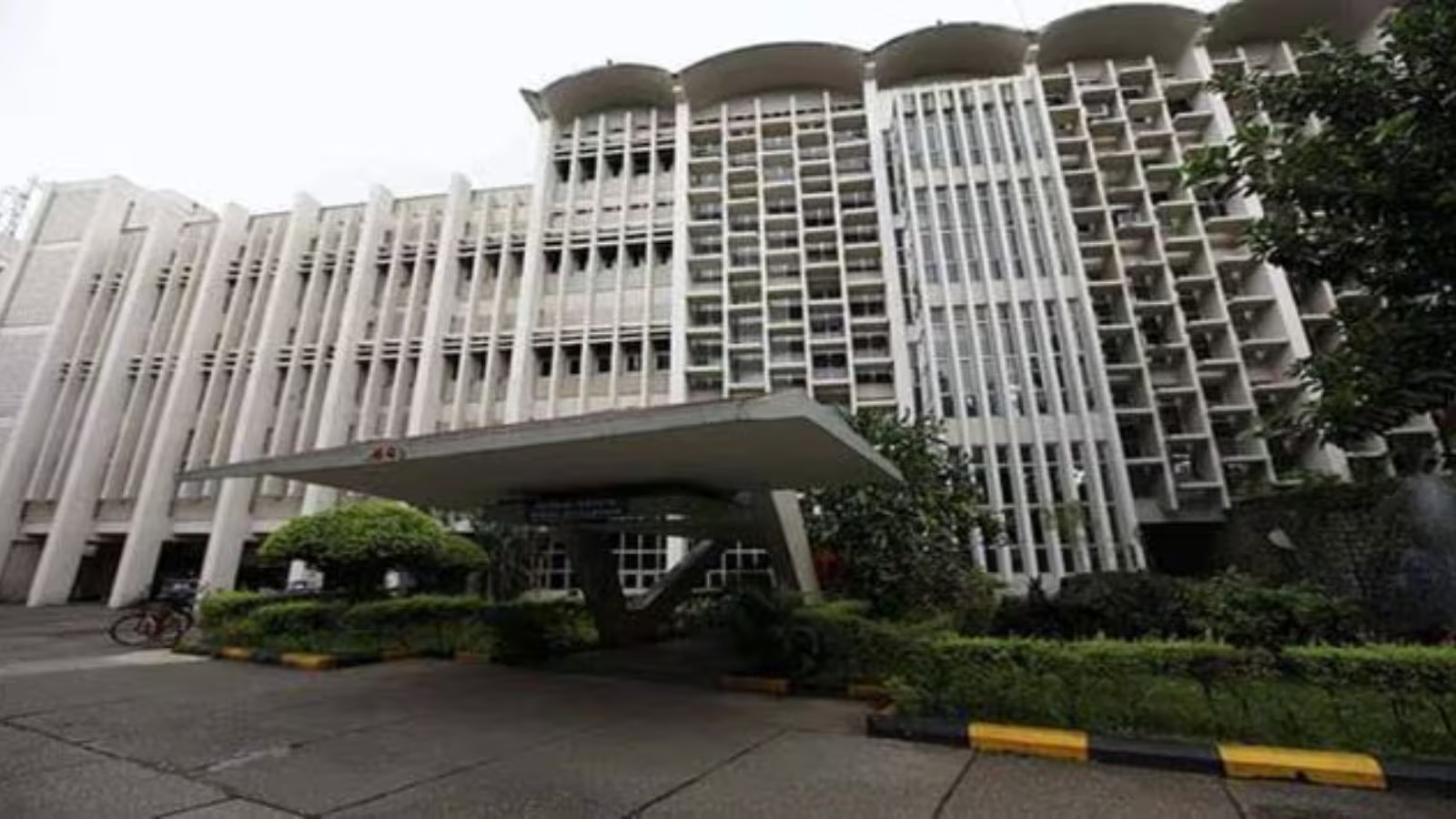
CityMall was founded in 2019 by Kikla and fellow IITian Naisheel Verdhan. In the early days, they built a community-led group-buying model for groceries and other staples, onboarding local micro-entrepreneurs who both generated demand and fulfilled orders in their neighbourhoods.
This was a deliberate design as e-commerce adoption in smaller towns was still nascent when they started, and having a known local face helped overcome the mistrust of online shopping, according to Kikla.
In 2021, Rahul Gill joined as a co-founder to help scale up the business. With the pandemic accelerating digital adoption, CityMall shifted demand generation to its app while community partners focused on fulfilment, handling most deliveries, to make the model more scalable.
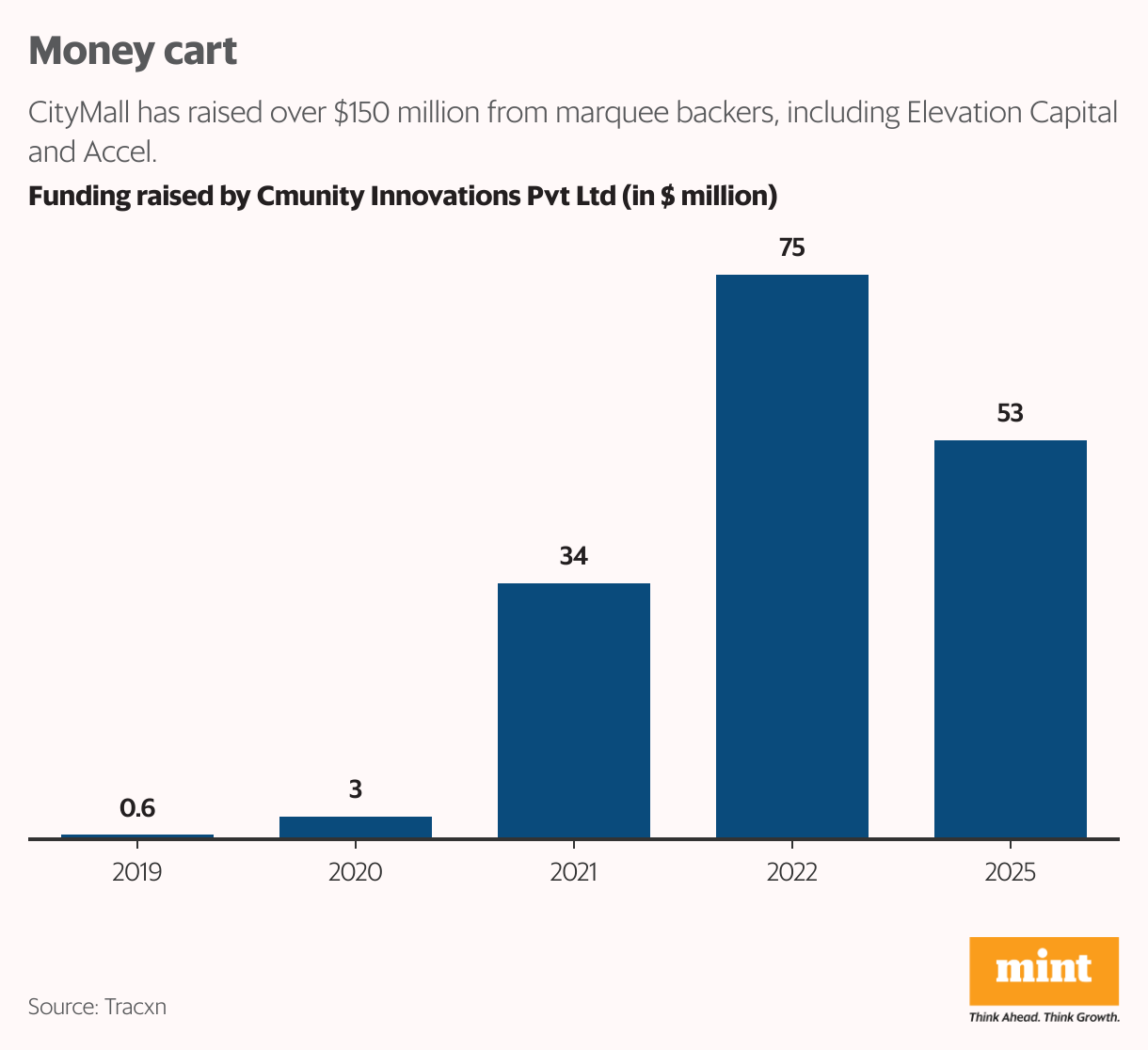
The startup’s pitch resonated strongly with investors, and it has received more than $150 million from marquee backers, including Elevation Capital and Accel, becoming one of the most heavily funded e-commerce bets aimed at rural consumers. Just three months ago, the company raised about $47 million at a flat valuation of about $320 million from existing investors, who see it as the leading contender to crack the non-metro market, one of India’s most coveted but elusive internet opportunities.
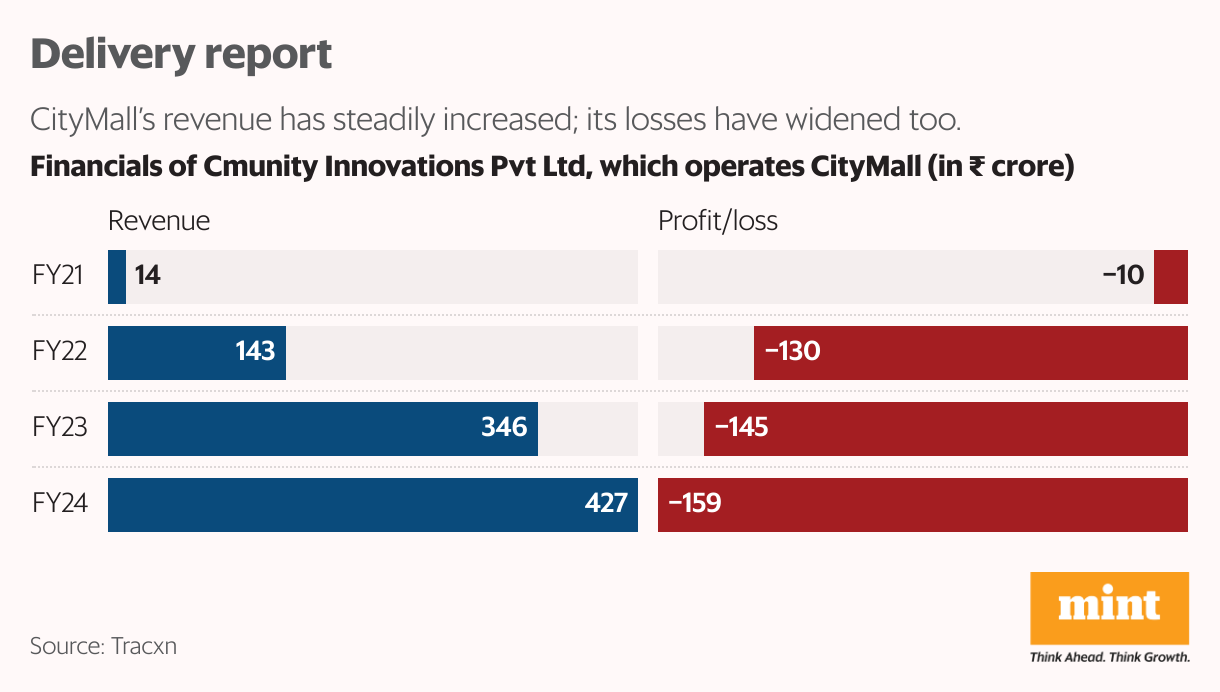
CityMall currently operates in about 60 cities in Bihar, Uttar Pradesh and Haryana. The startup’s revenue increased from ₹346 crore in fiscal year 2023 (FY23) to ₹427 crore in FY24, but its losses widened from ₹145 crore to ₹159 crore during the same period.
Complex model
CityMall’s e-commerce model differs from competitors because it is built around the needs of the small-town consumer, whose behaviour is fundamentally different from metro shoppers. These are consumers who do not prioritize speed but care about price and access, as those in the industry put it. Their grocery purchases are largely planned, monthly stock-up orders. Metro consumers, on the other hand, make frequent, impulsive purchases and value convenience above all else.
One key aspect of CityMall’s model is the average order value (AOV). In groceries, the AOV is typically at ₹400-450. That means the entire model, from procurement to last-mile delivery, must be structured to make money on a relatively small basket. Lifestyle platforms such as Meesho operate with higher-margin products, and quick-commerce services such as Blinkit or Swiggy Instamart had an AOV of around ₹700 in recent quarters, as per company filings.
This difference in AOV and margin profile changes everything about how supply chains are designed and run.
Unlike Instamart, Blinkit, BigBasket and Amazon Fresh, CityMall focuses on longer—even three-day—delivery timelines for low-priced items.
In groceries, the AOV is typically at ₹400-450. That means the entire model, from procurement to last-mile delivery, must be structured to make money on a relatively small basket.
As Arjun Malhotra, general partner at Good Capital, an investor in Meesho, noted, CityMall needs to offer compelling pricing working with thin grocery margins while keeping operations and delivery costs under control. “This model has been attempted before without success, so they’ll need to innovate, whether through technology, assortment or distribution, to make it work,” he said.
Most large, well-funded companies haven’t prioritized serving small-town consumers at lower cost points because it requires a fundamentally different logistical setup. CityMall is attempting to do so by stripping away frills. In their interactions with Mint, company executives said many tasks such as sorting, segregation and basic handling are done by the delivery executive. There’s no packaging cost, and doorstep delivery is replaced by batch delivery to the delivery partner, which keeps costs low.
Apart from co-founder Kikla, Mint spoke with eight former and current employees at the company.
Challenges galore
Employees we spoke to estimate that 25-30% of CityMall’s revenue comes from business-to-business orders placed by local shopkeepers. On paper, this inflates order volumes and repeat rates. But in reality, say those who know the workings of the business, it drags margins down, because neighbourhood shopkeepers, some of the savviest buyers in India’s retail ecosystem, cherry-pick deeply discounted items.
Kikla, however, clarified that such transactions have been reduced to less than 5% of all orders from 10-12% earlier, with suspect orders being identified and cancelled.
On another front, the company found many partners actively avoiding items that carried a risk of being returned: appliances, electronics or higher-value stock-keeping units, because a return meant a weeklong wait for reimbursement.
Some delivery executives also took advantage of ‘buy-one-get-one’ offers, kept the free unit for themselves, sold it in the black market, and then marked the product as missing in the system, leaving CityMall with a loss.
Some delivery executives took advantage of ‘buy-one-get-one’ offers, kept the free unit for themselves, sold it in the black market, and then marked the product as missing in the system, leaving CityMall with a loss.
Kikla said that once fraud is identified, there is a standard process the company follows, which could be formal police complaints. Other CityMall executives told Mint that because of disputes, police frequently show up at the office.
The executives further noted that as CityMall scaled up, the load on delivery partners kept increasing. The company found that new partners took time to find their rhythm, leading to missed orders, delayed deliveries and inconsistent experiences, like the ones this piece begins with.
Kikla, however, said the company has linked almost 25% of the commissions that get paid to delivery executives to customer experience. “There is a huge incentive or disincentive for community partners to make sure that those deliveries happen in time. But the most important way to tackle longer timelines is to have excess capacity. If you just zoom out and look at it, these are all (warehousing and delivery) under-capacity issues.”
The company has perpetually been in a state where demand is much higher than capacity, admitted Kikla. “So, building the capacity out ahead of the demand is what we are focusing on, which means investing more in our supply chain infrastructure,” he added.
Groceries or lifestyle?
While groceries form the bulk of CityMall’s business, the real profitability engine lies elsewhere. Grocery margins are in the 4-6% range; lifestyle categories such as fashion, home and kitchenware offer 20-25%.
In the lifestyle category, the company has moved to an inventory-led model, buying stock into its warehouses and selling directly through the app to capture higher margins. But scaling lifestyle inside a grocery-first supply chain proved to be hard.
Lifestyle categories require deep selection. A single category requires thousands of SKUs to feel complete. CityMall’s warehouses, however, were designed to move atta, oil, sugar and other staples—not hundreds of colours, sizes and styles, company executives said. Moreover, they added, the reverse supply chain for returns posed an even bigger challenge as, unlike groceries, these items need a closer inspection, repackaging and so on at scale, something CityMall lacked.
Despite this complexity, lifestyle remains an important lever. The category contributes nearly 40% of CityMall’s contribution margin even though it makes up just 15-20% of total business, according to the co-founder. Grocery, which accounts for the remainder, delivered only 60% of the contribution margin. In other words, the lifestyle vertical was doing a disproportionate amount of the heavy lifting on profitability.
Contribution margin is the profit remaining after deducting the direct, variable costs of production from revenue.
The clean-up
CityMall has spent the last two years fixing the fundamentals. “We focused on three or four warehouses. Two of them were already breakeven. That playbook is what we tried to replicate,” said a former executive. “A lot of problem solving was done at the warehouse level, from redesigning processes, rethinking mother hub operations, deciding the right last-mile structure, choosing the correct vehicles…”
Alongside operational fixes, the company invested heavily in antifraud systems. According to Kikla, tackling fraud is one of the top three challenges in this business, and most of it occurs at the back end, not at the community partner level.

View Full Image
The combined effect of these changes has been meaningful: supply chain costs have more than halved. “Our supply chain cost was over ₹100 per order around 2-2.5 years ago. We’ve brought it down to about ₹50 per order. It is now two to three times more efficient than any grocery delivery model in India. That is our biggest moat,” said Kikla.
Despite the occasional poor experience, CityMall still manages to retain customer loyalty in many markets. “For families earning ₹20,000-30,000 a month, saving even ₹1,000-2,000 is hugely meaningful. That’s why they stay,” said a former employee.
As for unit economics, a major lever in CityMall’s path to profitability is private labels (selling goods under its own brands). “In the last 10 months alone, our gross margins have grown significantly because of private labels. We started with staples 18-24 months ago and only recently expanded into FMCG (fast-moving consumer goods). That shift has changed our unit economics completely,” Kikla said.
Yet, questions remain about whether CityMall can scale the way Meesho did.
“Meesho had several advantages from first-mover positioning, non-MRP categories (unlike groceries) with pricing flexibility, and virtually no competition during its early scale-up years,” said Good Capital’s Malhotra.
The opportunity for CityMall is large, he noted, but the outcome will depend entirely on execution, given the competitive dynamics with quick commerce.
With digitalization accelerating across the country, e-commerce in India’s smaller towns is entering its next phase of growth. Tier-2 and tier-3 consumers are beginning to behave more like urban buyers, seeking not just value but also convenience and reliable service. This is where the challenge sharpens for CityMall. As convenience becomes a priority, expectations around customer support, timely delivery and issue resolution rise sharply, and these are areas the company will have to strengthen meaningfully.
As Madhur Singhal, managing partner and chief executive of Praxis Global Alliance, an advisory firm, noted, “No-frills models work well initially because value shoppers come on board easily. But as these same shoppers evolve, service quality starts to matter.”
Kikla knows the road ahead is long. “We have built the lowest-cost distribution channel. Our focus now is to ensure that this supply chain comes with a very high level of reliability,” he said. “There are a hundred ways to make errors. Keeping sanity while building this business is the biggest challenge.”
[ad_2]