[ad_1]
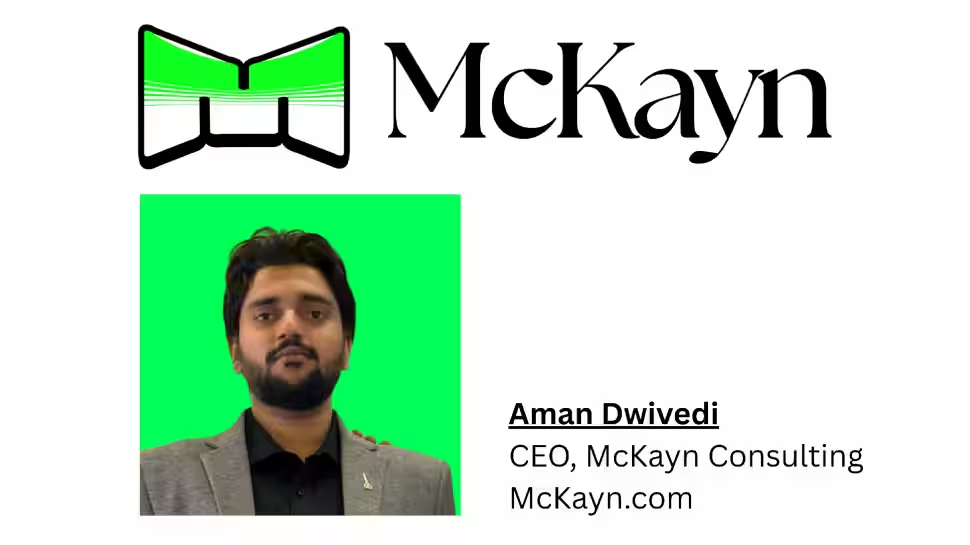
McKayn Consulting is a performance and affiliate marketing agency incubated by the self-made entrepreneur Aman Dwivedi. The agency has crossed over a new big milestone of over Rs 33 crore in total sales, a retail base of more than 21,000 clients, and growth options with over 20+ already developed e-commerce firms.
Today, the company has emerged into an unspoken yet powerful force in the ecosystem of Indian e-commerce development, on the back of a journey that began with a modest capital base accrued over four years of freelancing.
The business model of the firm is pretty much performance-based, whereby its profitability depends on the volume of sales it makes to its partner brands and not on commissions; McKayn is being structured as a long-term growth partner rather than a traditional digital agency.
Add Zee News as a Preferred Source

The timing of this story itself is what makes it newsworthy. Digital commerce in India has only now reached the correct juncture of growth toward a multi-hundred billion-dollar market, led by new online shopping habits, deepened mobile phone penetration, and the fast pace at which fintech uptakes are happening across the country post-pandemic.
While festival seasons, like Diwali 2025, record the highest online spending, performance-driven funnels are a key, yet silent, influencer in this boom used by McKayn Consulting for turning browsers to buyers of its brand portfolio consisting of e-commerce brands.
The ₹41500 Grind: Single Battle of a Teenager in Bettiah.
Aman Dwivedi is a relatively less-known freelancer couple of years ago in this small city of Bihar called Bettiah. It has an agricultural/small-business background rather than technical entrepreneurship.
He started working for online writing, simple web design, and virtual assistant at a very tender age of 17 years with just a laptop and the Internet.
The returns were abysmally low to begin with. His earnings in the first four years were some 500 in all.–about 41,500 in current values. It did not look very promising to friends and relatives. When other people were busy getting into college application or the usual career route, Aman was burning the midnight oil writing proposals, trying to understand how his clients thought and why the majority of his applications were not successful.
The years were nevertheless their formative ones, showing him the practice of online business: how to communicate with clients, how to deal with rejections, how to do work on a pressure situation, and how to continue even when the money was just enough to pay the data bills.
It is an irrational and dangerous gamble to stay in Bettiah and bet on the net in a state like Bihar, from where hundreds of its youths become migrants in search of jobs.
The Search Engine Optimization Euphania: Free Blogs to First Stability.
Knowing he was stuck but not yet ready to give in, Aman made another move that would change his path: he decided to specialize. This time, he did not try to do everything but concentrated on Search Engine Optimization.
Without having any mentor or free course, he instead filled himself with free blogs, case studies, and tutorials. He read SEO tutorials into the night, deconstructed high-ranking websites, and made several attempts to make sense of how the combination of keywords, backlinks, quality of content, and algorithm dynamics combined to bring traffic to sites.
He targeted clients where the big agencies weren’t targeting them: Facebook groups, small-business and underground marketing forums. There he offered his services to business owners and shop owners who attempted to gain the online attention. Few took a chance on him.
He began to record improvements gradually: better positioning, more organic traffic, and more leads to his customers.
Work finally over the years gave him a proper taste of real and stable income. No longer was he a freelancer who could take on anything that came his way; instead, he was a specialist who brought businesses up front through search.
The Algorithm Collapse: 6 Months of Survival Mode.
Just when things started getting back to normal, the ground gave way. Major changes came about in Google algorithms and, in relatively short order, the search landscape changed. Many of the clients of Dwivedi started losing their rankings.
The traffic from Google went down. Leads dried up. And with the decline of numbers, the confidence of the clients did too.
His clients, one after another, started canceling their contracts with him, and all his SEO clients collapsed within a very short span of time. After six months, Aman was virtually back to zero: no stable income, no way up, growing financial stress.
That was an embarrassing and challenging period. He had questioned his decisions and abilities, whether it was better for him to forego this online journey altogether.
Years of pushing through the rejections had created a subdued effect of strength. Rather than give up, he used it as an opportunity to analyze: what had broken, and what sort of business model would be better able to withstand such rapid changes in platforms?
Reinventing with the help of Affiliate marketing.
Those results became a new chapter. For Aman Dwivedi, affiliate marketing started to be considered as one kind of model in which you make commissions for selling products of other brands. It sounded so easy on paper: help the brands sell, and in return, it gets a percentage of the payment. Actually, it proved not to be that easy at all.
He dedicated his last time, efforts, and finances to knowing space. He created niche websites, advertised and experimented with various angles and offers. A lot of such experiments came out to be unsuccessful. Planned campaigns which seemed promising on day one died a natural death on day seven. Money flew away more rapidly than it got in.
But he persisted. Instead of chasing shortcuts, he studied what actually worked: how buyers actually bought, how long did it take them to buy, what kind of content they trusted on, and how to build funnels that would get people interested in buying. And with this, he slowly stopped thinking like a freelancer but started thinking like a growth partner.
Slowly, things clicked. Those small early wins in affiliate events provided the proof that the model would work if it were executed correctly; brands started paying attention to the performance he could deliver.
Growth Engine at McKayn Consulting
From scattered experiments with early affiliates to becoming McKayn Consulting, the affiliate and performance marketing agency was created with one focus in mind: not to act like a “traffic vendor,” but as a growth partner.
Instead of promising some vaguely defined exposure or impressions, McKayn zeroed in on performance: content strategy, funnel design, retargeting, and conversion optimization. Its offers were built upon a single simple idea: it would grow only when its partners grew.
In six months’ time, it became so busy that Aman hired a small team.
Monthly revenues went up to almost the equivalent of ₹20 lakh-a figure he would never have thought possible in his early days as a freelancer.
He further involved his school friend Ayush Raj to handle staff development and internal growth to support operations and training.
A New Reality: ₹33 Crore in Sales, 21,000+ Customers, and 20+ Brands
Today, McKayn Consulting is a multi-crore performance marketing firm that has, in this rather short time, driven over ₹ 33 crores in cumulative sales for its partner brands and embedded itself into the growth engines of more than 20+ established e-commerce businesses.

Excluding the revenue headline, there is another number telling that story: 21,000+ retail customers. This figure represents individual buyers who found, considered, and purchased products through funnels and campaigns designed or optimized by McKayn. They span cross-categories, from fashion-lifestyle to gadgets-wellness, reflecting the breadth of the firm’s impact across India’s e-commerce landscape.
To McKayn’s partner brands, the appeal is in the architecture: performance-based agreements that keep both sides aligned. Rather than collect big fixed retainers, the firm makes most of its money when it drives measurable results.
This skin-in-the-game strategy is highly observable in a market where customer acquisition costs are spiraling out of control.
Operating From the Margins, Competing at the Center
One of the most striking things about McKayn’s story is what it doesn’t have.
No venture capital is behind it.
There is no glass-walled office facing a metro city.
There are no large sales forces beating on the doors of corporates.
Instead, there is a lean team based out of the small town, on the same Internet that once paid its founder only ₹ 41,500 over 4+ years, powering tens of crores in sales for brands across India and the USA today-90% of McKayn Consulting clients are from the USA.
To that extent, this model has its merits. Unencumbered by investor pressure to chase vanity metrics or burn cash for growth, McKayn has been able to build quietly, focus on profitability, and nurture relationships rather than hype them up.
To many e-commerce brands, especially those outside of unicorn spotlight status, that philosophy is not just attractive, it’s necessary.
Lessons for India’s Next Generation of Digital Builders
Several lessons can be identified in the Aman journey that might be instructive to aspiring entrepreneurs, but more so outside the major startup hubs in India:
- Success often comes slowly and is not readily apparent. Four years of labor generated very little income, but the years created the skills and hardiness that would prove to be priceless later.
- Specialization counts. Focusing on SEO, and later on affiliate and performance marketing gave him expert-level skills which could adapt as the platforms and algorithms changed.
- Reinvention is survival: He didn’t stick with the old model when his SEO business fell apart; rather, he changed course to learn a new discipline and rebuild.
(This article is from the Brand Desk. User discretion is advised.)
[ad_2]