[ad_1]
TL;DR: Driving the newsAs the Strait of Hormuz gets blocked up by the US-Iran war, two Gulf pipelines – one in Saudi Arabia and one in the United Arab Emirates-are the only real ways for crude oil to get to world markets overland.The most important one is Saudi Arabia’s East-West pipeline, which runs 746 miles from the kingdom’s oil-producing east to Yanbu on the Red Sea. The second is the Habshan-Fujairah pipeline in the UAE, which takes crude oil from Abu Dhabi to the Gulf of Oman, which is outside of Hormuz. They are all doing work that they were made for: keeping at least some oil moving when the region’s most important maritime chokepoint isn’t reliable anymore.According to a report in the Wall Street Journal, the Saudi line could soon be carrying as much as 7 million barrels a day. However, about 2 million barrels are stuck in domestic refining, so only about 5 million barrels are available for export. The Emirati line adds between 1.5 million and 1.8 million barrels a day, according to numbers from the International Energy Agency and other market experts.That isn’t enough to take the place of Hormuz. But it’s enough to keep the market from going into full-blown panic.Why it mattersThe Strait of Hormuz is where about 20% of the world’s oil and gas supply usually goes. When that corridor is blocked or can’t be used, the question is no longer whether prices will go up. The question is how high and for how long.
That’s why these two pipelines are suddenly very important to a lot of people. They are more than just parts of the country’s infrastructure. They are shock absorbers for the global economy in case of an emergency.As per a report in the Financial Times, Amin Nasser, the head of Saudi Aramco, said the company hopes to get back to about 70% of normal crude shipments within days by increasing flows to Yanbu. Nasser said on Aramco’s earnings call that the conflict could have “catastrophic consequences” for energy markets and “drastic” effects on the economy as a whole if it goes on for too long.The Wall Street Journal also quoted Nasser as saying, “This is by far the biggest crisis the region’s oil and gas industry has ever faced.”That evaluation shows how big the situation is. The bypass lines don’t fix the whole supply problem, but they make things a lot worse without them.The big picture
The Saudi East-West pipeline was planned and built in the early 1980s, when the Iran-Iraq war was threatening shipping in Gulf waters. Its purpose was to protect Riyadh from this kind of strategic chokehold.Javier Blas, a Bloomberg Opinion writer, says that this is what the pipeline was made for. He writes that Saudi Arabia built it because they thought that Tehran might one day be able to do the unthinkable: stop traffic through Hormuz.Now that contingency is no longer just a theory. Tanker traffic through the strait has stopped, insurance costs have gone up, and big shipping companies have stopped crossing. Over 400 oil and product tankers are sitting still in the Gulf, and some vessel tracking shows that flows through Hormuz are much lower than usual.In that situation, Saudi Arabia and the UAE are giving the market a partial reroute. Bloomberg says that the two pipelines together could move about 6.5 million to 7 million barrels a day. That still leaves a big gap compared to the 20 million barrels of crude oil and refined products that usually go through the strait, but it buys time.US President Donald Trump admitted that the market was under stress while trying to stay calm: “We figured oil prices would go up, which they will.” They will also go down. They will come down very quickly. “And we will have gotten rid of a huge, huge cancer on the face of the Earth.”It seems clear what the political bet is in Washington: That the pipelines can soften the blow long enough to keep an oil spike from turning into a bigger economic problem.Between the lines
- These pipelines are more than just logistics tools. They are now important targets.
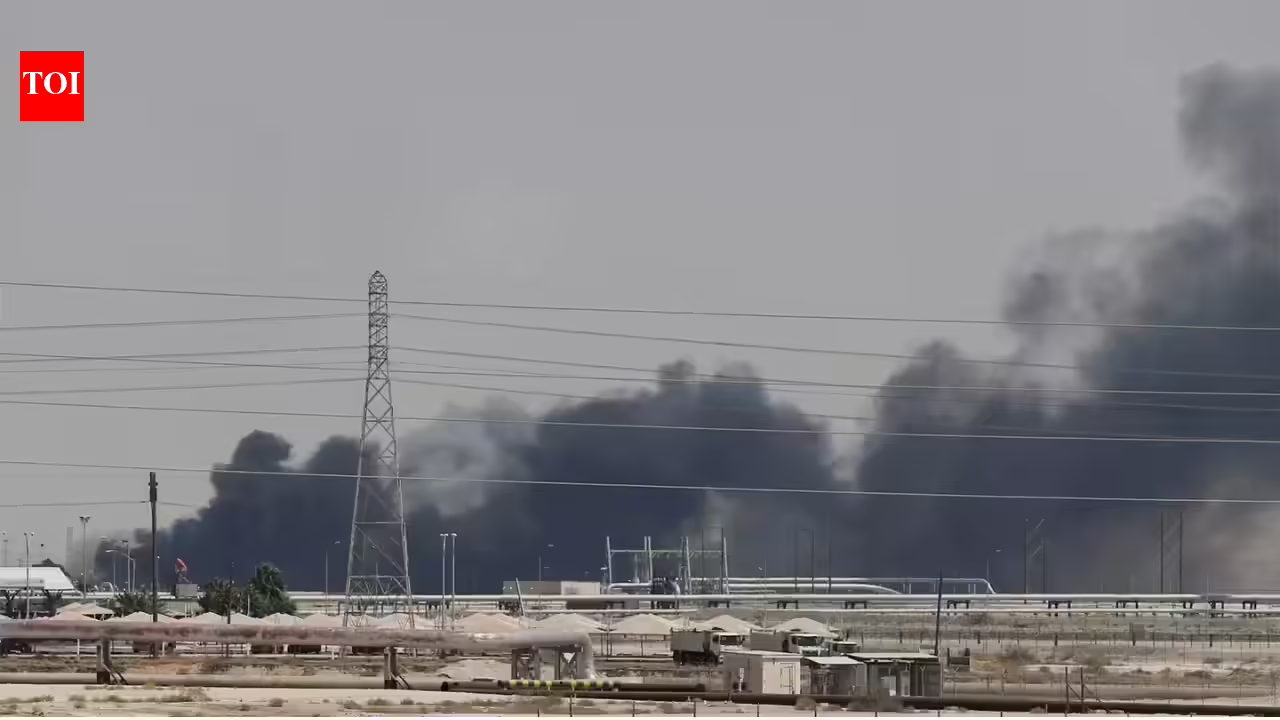
- According to the WSJ report, Iran has already attacked energy infrastructure in the Gulf, and experts say there is little stopping Tehran from also attacking the Saudi and Emirati bypass routes. Traders and security experts both share that fear, because the workaround only works as long as the loading ports, export terminals, and pumping stations stay in good shape.
- The Journal quoted Adi Imsirovic, a former trader and Oxford lecturer, as saying, “If you suddenly see two very large crude carriers coming out of Yanbu and one out of Fujairah, there is a psychological effect that at least some oil is coming out.” He also said, “What really worries me is that it’s not that hard to hit those pipelines.”
- That’s the main weakness. These lines make us less dependent on Hormuz, but they don’t get rid of all the risk in the area. There have already been worries about attacks on the UAE’s Fujairah hub. FT reported that a drone strike started a fire at Adnoc’s Ruwais refinery this week. And on the Saudi side, oil that gets to Yanbu still has to go through the Red Sea, where the Houthis have threatened shipping in the past.
- Greg Priddy from the Center for the National Interest told Middle East Eye, “This makes the Houthis important.” He went on to say, “Drones can still get to all that infrastructure, and the oil that leaves Yanbu for Asia has to go through the Bab el-Mandeb.”
- The bypass does not make things safer, in other words. It only changes the risk’s location.
Zoom inEven when they’re working at full speed, the pipelines leave big gaps in the market.Saudi Arabia might be able to change the route of a lot of its crude oil exports, but not all of them can be moved this way. The Wall Street Journal said that Aramco still sends a lot of oil products through Hormuz that can’t be moved. Iraq, Kuwait, and Bahrain are still more vulnerable. And as experts told Middle East Eye, the real squeeze may be more on refined products than on crude oil.That difference is important. Policymakers can point to crude oil still moving. But the economy as a whole depends on more than just oil prices. It also depends on diesel, jet fuel, and feedstocks.Another sign of how messed up the market has become is that buyers are paying more for barrels that can load outside of Hormuz. The Wall Street Journal said that crude oil from Oman has gone up a lot compared to Dubai grades that are stuck on the wrong side of the chokepoint. Tankers are going to Yanbu and Fujairah instead. Petrobras says that Saudi Arabia is still keeping its promises by shipping through the Red Sea route, even though shipping costs have gone up a lot.Neil Crosby of Sparta Commodities put it bluntly in the Journal: “We’ve basically solved half of the problem.”What’s next?The next phase depends less on pipeline engineering than on war duration.If the conflict is short, the Saudi and Emirati lines may be remembered as the tools that prevented a shipping crisis from turning into an oil shock. If it drags on, their limits will define the next problem: stranded Gulf crude, disrupted product flows, rising freight costs and an expanding list of vulnerable energy targets.For now, the market’s emergency map has narrowed to two lines across the desert. One ends at Yanbu. The other ends at Fujairah. And until Hormuz is reopened in practice, not just in rhetoric, those two pipelines may be the only reason the global oil system is still functioning at all.(With inputs from agencies)
[ad_2]